In the late 1950s and early 1960s, such songs as "We Shall Overcome," "Keep Your Eyes on the Prize," and "Do What the Spirit Says Do" were sung at virtually every mass meeting, demonstration, and planning session of Civil Rights activists. They were sung on the Freedom Rides, during the marches, and in jail cells of the South. Movement activists have commented frequently and eloquently on the ways that singing and songs gave them strength and a sense of self. This study offers a close analysis of the lyrics of the songs most central to the Civil Rights Movement, with an eye to understanding the songs as self-persuasion. In the songs, the activists defined themselves and their world, and reinforced a plan of action for their participation in the Movement. This analysis of the freedom songs is set in the context of Movement history and supported with commentary from activists and background information on Movement activities. In addition, this study offers readers insights into the moving and inspiring power of the freedom songs.
eBook - ePub
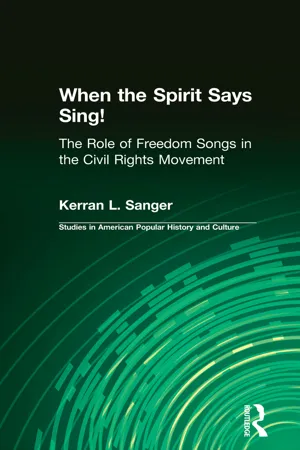
When the Spirit Says Sing!
The Role of Freedom Songs in the Civil Rights Movement
- 246 pages
- English
- ePUB (mobile friendly)
- Available on iOS & Android
eBook - ePub
II
"I Hear Singing In the Air": Singing As Communication Strategy
History has never known a protest movement so rich in song as the civil rights movement. Nor a movement in which songs are as important.1
During the years of the civil rights movement, activists sought strategies to communicate with one another as well as with people outside the movement's vanguard. Committed to nonviolence, the activists searched for potentially powerful forms of communication consistent with the ideals of the group. The people who made up the movement were, by and large, relatively powerless as individuals, but they chose to join together in acts designed to communicate their unified commitment to fight injustice. They eschewed sole reliance on traditional public address, opting often for actions that can be considered as purposeful, or rhetorical. These actions included sit-ins, mass demonstrations, Freedom Rides, and other forms of civil disobedience. And during all of these gatherings, whenever the activists met, they engaged in the behavior of singing, perhaps the most powerful rhetorical behavior of all in the civil rights movement.
This discussion of the act of singing presumes that the activists' choice to sing is interesting in its own right—in the United States, singing is not that common a communication option. The activists of the civil rights movement sang often, with clear purpose and great confidence. The freedom songs of the civil rights were sung during mass meetings, in jails, in churches, and in isolation, were sung by the elderly, by college students, by children, and by those of indeterminate age, were sung in fear, desperation, and jubilation. Activists saw these songs, such as "We Shall Overcome," "Keep Your Eyes on the Prize," and "Oh Freedom" as central to their success in opposing segregation and inequality. How do we know the activists felt this way? Listen . . .
Singing is the backbone and the balm of this movement.
[Singing] is like an angel watching over you.
This song represented the coming together ... You felt uplifted and involved in a great battle and a great struggle.
You sing the songs which symbolize transformation, which make that revolution of courage inside you.
The movement without songs would have been like birds without wings.
There was music in everything we did.
One cannot describe the vitality and emotion . . . [singing] generates power that is indescribable.
When you got through singing . . . you could walk over a bed of hot coals, and you wouldn't notice.
There is no armor more impenetrable than song.2
These chums are only a few that activists have made regarding the role of the freedom songs in their lives and their struggle. They have a great deal more to tell us about their singing—how it worked for them as a strategy and why it engendered such strong feelings among them. A thorough study of their testimony about singing indicates that the activists strongly believed the songs were an essential aspect of the total persuasive strategy of the civil rights movement. Before we tum to a close study of the song lyrics, it is important to understand what the behavior of singing meant for the activists.
That the activists felt song to provide them with a special power ts evident in their testimony, where they asserted that song was central to the progress of the movement. Guy Carawan was Music Director at the Highlander Folk School and in that capacity he encouraged singing among civil rights activists. Carawan made bold claims regarding the power of the songs to accomplish great things in the movement:
Freedom songs today are sung in many kinds of situations: at mass meetings, prayer vigils, demonstrations, before Freedom Rides and Sit-ins, in paddy wagons and jails, at conferences, work-shops and informal gatherings. They are sung to bolster spirits, to gain new courage and to increase the sense of unity. The singing sometimes disarms jail guards, policemen, bystanders and mob participants of their hostilities.3
Bob Cohen, director of the Mississippi Caravan of Music, similarly addressed the far-reaching effects of the singing when he argued that "somehow you can go in the face of violence and death, cynicism and inaction of the FBI, the indifference of the Federal Government when you can sing with your band of brothers."4 According to these activists, singing provided movement participants with significant power to face the internal enemies of fear and doubt as well as the external trials of the movement.
When the activists spoke of their singing and its effects, it was often in tones of awe, as if they could not quite believe what their singing could accomplish. In speaking of the unofficial anthem of the movement, "We Shall Overcome," Wyatt Tee Walker said simply that "it generates power that is indescribable."5 Candie Carawan recounted her experience in jail and her realization there that songs could be more than a source of entertainment. She said, "Never had I heard such singing. Spirituals, pop tunes, hymns, and even slurpy old love songs all became so powerful."6 Even onlookers to the movement, such as white journalist Pat Watters, were affected by the mood of the mass meetings—"mystical, inspired and excited, ecstatic"—and the music there that "cannot be described—or recaptured."7 These people, and seemingly all others who experienced the singing of the civil rights movement, cast song as a motive force in that struggle, a force giving the participants the strength to move forward and to involve others.
The songs figured so greatly in the minds of some activists that they expressed doubt that the movement could progress or succeed without singing. Bernice Reagon, for instance, claimed that "by the end of the Freedom Rides, the songs of the Sit-ins, bus and jail experiences were considered essential for organizing. No mass meeting could be successfully carried off without songs."8 Both Cordell Reagon and Student Nonviolent Coordinating Committee (SNCC) field secretary Charles Jones remarked on the centrality of the songs to the campaign in Albany, Georgia. According to Reagon,
without the songs, the Albany movement could not have been. They sang these songs on the [picket] line and off the line, day in and day out, and went to bed humming "We Shall Overcome."
Jones's words echoed Reagon's when he said simply "there could have been no Albany Movement without music."9 In singing, activists felt they had found an activity that united them, shielded them from harm, and gave them the very power and strength to move forward.
It might be argued, of course, that the activists had no evidence of any link between singing and the powers they attributed to it. The important consideration is not whether singing actually allowed activists to accomplish all the things they claimed for it but, rather, that they believed it did. If activists believed singing provided them with the strength to face difficult situations, then, when they sang, they were likely to find that, in fact, they did feel stronger. The claims they made about the communicative power of song fostered an attitude toward singing among participants in the movement, and gave this form of communication enormous power in their lives—the power that comes with expectations.
Scholars suggest that singing differs from other forms of communication, in that it more fully involves those who take part. Rhetorical critics argue that musical sound engages human feeling in significant ways because its kinesthetic appeal promotes a physiological and psychological response.10 In many forms of demonstration, civil rights activists were involved both by their physical presence and by the act of protest—whether it was marching, sitting-in, or swaying with the music of a song. In addition, when the activists sang, their involvement grew to include not only their presence and physical movement, all rhetorical insofar as they constituted purposeful action, but the voicing of their commitment as well.
Singing was most often engaged in during other types of demonstration, which added another layer of communication to the mass marches. The communication of the movement was usually much more than a single voice speaking in a quiet room to silent listeners. Instead, it was a rich mixture of singing, listening, marching, swaying, and other symbolic acts. The involvement was much greater and, potentially, much more influential when communication had several layers of expression.
Singing was, perhaps, most important to activists when other symbolic acts were denied them. According to the activists, some of the most fervent and inspired singing in the movement took place in the cells of Parchman Penitentiary and the Hinds County Jail in Mississippi where the Freedom Riders were imprisoned. In jail, many other forms of direct action were denied the activists but, in singing, they were able to find a positive rhetorical place between passivity and acts of violence. Euvester Simpson referred to time she spent in jail as a result of trying to register to vote, and remarked that the "only way we could get through that ordeal was to sing any song that came to mind."11 By singing, the activists continued to communicate their refusal to be rendered impotent or to be drawn to the level of their adversaries. Their jailers recognized the power that their prisoners held when they sang and often threatened the activists. Zinn reported that:
Charles Shewed had been taken with a group of demonstrators to "Terrible" Terrell County, escorted there by Sheriff Zeke Mathews, who announced: "There'll be no damn singin' and no damn prayin' in my jail."12
For civil rights activists, the choice of music as a mode of communication was a choice consistent with their desire to act and their belief that song was essentially symbolic act. It complemented the other acts of the civil rights movement and sometimes stood alone, or combined with prayer, as the only positive communication outlet available to the protestors.
The activists belief in the power of song and its "correctness" for meeting their needs meant that activists often chose singing even when other options, like speaking, were available. In their comments, activists equated song with speech or, often, asserted that song did for them what speech could not. Bob Cohen's description of Fannie Lou Hamer indicated that, for this particular black leader, song was used in essentially the same way that speeches were:
When Mrs. Hamer finishes singing a few freedom songs one is aware that he has truly heard a fine political speech, stripped of the usual rhetoric and filled with the anger and determination of the civil rights movement. And on the other hand in her speeches there is the constant thunder and drive of music.13
Cohen's comments equated political speaking and singing but he also subtly argued for the superiority of singing when he claimed that song retained its power without the bombast and meaningless words so often associated with political speaking.
Speech was insufficient not only for black leaders like Hamer but for the average person as well, according to the activists. Bernice Reagon claimed that, in Albany, Georgia, "masses of people had much to say about their condition and found the language with which to s...
Table of contents
- Cover
- Title
- Copyright
- Contents
- Preface
- Introduction
- "I Hear Singing In the Air": Singing As Communication Strategy
- "We Shall All Be Free": The Activists' Goal and Self-Definition
- "I See Freedom in the Air": Defining a View of the World
- "We Shall Not Be Moved": Defining a Blueprint for Action
- Appendix
- Bibliography
- Copyright Notices
- Index
Trusted by 375,005 students
Access to over 1.5 million titles for a fair monthly price.
Study more efficiently using our study tools.
Frequently asked questions
Yes, you can cancel anytime from the Subscription tab in your account settings on the Perlego website. Your subscription will stay active until the end of your current billing period. Learn how to cancel your subscription
No, books cannot be downloaded as external files, such as PDFs, for use outside of Perlego. However, you can download books within the Perlego app for offline reading on mobile or tablet. Learn how to download books offline
Perlego offers two plans: Essential and Complete
- Essential is ideal for learners and professionals who enjoy exploring a wide range of subjects. Access the Essential Library with 800,000+ trusted titles and best-sellers across business, personal growth, and the humanities. Includes unlimited reading time and Standard Read Aloud voice.
- Complete: Perfect for advanced learners and researchers needing full, unrestricted access. Unlock 1.5M+ books across hundreds of subjects, including academic and specialized titles. The Complete Plan also includes advanced features like Premium Read Aloud and Research Assistant.
We are an online textbook subscription service, where you can get access to an entire online library for less than the price of a single book per month. With over 1.5 million books across 990+ topics, we’ve got you covered! Learn about our mission
Look out for the read-aloud symbol on your next book to see if you can listen to it. The read-aloud tool reads text aloud for you, highlighting the text as it is being read. You can pause it, speed it up and slow it down. Learn more about Read Aloud
Yes! You can use the Perlego app on both iOS and Android devices to read anytime, anywhere — even offline. Perfect for commutes or when you’re on the go.
Please note we cannot support devices running on iOS 13 and Android 7 or earlier. Learn more about using the app
Please note we cannot support devices running on iOS 13 and Android 7 or earlier. Learn more about using the app
Yes, you can access When the Spirit Says Sing! by Kerran L. Sanger in PDF and/or ePUB format, as well as other popular books in History & World History. We have over 1.5 million books available in our catalogue for you to explore.