- 288 pages
- English
- ePUB (mobile friendly)
- Available on iOS & Android
eBook - ePub
About this book
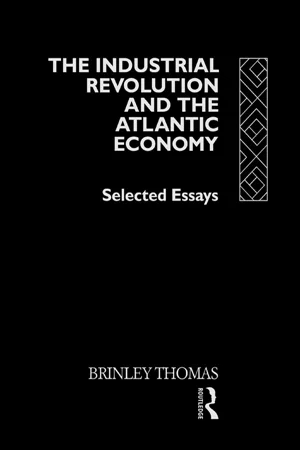
In recent years it has become commonplace to downplay notions of an industrial revolution and argue instead that Britain's transformation was gradual and incremental. In The Industrial Revolution and the Atlantic Economy Brinley Thomas contests this view, arguing that change in the energy base and hence in technology has enabled Britain to overcome
1
BRITAIN’S ENERGY CRISIS IN THE SEVENTEENTH CENTURY1
John U.Nef’s classic work, The Rise of the British Coal Industry, concluded that
between the accession of Elizabeth and the Civil War, England, Wales, and Scotland faced an acute shortage of wood, which was common to most parts of the island rather than limited to special areas, and which we may describe as a national crisis without laying ourselves open to a charge of exaggeration.1
(Nef 1932, I: 161)
In his view this crisis was the fundamental cause of the fourteenfold increase in coal production between the 1550s and the 1680s, and ‘by the mid-seventeenth century a new industrial structure was being built in England on coal and this structure provided the basis for the industrialized Great Britain of the nineteenth century’ (Nef 1964:170).
Nef’s work left a profound mark and inspired a considerable literature, some of which rejected his main thesis. For example, George Hammersley’s detailed examination of the Crown woods in the sixteenth and seventeenth centuries led to the conclusion that ‘the much-vaunted fuel shortage…was always a strictly local and limited phenomenon. The story gained ground by an extension of hard cases—those of London, Bristol and Northumberland for instance—to make bad generalizations’ (Hammersley 1957:159). Other criticisms were made by Flinn (1959b, 1978) and by Coleman (1977). Space does not allow an adequate summary of the many issues raised in this debate. In this chapter I shall concentrate on one important aspect—the performance of the British iron industry in the seventeenth century. Between the 1630s and the 1680s, when there was a massive increase in the demand for iron, why did Britain’s iron output fail to respond? Within the limits set by the available statistical data (which are far from perfect), an attempt will be made to analyse the supply and demand shifts and the course of prices in the markets for timber, charcoal and iron.
THE REVISIONISTS’ ARGUMENTS
As an introduction a few technical facts about the charcoal iron industry may be noted. The kind of timber needed to make charcoal was cordwood, i.e. trees aged about twenty years or less which were usually planted systemically in coppices. It is estimated that in 1660 coppice woods in Kent, Surrey and Sussex occupied no less than 200,000 acres (Schubert 1957:222). Because of the fragility of charcoal and the high costs of transport, it did not usually pay to move it more than about 5 miles; beyond this radius the marginal cost became prohibitive. At any one location output was limited by the rate of regrowth (the natural renewal of woods) and within that limit a well-run coppice could go on indefinitely. A 5-mile radius comprises about 50,000 acres and in the seventeenth century it would take about 13,000 acres of timber to feed a sizeable blast furnace and forge forever (Hammersley 1973:606). To accommodate two furnaces and forges, about two-thirds of the accessible area would have to be woodland, and this was rarely found in any part of the country; even the Forest of Dean, one of the most thickly wooded areas, was only 55 per cent woodland according to a survey made in 1641 (ibid.: 606). Under these constraints, if ironmasters wished to achieve a major increase in output they had to open up new furnaces and forges in other areas which possessed the required supplies of charcoal, water power, limestone and, if possible, iron ore. Thus, the response of the industry to an increase in the nation’s demand for iron took the form of an extension of operations to new sites while production continued at many of the old works.
Nef’s critics argue that ironmasters were not being forced to move to remote areas because of ‘the hunger for fuel’ (Ashton 1951:15). The revisionists admit that there was a secular rise in the price of charcoal, probably about threefold between the 1590s and the 1690s, but it is held that the effect of this was partly offset by greater efficiency in the use of the fuel, e.g. a halving ofcharcoal consumption per ton in smelting during the seventeenth century (Hammersley 1973: Tables 2 and 3). But what about the fourteenfold increase in the annual output of coal from 210,000 tons in the 1550s to 2,982,000 tons in the 1680s (Nef 1932, I: 19)? The new orthodoxy denies that this was induced by a growing shortage of charcoal. The substitution of coal for charcoal in many uses is attributed to the fact that at any time in the sixteenth and seventeenth centuries coal was less expensive than charcoal per unit of heat or of output. The reason given for this is that
the labour involved in making coal available at an industrial site cost less than that involved in preparing and delivering charcoal, again, in terms of units of heat or of output. That this was as true of the sixteenth century as of the eighteenth is shown by the immediate substitution of coal for charcoal wherever current technology permitted. Coal was used in salt-making, soap-boiling, and brewing long before any historian has suggested that the iron industry or any other industry had made serious inroads on the nation’s timber supplies.
(Flinn 1959b: 119)
The conclusion reached by Michael Flinn was that ‘so far from there being a timber famine, it is abundantly clear that the supply of both timber and cordwood during the two centuries after 1550 was enormously increased with surprisingly little real increase in prices’ (ibid.: 116).
Much has been learned from the valuable researches of the revisionists. One can agree with their rejection of the claim that there was an industrial revolution in the period 1550–1700, but the question remains whether the evidence about timber demand and supply in the seventeenth century has been satisfactorily interpreted. They were right to point out that a necessary test of a shortage of a commodity is a rise in its price in a free market relative to the general price level. Unfortunately, in an attempt to play down the existence of stringency in the timber market, the revisionist argument relies on a concept which is theoretically questionable. Emphasis is placed on a spurious distinction between the price of standing timber and the price of charcoal at the place of delivery. For example, Hammersley states that
it is too easily taken for granted that changes in the priceof fuel directly reflect changes in the price of wood, whereas this incorporated also the cost of labour to cut and stack wood, to convert it into charcoal and to carry it to the ironworks…. If wood had to be bought, its price contributed only 40–60 per cent to the cost of fuel at the works; cutting and coaling accounted for 30–40 per cent, transport to the works for another 11–21 per cent.
(Hammersley 1973:608)
It is a mistake to isolate the price of standing timber from other elements of cost and to suggest that a rise in the price of charcoal at the place of delivery could be due not to a scarcity of timber but to the intermediate costs of cutting, cording, charking and transport. The various stages in the production of a commodity are an indissoluble whole. What matters is the price of the final product at the place of delivery.
There can be no doubt that conditions varied considerably in different localities. However, if there was excess demand for a particular product in certain regions, one would expect this to be reflected in relative prices. An attempt has been made to strengthen the revisionist case by using the available price indices for the sixteenth and seventeenth centuries. For example, Donald Coleman argues as follows.
Had there been a national timber crisis one would have expected timber prices to rise accordingly; in fact the best available price index shows timber prices between 1450–9 and 1640–9 rising by only 395 per cent whilst those of all agricultural products rose by 571 per cent.
(Coleman 1977:86)
These percentages covering two centuries conceal what was happening during shorter periods. The source on which the indices are based provides information for each decade, and Table 1.1 summarizes the evidence for subperiods.
It is clear that the pattern of relative prices went through various phases. During the century ending in 1540–9 standing timber prices hardly rose at all and they fell in relation to industrial prices by 15 per cent, whereas agricultural prices went up by 76 per cent and by 37 per cent relative to industrial prices. During the second half of the sixteenth century food prices continued their steep upward course in relation to both industrial and timber prices. Whereas these figures support the inference that there was no timber crisis in the period 1450–1600, they tell a different story for the first half of the seventeenth century when timber prices rose by 81 per ce...
Table of contents
- Cover
- Half Title
- Title Page
- Copyright Page
- Dedication
- Table of Contents
- List of figures and tables
- Acknowledgements
- Introduction
- 1 Britain’s energy crisis in the seventeenth century
- 2 The first Atlantic economy, 1700–76
- 3 The end of the charcoal iron age
- 4 Britain’s food supply, 1760–1846: the Irish contribution
- 5 Henry Cort and the primacy of Britain
- 6 Robert Owen (1771–1858): a hero of the Industrial Revolution
- 7 Demographic determinants of British and American building cycles, 1870–1913
- 8 Long swings and the Atlantic economy: a reappraisal
- 9 A cauldron of rebirth: the Industrial Revolution and the Welsh language
- 10 A plea for an organic approach to economic growth
- Index
Trusted by 375,005 students
Access to over 1.5 million titles for a fair monthly price.
Study more efficiently using our study tools.
Frequently asked questions
Yes, you can cancel anytime from the Subscription tab in your account settings on the Perlego website. Your subscription will stay active until the end of your current billing period. Learn how to cancel your subscription
No, books cannot be downloaded as external files, such as PDFs, for use outside of Perlego. However, you can download books within the Perlego app for offline reading on mobile or tablet. Learn how to download books offline
Perlego offers two plans: Essential and Complete
- Essential is ideal for learners and professionals who enjoy exploring a wide range of subjects. Access the Essential Library with 800,000+ trusted titles and best-sellers across business, personal growth, and the humanities. Includes unlimited reading time and Standard Read Aloud voice.
- Complete: Perfect for advanced learners and researchers needing full, unrestricted access. Unlock 1.5M+ books across hundreds of subjects, including academic and specialized titles. The Complete Plan also includes advanced features like Premium Read Aloud and Research Assistant.
We are an online textbook subscription service, where you can get access to an entire online library for less than the price of a single book per month. With over 1.5 million books across 990+ topics, we’ve got you covered! Learn about our mission
Look out for the read-aloud symbol on your next book to see if you can listen to it. The read-aloud tool reads text aloud for you, highlighting the text as it is being read. You can pause it, speed it up and slow it down. Learn more about Read Aloud
Yes! You can use the Perlego app on both iOS and Android devices to read anytime, anywhere — even offline. Perfect for commutes or when you’re on the go.
Please note we cannot support devices running on iOS 13 and Android 7 or earlier. Learn more about using the app
Please note we cannot support devices running on iOS 13 and Android 7 or earlier. Learn more about using the app
Yes, you can access The Industrial Revolution and the Atlantic Economy by Thomas Brinley in PDF and/or ePUB format, as well as other popular books in Business & Business General. We have over 1.5 million books available in our catalogue for you to explore.