China's foreign policy in the Arab world is important because it reflects China's general foreign policy. In this study, first published in 1981, the author draws upon a wealth of previously unpublished and inaccessible material to analyse Chinese attitudes in three cases: the two Arab liberation movements, the Palestine Resistance Movement and the Popular Front for the Liberation of the Oman, and the established and independent State of Kuwait. Since the Arab liberation movements played a significant political role within their fields of operation, it was necessary for China to decide whether these movements did actually fit in with Chinese foreign policy objectives. Dr Behbehani's analysis of these two case studies provides the basis for a discussion of whether China's motives in supporting the liberation movements are theoretical or purely practical. China's support for Kuwait's political internal continuity is related to the stability of the whole Gulf region. The author analyses Chinese support for Kuwait and the surrounding conservative states on two main bases, political and economic, in the form of trade. It is through these channels, particularly the economic one, that China has sought to establish itself in the Gulf and the Arabian peninsula.
eBook - ePub
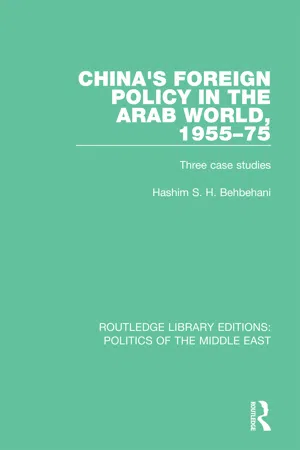
China's Foreign Policy in the Arab World, 1955-75
Three case studies
- 442 pages
- English
- ePUB (mobile friendly)
- Available on iOS & Android
eBook - ePub
Chapter 1
China and the Arab world
China’s foreign policy towards the Arab world is here dealt with in three separate, distinct, but complementary phases (1955–66; 1967–70; 1970–5). The first deals with issues of foreign policy which emerged after independence in 1949 until the early 1960s, although by 1959 Chinese leaders had set a course for a foreign policy independent of that of the USSR, whose role and prestige in the communist bloc had previously dominated all communist bloc foreign policies. Immediately after the establishment of the People’s Republic of China (PRC), the new regime was confronted with one of the most serious military operations in the history of the emerging state. The Korean War, in 1950, though it was by no means wanted by China, actually enhanced the People’s Republic’s prestige in the world as a whole, and particularly within the communist bloc. Security in Manchuria, as its most important heavy industrial area, was essential to China. Since North Korea had a common border with Manchuria, it was important that the North Korean regime be sympathetic to, and preferably under the influence of, the Chinese regime. Thus China had to face directly the most formidable nation in the world, and its troops found themselves in direct confrontation with American forces on the battlefield. China’s ability to withstand American might was very important to the survival of the regime. Moreover, it is important to remember that although the USSR supplied a limited quantity of arms to its allies, the Soviet role in the conflict was only secondary. This confirmed China’s fears concerning the limited extent to which the Soviet leadership was willing to intervene actively on the side of its communist allies.
After the stalemate in Korea, and once China’s borders were secure in that area, attention was diverted to Indo-China, where France was facing insurmountable difficulties, particularly in Vietnam. The Geneva Peace Conference from 27 April to 15 June 19541 had originally been convened to discuss the unification of Korea; but it failed to accomplish this task and, taking place shortly after the Viet Minh victory at Dien Bien Phu, only succeeded in temporarily halting the war in Indo-China. Shortly after this, China once again got involved in a problem which was considered central to its basic foreign policy objectives: in September 1954, it shelled Quemoy, an island off the coast of China held by the Republic of China (Taiwan). Though China failed to liberate Taiwan, this had apparently not been its immediate objective. Rather, the whole affair had been aimed at following a ‘tit for tat’ policy against ‘US imperialism’, and brought about two developments. On the one hand, Taiwan signed a Mutual Defence Treaty with the USA, thus adding a new element to the USA’s intensification of the cold war policy of ...
Table of contents
- Cover
- Half Title
- Title Page
- Copyright Page
- Original Title Page
- Original Copyright Page
- Dedication
- Table of Contents
- Illustrations
- Abbreviations
- Note on transliteration and sources
- 1 China and the Arab world
- 2 Sino-Palestinian relations 1955–66
- 3 The 1967 June War and its aftermath: developments in the Palestine Resistance Movement
- 4 Black September and its aftermath
- 5 Turning point in Sino-Palestinian relations
- 6 Brief history of the Liberation Movement in Oman
- 7 China’s attitudes to, involvement in, and withdrawal from, the Omani War, 1955–75
- 8 China and Kuwait
- Conclusion
- Appendix 1 Fatah military study on China
- Appendix 2 Arab Labour Party of Oman’s study on the historical development of Oman
- Appendix 3 PFLOAG: internal directives
- Appendix 4 Minutes of talks
- Appendix 5 Sino-Arab delegation exchanges, 1956–75
- Appendix 6 Sino-Arab trade, cultural, and friendship treaties and agreements 1955–75
- Notes
- Bibliography
- Index
Trusted by 375,005 students
Access to over 1.5 million titles for a fair monthly price.
Study more efficiently using our study tools.
Frequently asked questions
Yes, you can cancel anytime from the Subscription tab in your account settings on the Perlego website. Your subscription will stay active until the end of your current billing period. Learn how to cancel your subscription
No, books cannot be downloaded as external files, such as PDFs, for use outside of Perlego. However, you can download books within the Perlego app for offline reading on mobile or tablet. Learn how to download books offline
Perlego offers two plans: Essential and Complete
- Essential is ideal for learners and professionals who enjoy exploring a wide range of subjects. Access the Essential Library with 800,000+ trusted titles and best-sellers across business, personal growth, and the humanities. Includes unlimited reading time and Standard Read Aloud voice.
- Complete: Perfect for advanced learners and researchers needing full, unrestricted access. Unlock 1.5M+ books across hundreds of subjects, including academic and specialized titles. The Complete Plan also includes advanced features like Premium Read Aloud and Research Assistant.
We are an online textbook subscription service, where you can get access to an entire online library for less than the price of a single book per month. With over 1.5 million books across 990+ topics, we’ve got you covered! Learn about our mission
Look out for the read-aloud symbol on your next book to see if you can listen to it. The read-aloud tool reads text aloud for you, highlighting the text as it is being read. You can pause it, speed it up and slow it down. Learn more about Read Aloud
Yes! You can use the Perlego app on both iOS and Android devices to read anytime, anywhere — even offline. Perfect for commutes or when you’re on the go.
Please note we cannot support devices running on iOS 13 and Android 7 or earlier. Learn more about using the app
Please note we cannot support devices running on iOS 13 and Android 7 or earlier. Learn more about using the app
Yes, you can access China's Foreign Policy in the Arab World, 1955-75 by Hashim S.H. Behbehani in PDF and/or ePUB format, as well as other popular books in Economics & Economic Theory. We have over 1.5 million books available in our catalogue for you to explore.