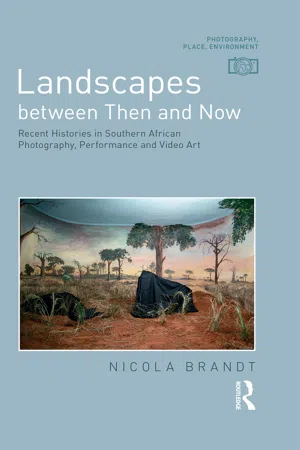
In Landscapes Between Then and Now, Nicola Brandt examines the increasingly compelling and diverse cross-disciplinary work of photographers and artists made during the transition from apartheid to post-apartheid and into the contemporary era.
By examining specific artworks made in South Africa, Namibia and Angola, Brandt sheds light on established and emerging themes related to aftermath landscapes, embodied histories, (un)belonging, spirituality and memorialization. She shows how landscape and identity are mutually constituted, and profiles this process against the background of the legacy of the acutely racially divisive policies of the apartheid regime that are still reflected on the land. As a signpost throughout the book, Brandt draws on the work of the renowned South African photographer Santu Mofokeng and his critical thinking about landscape.
Landscapes Between Then and Now explores how practitioners who engage with identity and their physical environment as a social product might reveal something about the complex and fractured nature of postcolonial and contemporary societies. Through diverse strategies and aesthetics, they comment on inherent structures and epistemologies of power whilst also expressing new and radical forms of self-determinism. Brandt asks why these cross-disciplinary works ranging from social documentary to experimental performance and embodied practices are critical now, and what important possibilities for social and political reflection and engagement they suggest.
In the essay 'The Landscape Is Not Empty', Sean O'Toole relates the desolation of the South African intellectual, linguist, activist and writer Solomon Tshekisho Plaatje when he realized on a morning in June 1913, when the infamous Natives Land Act was passed, that he had become 'an outsider in the land of his birth'.1 In the chronicles of resistance against racial and political injustice in South Africa, the works of Plaatje (1876-1932) and that of the photographer Ernest Cole (1940-1990) stand out among the first to expose the extent of the control of apartheid over the lives of the majority in South Africa.
Plaatje was a founder member and the first Secretary-General of the South African Native National Congress (SANNC). which became the African National Congress (ANC).2In 1913 Plaatje travelled more than 2,000 kilometres across South Africa to record the harsh realities of the lives of his fellow South Africans. The journals of Plaatje's travels culminated in the book Native Life in South Africa, which was published in London in 1916. Many decades would pass before Plaatje's quest to be heard was recognized in the lives of black South Africans or before they could begin to claim a sense of belonging in their own country.
Along with the journals of Plaatje, the text and black-and-white photographs of Ernest Cole are similarly powerful testaments to human degradation and endurance. To make it easier for him to work in the harshly segregated environment of apartheid, Cole had himself reclassified from 'Black' to 'Coloured'.3In 1966, he departed for New York with a seven-year photographic record of how black South Africans were being forced to live under apartheid. In his book House of Bondage, published in the United States in 1967, Cole wrote: 'Three-hundred years of white supremacy in South Africa have placed us in bondage, stripped us of our dignity, robbed us of our self-esteem and surrounded us with hate.'4
In this chapter, I sketch out a broad historical backdrop against which different permutations of social documentary photography developed in South Africa, especially in the final decades of apartheid and into the post-apartheid years. I also reflect on how the field was significantly gendered and racialized, especially under apartheid. On one end of the spectrum, documentary realism remained
Figure 1.1 Ernest Cole, Europeans only, mid-1960s.
Figure 1.2 Ernest Cole, PoliceSwoop, mid-1960s.
grounded in the tenets of bearing witness with limited intervention, particularly embracing the contingency of 'reality'. On the other end is the flourishing of experimental forms of the documentary idiom within contemporary art, especially since the 1990s. After apartheid ended, a number of photographers and artists continued to attempt to find innovative ways to engage critically with their environments while remaining within the broad remits of the documentary 'tradition'. This is especially the case for a younger generation who have been inspired by forerunners of social documentary, such as Cole, Mofokeng and David Goldblatt, who were engaged at the renowned Market Photo Workshop, set up by Goldblatt in Johannesburg in 1989. Since its founding in 1989, the Workshop has provided a platform for photographic talent in South Africa, working in what is described by some critics as a more varied and transformative 'near' or 'post-documentary' approach.5It continues to play an important role not only in developing an ethics of seeing, but also in schooling photographers in practical skills, and visual literacy.
Figure 1.3Drum Magazine, Fashion in Casual Wear, July 1956.
Under apartheid, social documentary's function was crucial. At the Culture and Resistance Conference held in Botswana in 1982, Peter McKenzie (b. 1955), 'the first Black person to study photography formally in South Africa',6asserted that 'no photographer can lay claim to any individual artistic merit in an oppressed society'.7Photography was in the first place meant to have sociopolitical impact; personal perspectives and aesthetics took second place. Darren Newbury notes that struggle photographers were those who took up the call for a more militant practice against apartheid in the late 1970s and who built upon the earlier work of South African photographers such as Cole, Jürgen Schadeberg (b. 1931), Leon Levson (1902-1968) and Eli Weinberg (1908-1981).8To gauge the social and political relevance of the work of these photographers, it is important to gain an overview of the visual tradition and historical milieu from which they came.
The first attempts to document urban black existence in South Africa (and a departure from colonial fantasies about 'unspoilt' tribal life) were, as Newbury says, made by photographers who were motivated by a 'liberal-reformist ethos'.9Levson's work in the late 1940s was made in the townships and informal settlements around Johannesburg10and is regarded as 'one of the first examples of the alignment of photography with political activism'.11The history of South African documentary photography is also closely associated with the rise of the magazine Drum, established in 1951, which provided opportunities for black photographers. It initially made its mark on black society with its 'urban, racy style'.12Images of urban life in South Africa's townships increasingly became part of its visual culture, with the magazine taking the lead in portraying the social and cultural life of its readers in the 1950s.13
Jürgen Schadeberg came to South Africa from Germany in 1950 and was Drum's primary photographer and artistic director for the next ten years. The celebration of urban black identities in Drum countered the denial of the urban African and the inevitable association of the African with a rural/'ethnic identity. Black journalists and photographers were given the opportunity to hone their skills at a time when there were few other opportunities to be trained in their craft or for their work to reach the public.14Photographers such as Bob Gosani (1934-1972) and Peter Magubane (b. 1932) became part of its distinguished group of image-makers, followed by others including Ernest Cole, Alf Kumalo (1930-2012), Victor Xashimba, Gopal Naransamy and G.R. Naidoo.15They actively opposed image-making that underscored a particular kind of ethnographic or conservative gaze associated with earlier and contemporary bodies of work produced by photographers such as Alfred Martin Duggan-Cronin's compendium of idealized types as in The Bantu Tribes of South Africa or Stuart Larrabee's Tribal Women of South Africa.
Newbury writes that Cole's archive, House of Bondage, a classic of the social documentary mode, was particularly significant as a criticism of apartheid.16 The series documented the brutal and banal intrusiveness of the regime at almost every level of black life.17Cole did not do much work in rural areas where politics against apartheid were less active.18His new classification from 'Black' to 'Coloured' gave him somewhat more freedom of movement, but despite the fame brought about from his images of apartheid, Cole died depressed and lonely in Harlem in 1990, aged sixty-seven.19
In the late 1960s, at the time when Cole left South Africa, the 'humanist' approach in America was rapidly being eclipsed by new avant-garde practices.20 Liberalism (and humanism), as Paul Gilroy known for his studies of black cultural expression points out, has a 'deeply ambivalent relation to the idea of "race", whose "precious idea of universal humanity" has excluded black bodies "from its inner circle on raciological grounds"'.21According to Newbury, Cole was 'working both within and against' this humanist tradition. Tastes and trends were changing, and photographers with more subjective visions were gaining traction. The public role of the photographer as a trustworthy interpreter of events and issues was supplanted by 'individual peculiarities of vision'.22Yet despite this shift and due to the abiding pariah reputation of the apartheid state, Cole's documentary work continued to circulate. House of Bondage became one of the most significant series in the history of South Africa's visual culture.23
As the regime's brutality escalated, Drum began to play an important role in exposing the violence of apartheid and providing a critically important platform for the work of journalists and photographers. In this telling description of his experience at the Sharpeville massacre in 1960, when sixty-nine people were killed by police and many others injured during demonstrations against pass laws, Peter Magubane wrote:
Unfortunately, the police opened fire on the crowd of people standing outside the station. More than sixty people were killed. I had a hard time getting into the area, which was all fenced off, but I got in there only three minutes after the shooting and was able to take a few pictures. I had never seen so many people dead before; I could not work easily.24
In line with these earlier social documentary bodies of work, Goldblatt produced a number of photographic series during the apartheid years, including On the Mines, first published in 1973. It depicted the working and social cultures on the gold mines of the Witwatersrand, while his series on Afrikaners in mining communities, titled In Boksburg, published in 1982, reflected starkly on the values of the white middle-class culture in apartheid South Africa.25In everyday scenes Goldblatt depicts the complacency of whites who go about their lives amid the racist system set up to preserve their privileges.
In 1981, the progressive photography collective Afrapix was established by Omar Badsha, Lesley Lawson and a small group of black and white photographers and political activists, to inform the international community about apartheid and to train photographers in documentary photography.26From its inception until its dissolution in 1991, the Afrapix collective consisted of some forty members, including Badsha, Mofokeng and others such as John Liebenberg, Cedric Nunn, Paul Weinberg arid Guy Tillim.27Afrapix ran several workshops, held numerous shows, both locally and internationally, and trained and inspired an entire generation of photographers. Although these photographers were often on the forefront of reportage from the conflict areas of the apartheid era, Afrapix encouraged a broad range of photographic idioms and promoted numerous exhibitions during the 1980s.28
In The Rise and Fall of Apartheid Enwezor wrote that in the 1980s the 'sophisticated network of publishing, distribution, and dissemination', especially of photography, could be seen as a form of political activism and noted that the basis of photographic practice that grew out of this period was one that took its departure from 'the point of view of social documentary rather than photojournalism'. He argued that 'social documentary was the founding ethos of the Afrapix collective'29and that the search for 'new kinds of imagery marked a potent consolidation of the visual language of photography',30Sean Jacobs notes that, according to the Afrapix ethos, it 'stretched the boundary between the requirements of hard news and developed a socially relevant documentary photography practice that raised critical issues around the role of the photographer (as a witness to the times) and the complex relationship of how people in a racially fractured society were portrayed'.31
Broadly speaking, the Afrapix aesthetic was chara...
Table of contents
Cover
Half Title
Title Page
Copyright Page
Contents
List of Illustrations
Preface
Glossary of Acronyms
Map of the Region
Introduction and Background
1 Beyond Bearing Witness
2 Santu Mofokeng's Appropriated Landscapes
3 Picturing Stillness, Aura and Ambivalence
4 Namibia's War of Independence: Power, Knowledge and Amnesia
5 Memorial Landscapes: Between Documentary Realism and the Imaginary
6 Histories and Landscapes Embodied
7 Imagined Geographies and New Practices of Self
Epilogue
Acknowledgements
Notes
Index
Trusted by 375,005 students
Access to over 1.5 million titles for a fair monthly price.
Study more efficiently using our study tools.
Frequently asked questions
Yes, you can cancel anytime from the Subscription tab in your account settings on the Perlego website. Your subscription will stay active until the end of your current billing period. Learn how to cancel your subscription
No, books cannot be downloaded as external files, such as PDFs, for use outside of Perlego. However, you can download books within the Perlego app for offline reading on mobile or tablet. Learn how to download books offline
Perlego offers two plans: Essential and Complete
Essential is ideal for learners and professionals who enjoy exploring a wide range of subjects. Access the Essential Library with 800,000+ trusted titles and best-sellers across business, personal growth, and the humanities. Includes unlimited reading time and Standard Read Aloud voice.
Complete: Perfect for advanced learners and researchers needing full, unrestricted access. Unlock 1.5M+ books across hundreds of subjects, including academic and specialized titles. The Complete Plan also includes advanced features like Premium Read Aloud and Research Assistant.
Both plans are available with monthly, semester, or annual billing cycles.
We are an online textbook subscription service, where you can get access to an entire online library for less than the price of a single book per month. With over 1.5 million books across 990+ topics, we’ve got you covered! Learn about our mission
Look out for the read-aloud symbol on your next book to see if you can listen to it. The read-aloud tool reads text aloud for you, highlighting the text as it is being read. You can pause it, speed it up and slow it down. Learn more about Read Aloud
Yes! You can use the Perlego app on both iOS and Android devices to read anytime, anywhere — even offline. Perfect for commutes or when you’re on the go. Please note we cannot support devices running on iOS 13 and Android 7 or earlier. Learn more about using the app
Yes, you can access Landscapes between Then and Now by Nicola Brandt in PDF and/or ePUB format, as well as other popular books in Art & Historical Geography. We have over 1.5 million books available in our catalogue for you to explore.