Rulers of Literary Playgrounds: Politics of Intergenerational Play in Children's Literature offers multifaceted reflection on interdependences between children and adults as they engage in play in literary texts and in real life. This volume brings together international children's literature scholars who each look at children's texts as key vehicles of intergenerational play reflecting ideologies of childhood and as objects with which children and adults interact physically, emotionally, and cognitively. Each chapter applies a distinct theoretical approach to selected children's texts, including individual and social play, constructive play, or play deprivation. This collection of essays constitutes a timely voice in the current discussion about the importance of children's play and adults' contribution to it vis-à-vis the increasing limitations of opportunities for children's playful time in contemporary societies.
eBook - ePub
Rulers of Literary Playgrounds
Politics of Intergenerational Play in Children’s Literature
- 250 pages
- English
- ePUB (mobile friendly)
- Available on iOS & Android
eBook - ePub
Rulers of Literary Playgrounds
Politics of Intergenerational Play in Children’s Literature
About this book
Information
Part 1
Social and Political Contexts of Play
1The ABC of Late Soviet Wastepaper for Pioneers and Their Parents
Birgitte Beck Pristed
The act of playing with literature transgresses purely linguistic notions of literary communication as abstract decoding of verbal and/or visual signs. Instead, playing with literature inevitably points to the materiality of its medium – that is, to books as toy objects – and extends activities evolving around these textual items far beyond merely reading, speaking, and listening. Media historians, focusing on the nineteenth- and twentieth-century development of modern mass media such as newspapers, radio, TV, and computers, have often tended to overlook the traditional book as a medium. However, the digital advent of children-friendly apps for computer tablets, which has certainly challenged the status of paper as the given and transparent medium of children’s literature, has provoked a new interest among a number of scholars in the contrastive material aspects of old-fashioned printing paper, its intrinsic qualities, sociocultural status, and political functions within textual communication.1 Such ideological functions of paper are especially evident and important in the context of Soviet children’s culture, literature, and play.
In the Soviet era, paper played a pivotal role as a medium of the Socialist enlightenment project, with its development of mass education and agitation systems, mass printing, and modern bureaucracy. At the same time, paper represented a so-called deficit material, and the state publishing and printing industry suffered under permanent problems with paper deliveries. The lack of paper not only affected the material quality of Soviet children’s books, children’s access to and handling of reading and writing materials, and their creative use of paper as a toy, but it also sparked the institutionalized practice of children collecting recycling paper. This chapter discusses the changing political and didactical rationale of late Soviet paper recycling campaigns addressed to pioneers and schoolchildren by examining the visual and verbal rhetoric of propaganda books and paper recycling posters from 1956 to 1991.2 How do the poster and propaganda material visualize and imagine the medium of paper in relation to late Soviet concepts of childhood, adult–child relations, play and work, books and literature?
Early Soviet propaganda campaigns stressed pioneers’ patriotic duty to collect wastepaper to overcome economic and industrial scarcities for the sake of the country. However, in the late Soviet period, a more developed concept of paper recycling added new environmental-symbolic and cultural meanings to paper as both a valuable natural resource and a source of a future, allegedly blossoming abundance of children’s literature and schoolbooks. Thus, the main propaganda rationale for children’s collection of wastepaper changed from an early focus on production to a later focus on Socialist consumption. The wastepaper campaigns aimed at turning the adult, economy-orientated goal of waste recycling into a playful and seemingly pleasurable competition in young pioneers’ everyday life. However, the article argues that by encouraging and stimulating pioneers to participate in the extraliterary activities of paper circulation, the wastepaper campaigns staged Soviet children not merely as passive consumers but instead as active co-creators of literary paper products and cultural renewal. Furthermore, Soviet children assumed a leading, organizational role by guiding their parents to collect household waste, thus reversing the traditional model of the adult–child relation.
Paper and Pioneers from the Early to Late Soviet Period
At a first glance, recycling and revolution seem to be mutually exclusive concepts. The spirit of revolution wants to throw the old overboard and start anew from scratch. In contrast, the concept of recycling implies that old stuff is valuable and may be useful and reused. This inherent contradiction is evident in the development of Soviet recycling concepts over time. The early Soviet period was characterized by de facto extreme paper scarcity. After the Revolution and Civil War, paper production had dropped to a catastrophic 10 per cent of the prerevolutionary period, and though Soviet paper production expanded during the years of forced industrialization under the First Five Year Plan (1928–32), a parallel stop to paper import from politically foreign Capitalist enemies turned the paper crisis into a chronic condition (Chuiko 30–31).
The pioneer organization, founded in 1922, mobilized schoolchildren between the age of 10 and 15 to participate in wastepaper collection campaigns as children’s own economic contribution to the fulfilment of the adults’ Five Year Plans. Participation in wastepaper collection was part of the pioneers’ political education and a patriotic duty. Thus, children should learn to become active, responsible future workers by helping to provide the industry with valuable material resources from an early age. Although the iterative practice of collecting wastepaper remained a more or less stable aspect of children’s everyday life throughout the Soviet era, the rhetoric and rationale for doing so significantly changed from the early to the late Soviet period. This may be illustrated by a comparison of two propaganda graphics from recycling campaigns, aimed at mobilizing pioneers and schoolchildren in 1929 and 1984, respectively.
Under the headline “We’ll give the country paper. We’ll clean out wastepaper from institutions, depots, and houses,” the January 5, 1929 edition of the newspaper Pioneer Pravda presents a cartoon of an angry-looking young pioneer, Kolia, whose remarkably long, rebellious Pinocchio nose sweeps like a sword through a huge pile of chaotically unordered paper. Self-assertive Kolia aggressively puts his foot down on the paper stack while pointing to his forehead and rolling eyes in contempt of the adult bureaucrat below him, who is being crushed and pulped himself under his mountain of superfluous paper files.3
This piece of propaganda originates from Stalin’s attack on “bureaucratism” and the Stalinist so-called makulatura campaign December 1928–February 1929,4 which exploited the labor of eight million schoolchildren to remove “wastepaper” from institutions, archives, and enterprises for the need of the paper industry. Out of the 80,000 tons of collected wastepaper, a conservatively estimated 14,069 tons were irreplaceable archival material, primarily belonging to the historical and cultural heritage of Tsarist Russia. Notably, it was not archivists but employees from the state recycling agencies who selected materials for recycling. Eventually, many of the “old specialists” of the state archives became victims of Stalin’s purges (Khorkhordina 181–82, 203–4).
The Pioneer Pravda article’s catchy and playful rhyme “without all these clerical letters / our work moves on much, much better”5 invites children to take part in a symbolic act of purging by pulping history and deleting memory in a terrifying form of intergenerational play, which was mocking rather than pleasure-driven. The campaign took place in a political atmosphere where public press was soon to celebrate children for denouncing their parents, and propaganda imagined the child as the unspoiled Soviet citizen of the future (Kelly 79–80). Hence, by instrumentalizing the destructive force inherent in some processes of children’s play, the cartoon and article present early Soviet paper recycling as a radical modernization practice with the economic goal of increasing and speeding up the industrial production of the paper plants. The cultural/political argument for recycling appears to be that, by cleaning out the waste of an unnecessary elder generation, the young generation combat the paper crisis. The text argues that this is important, because without paper there cannot be any books, journals, or “culture,” but the cartoon clearly focuses on the destruction of old culture.
On the face of it, artist Aleksandr Chantsev (1949–2002) seems to repeat this argument in his 1985 poster “School children, collect wastepaper! It is a resource for new books and notebooks.”6 However, here all similarities stop. Chantsev’s bright yellow poster presents a schoolgirl and a boy who have not much in common with their predecessor Kolia from 1929 apart from the red scarf. The rosy-cheeked smiling children appear friendlier, harmless, and better behaved than Kolia. Symmetrically, they carry a neat bundle of newspapers and a string bag, respectively, full of paper waste, which they drop down into a container, formed as a huge arrow. The downward arrow also represents the page opening of a large book, on which the children stand, indicating the direction to an abundance of text and exercise books, whose topics cover an entire ABC or Cyrillic Azbuka, from Astronomy and space exploration, to Botany and Geometry. Between these leaves of paper, green leaves of blossoming plants are growing, suggesting a harmonious symbiosis between the flowers of culture and nature. In contrast to Kolia, these schoolchildren are not cleaning out old waste in a violent act of modernization; rather their careful collecting of past materials nurtures and protects both nature and culture. Revolution is now history. Hence, the emphasis in the 1985 poster on the large arrow indicates a more developed concept of recycling, which may even be understood as a postmodern practice of an eclectic re-use of the scraps of the past to create cultural products.7 Obviously, this poster visualizes a different concept of the child, of the relation between old and new, and of how to handle and play with paper. What happened between the two graphics from 1929 and 1985?
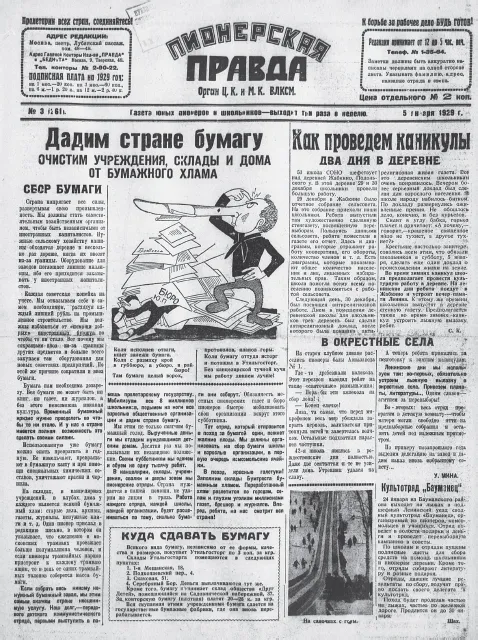
Figure 1.1 Frontpage of the January 5, 1929 edition of the newspaper Pioneer Pravda
Source: Russian State Children’s Library.
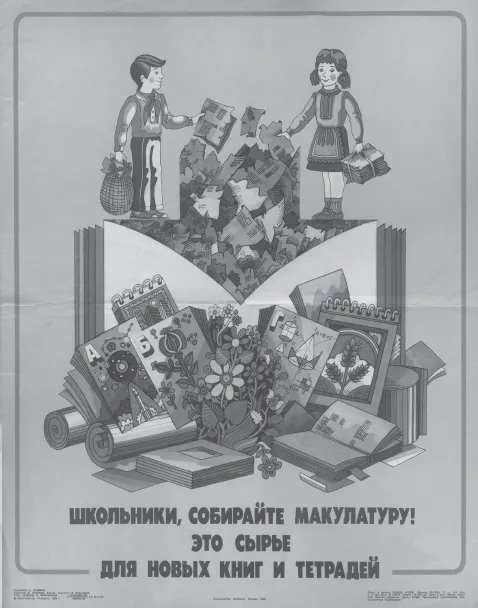
Figure 1.2 Aleksandr Chantsev’s 1985 poster “School children, collect wastepaper! It is a resource for new books and notebooks!”
Source: Russian State Library, Poster Collection.
After another devastating blow to Soviet paper industry during World War II, the Communist Party gave high priority to the expansion and modernization of paper production in the 1960s and 1970s and initiated the building of several new mass-scale plants (Chuiko 52). In parallel to rising paper production rates, the publishing industry’s print-runs of books, newspapers, and journals also seemed to be ever-growing. Late Soviet growing urbanization, an increasing level of education, better living conditions, and more leisure time were all factors that contributed to an increasing book and paper demand in the population. However, since readers did not want to buy million-high print-runs of Party-conform and Marxist-Leninist agitation literature, much of this literature was simply pulped again, while schoolbooks and children’s literature were often difficult to obtain (Dinerštein 167). In fact, annual Soviet paper consumption per inhabitant remained less than 10 per cent of the corresponding American figures ...
Table of contents
- Cover
- Half Title
- Series
- Title
- Copyright
- Contents
- List of Figures and Tables
- Acknowledgments
- The Playground of Children’s Literature
- Part 1 Social and Political Contexts of Play
- Part 2 Constructs of Children’s Agency in Representations of Childhood and Play
- Part 3 Materialities of Play
- Coda
- List of Contributors
- Index
Trusted by 375,005 students
Access to over 1.5 million titles for a fair monthly price.
Study more efficiently using our study tools.
Frequently asked questions
Yes, you can cancel anytime from the Subscription tab in your account settings on the Perlego website. Your subscription will stay active until the end of your current billing period. Learn how to cancel your subscription
No, books cannot be downloaded as external files, such as PDFs, for use outside of Perlego. However, you can download books within the Perlego app for offline reading on mobile or tablet. Learn how to download books offline
Perlego offers two plans: Essential and Complete
- Essential is ideal for learners and professionals who enjoy exploring a wide range of subjects. Access the Essential Library with 800,000+ trusted titles and best-sellers across business, personal growth, and the humanities. Includes unlimited reading time and Standard Read Aloud voice.
- Complete: Perfect for advanced learners and researchers needing full, unrestricted access. Unlock 1.5M+ books across hundreds of subjects, including academic and specialized titles. The Complete Plan also includes advanced features like Premium Read Aloud and Research Assistant.
We are an online textbook subscription service, where you can get access to an entire online library for less than the price of a single book per month. With over 1.5 million books across 990+ topics, we’ve got you covered! Learn about our mission
Look out for the read-aloud symbol on your next book to see if you can listen to it. The read-aloud tool reads text aloud for you, highlighting the text as it is being read. You can pause it, speed it up and slow it down. Learn more about Read Aloud
Yes! You can use the Perlego app on both iOS and Android devices to read anytime, anywhere — even offline. Perfect for commutes or when you’re on the go.
Please note we cannot support devices running on iOS 13 and Android 7 or earlier. Learn more about using the app
Please note we cannot support devices running on iOS 13 and Android 7 or earlier. Learn more about using the app
Yes, you can access Rulers of Literary Playgrounds by Justyna Deszcz-Tryhubczak, Irena Kalla, Justyna Deszcz-Tryhubczak,Irena Barbara Kalla,Irena Kalla, Justyna Deszcz-Tryhubczak, Irena Barbara Kalla in PDF and/or ePUB format, as well as other popular books in Literature & Literary Criticism. We have over 1.5 million books available in our catalogue for you to explore.