This book, first published in 1988, is a study of clientelism in the south of Italy, its relationship with the mafia and its importance in the context of national politics. The book explains the existence of clientelism in modern societies and its relation to the distribution of public resources. It examines the growth of political consensus in the region and whether and where clientelism can be explained in the terms of the mafia. The title examines the relationship between local and national politics and the ideological aspects of clientelism in operation. It makes a detailed comparison of the developments of the Cristian Democratic and Socialist parties in Calabria. With its broad analysis of an important contemporary and historical phenomenon, this book is likely to be of interest to political scientists, historians, anthropologists and students of Italian politics.
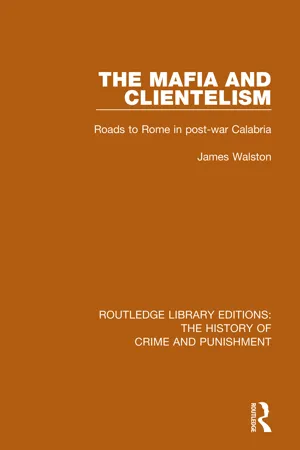
- 286 pages
- English
- ePUB (mobile friendly)
- Available on iOS & Android
eBook - ePub
About this book
Information
1
Political Clientelism in Modern Societies
La seconda causa generale è l’interesse particolare che molti hanno in detti disordini, che fanno il medesimo effetto in quel regno che suol fare l’edera in un muro; la quale poiché l’ha rotto e penetrato da tutte le parti, talmente che da se stesso non potrà più sostentarsi, lo sostenta poi lei e lo mantiene in piedi.Lorenzo Priuli, Venetian Ambassador to Paris;Annual Report 1582
The aim of this study is to produce a convincing analysis of the ways in which politics are conducted in southern Italy and in particular in the region of Calabria; a comparison will be made between the cities of Cosenza and Reggio Calabria over the post-war period and between the two major parties which have governed the two centres and the region over the past forty years: the Christian Democratic Party (DC) and the Socialist Party (PSI). The analysis will also try to map out some of the roads which link a peripheral area in the south of Italy with Rome, the political capital and centre for the distribution of public resources. I will also describe the workings of mafia in these spheres, the areas where it is an important influence and suggest the extent of its influence.
In order to do so, the boundaries of the research must be established and the key terms of mafia and clientelism described so as to make them workable. This first chapter seeks to do just that; it will be argued that the general principles and concepts may be successfully applied to southern Italy as a whole.
The primary analytic instrument to be used is the concept of clientelism, an explanatory device which has been used in a wide variety of contexts. It is a term which refers to political and social systems wholly or largely based on patron-client relationships; in these systems resources are controlled and transferred on a personal basis. In contemporary societies when these resources are public the rules followed are usually contrary to an official system. The contexts in which the term has been used will be considered. In parts of Italy organised crime and clientelism have become superimposed in a variant and violent form of clientelism which is mafia.1 It will also be dealt with in the introduction since it has considerable relevance when studying politics in the province of Reggio Calabria and a growing importance for the whole of Italy.
Notable clientelism
The term ‘notable clientelism’ is used mainly by anthropologists studying traditional or primitive societies. As the name suggests it is the relationship between a notable patron who controls resources (usually his own) and numbers of individual clients who depend on him for survival. Notable clientelism is a relatively simple relationship. It is between two individuals only; it goes on for a long span in time; the two parties are markedly unequal; above all, it is a personal rather than a bureaucratic link and it is an instrumental connection in that it exists only in order to further the aims of the parties involved. There is no overt or threatened violence in the relationship and the society itself usually does not consider the relationship in any way illegal or immoral.
All societies at all times produce large numbers of dependence relationships; clientelism is only one of these. In the following paragraphs I will try to describe the sense in which I will use this term. Quite apart from the way the word is used by anthropologists, political scientists and historians, there is further confusion because of the colloquial use of the word. The two key words ‘patron’ and ‘client’ are even used interchangeably at times: ‘Patrons are requested not to park on the grass’ or ‘we have a special class of client at this shop’. In some contexts patrons are seen as the successors of Maecenas. As Ernest Gellner noted in his introduction to a reader on the subject: ‘the non-Philistine Left holds that the state should be a patron of the arts. By this they do not mean, however, that the police should wrest control of Sotheby’s from the Mafia’.2 These are meanings which can be discarded immediately.
There are other meanings, though, used and carefully defined by scholars which do not adequately cover the phenomenon as it can be observed in modern industrial societies. I shall examine some of these definitions and consider in which way they contribute to or hinder an understanding of certain types of observable behaviour. From this discussion, I hope to be able to draw a picture of clientelism as a means of allocating resources, in particular, public resources. I will then suggest the shapes that clientelistic exchanges may take in a modern welfare state and the type of networks which may occur. The function of clientelism in modern societies will then be considered in the light of the previous theoretical descriptions; the theory will also be compared with the practice of clientelism in national government in Rome and local and regional government in the south.
Patron-client relationships have always been assumed to exist in traditional societies; the bulk of both theoretical and empirical research, refers to this type of community and has generally been carried out by anthropologists. Their definitions must therefore be considered first.
Obviously, differences in approach exist within these definitions, but as a blanket term, we may use ‘notable’ clientelism to cover them all. A number of features may be isolated in order to give substance to the term. A clientelistic relationship is a two-way process;3 it is an ‘enduring relationship between individuals of unequal wealth or power and the asymmetrical exchange of goods and services’;4 it is of course a ‘more or less personalized, affective and reciprocal relationship’.5 These features give a definition of clientelism:
[Clientelism] is conceived as an asymmetrical, quasi-moral relation between a person (the patron) who directly provides protection and assistance (patronage) and/or influences persons who can provide these services (brokerage), to persons (clients) who depend on him for such assistance.6
The case studies which define clientelism in this way consider societies where there is a concentration of resources in the hands of a few individuals and where the nature of the society means that there is a personal relationship between those who control the resources and those who need access to them. A further shortcoming of most of these studies is that they describe relationships which are already in existence; they give static pictures which seldom explain how these links grew up or how they proceed over time. On occasions there is also the presumption that the society is structured so as to make patron-client relationships inevitable. As a general rule, the societies which have been studied are agricultural rather than industrial, underdeveloped or developing rather than developed, traditional rather than modern. Only in the 1970s and 1980s has clientelism in developed societies also been analysed.7 The classical paradigm of notable clientelism is the peasant community where those who work the land depend almost entirely for survival on those who own the land; in some cases it is not the owner but his agent who acts as patron, but the functional relationship remains the same. Even when the notables move into public life, their position is held thanks to their own resources rather than vice versa.8 Jeremy Boissevain in the definition quoted above also includes the adjective ‘quasi-moral’ as one of the essential features of clientelism. This is a point which we will return to when we come to deal with clientelism in a modern society where the lack of morality is one of the essential features. Notable clientelism is thus based on scarce resources being controlled by a few patrons in a rural setting.
Before going on to similar relationships in modern societies, there are some dependence relationships which cannot be classified as clientelistic even though at first they seem to have much in common with the phenomenon.
The study of patron-client relationships gives us an insight into the way resources are allocated in a given society. These relationships are ‘personal and affective’. We can thus postulate a continuum which runs from purely personal criteria for the distribution of material and non-material goods to criteria based entirely on universalistic standards of economic or social rationality; clientelism would be at one end of this continuum and the ideal bureaucracy would be at the other. The main limitation of such a scheme is that it would oversimplify what are in fact extremely complex situations. At one end, the ideal bureaucracy does not exist; in reality, ‘personal’ criteria are present in real bureaucracies. At the other end, there are a number of different types of society which, while using personal principles for the distribution of resources cannot be grouped together without a blurring of analytic focus.
We can take feudalism as an example of a society structured according to personal values where some of the rules for the distribution of resources show more than superficial similarity to those used in clientelism. Relationships were based on personal loyalty, they were manifestly unequal and they were enduring. If, however, we describe feudalism as a society based on clientelistic loyalty, we risk flattening the concept into a grey meaningless smudge which ignores the clear differences between modern clientelistic societies and feudal ones. The same observation may be made about societies which are mainly based on tribal or kinship ties. The distinction lies in the institutionalisation of either tribal or feudal societies; in his study of Communism in the south of Italy, Tarrow pointed out that:
Observers often confuse clientele relationships with feudalism; in reality, it is quite different. In feudal society, social relationships were formalized, hierarchical and legally sanctioned …. Clientelismo on the other hand is shifting and informal and has no institutional recognition in concrete institutions (my italics).9
Thus societies where resources are allocated according to formal and explicit criteria are not clientelistic, in my terms, even though they may well be based on personal loyalty. It is true, though, that clientelism is often found in areas where there is some residual feudalism and that the notable took over from where the feudal left off and the party boss takes over from the notable. Occasionally, there is even a personal or family continuity in the roles. But the function is different in that clientelism exists where the modern state has not taken over fully. Similarly, societies with clans or tribes do not fall within the definition since the clan ties are an integral part of the political and social system.
Thus the reality of patron-client relations within the conceptual scheme that we have described so far can be easily imagined. It is the scheme of notable clientelism mentioned above and can only be applied to societies where state influence and control of resources is weak and or ineffective. It is a system where the local patron is in a position of pre-eminence in his community normally because of wealth but on occasions (as with the mafioso) through control of information or the threat of violence. The landless peasant depends on him for credit, disposal...
Table of contents
- Cover
- Half Title
- Title Page
- Copyright Page
- Original Title Page
- Original Copyright Page
- Dedication
- Table of Contents
- List of Tables
- Acknowledgements
- A Note on Sources
- Abbreviations
- Conversion Table
- Introduction
- 1. Political Clientelism in Modern Societies
- 2. The Clientelistic State
- 3. Calabria
- 4. Cosenza
- 5. Reggio Calabria
- 6. Conclusions
- Sources and Bibliography
- Index
Trusted by 375,005 students
Access to over 1.5 million titles for a fair monthly price.
Study more efficiently using our study tools.
Frequently asked questions
Yes, you can cancel anytime from the Subscription tab in your account settings on the Perlego website. Your subscription will stay active until the end of your current billing period. Learn how to cancel your subscription
No, books cannot be downloaded as external files, such as PDFs, for use outside of Perlego. However, you can download books within the Perlego app for offline reading on mobile or tablet. Learn how to download books offline
Perlego offers two plans: Essential and Complete
- Essential is ideal for learners and professionals who enjoy exploring a wide range of subjects. Access the Essential Library with 800,000+ trusted titles and best-sellers across business, personal growth, and the humanities. Includes unlimited reading time and Standard Read Aloud voice.
- Complete: Perfect for advanced learners and researchers needing full, unrestricted access. Unlock 1.5M+ books across hundreds of subjects, including academic and specialized titles. The Complete Plan also includes advanced features like Premium Read Aloud and Research Assistant.
We are an online textbook subscription service, where you can get access to an entire online library for less than the price of a single book per month. With over 1.5 million books across 990+ topics, we’ve got you covered! Learn about our mission
Look out for the read-aloud symbol on your next book to see if you can listen to it. The read-aloud tool reads text aloud for you, highlighting the text as it is being read. You can pause it, speed it up and slow it down. Learn more about Read Aloud
Yes! You can use the Perlego app on both iOS and Android devices to read anytime, anywhere — even offline. Perfect for commutes or when you’re on the go.
Please note we cannot support devices running on iOS 13 and Android 7 or earlier. Learn more about using the app
Please note we cannot support devices running on iOS 13 and Android 7 or earlier. Learn more about using the app
Yes, you can access The Mafia and Clientelism by James Walston in PDF and/or ePUB format, as well as other popular books in Historia & Historia británica. We have over 1.5 million books available in our catalogue for you to explore.