eBook - ePub
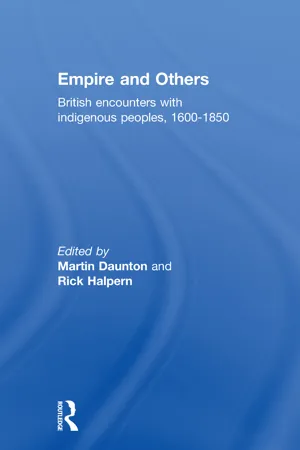
Empire And Others
British Encounters With Indigenous Peoples 1600-1850
- 412 pages
- English
- ePUB (mobile friendly)
- Available on iOS & Android
eBook - ePub
Empire And Others
British Encounters With Indigenous Peoples 1600-1850
About this book
Much has been written about the forging of a British identity in the 17th and 18th centuries, from the multiple kingdoms of England, Scotland and Ireland. But the process also ran across the Irish sea and was played out in North America and the Caribbean. In the process, the indigenous peoples of North America, the Caribbean, the Cape, Australia and New Zealand were forced to redefine their identities. This text integrates the history of these areas with British and imperial history. With contributions from both sides of the Atlantic, each chapter deals with a different aspect of British encounters with indigenous peoples in Colonial America and includes, for example, sections on "Native Americans and Early Modern Concepts of Race" and "Hunting and the Politics of Masculinity in Cherokee treaty-making, 1763-1775". This book should be of particular interest to postgraduate students of Colonial American history and early modern British history.
Chapter One
Introduction: British identities, indigenous peoples, and the empire
Empire and others results from an innovation and establishes a precedent. In 1997, the two long-standing colloquia organized by the Department of History at University College London were merged: the Neale Colloquium in British History and the Commonwealth Fund Colloquium in American History. The ambition was to address themes linking the historiographies of both sides of the Atlantic in a way which would reframe chronologies, transfer insights, and redefine problematics.
British historiography has much to gain from this dialogue. Unlike American historians, who have long dealt with indigenous peoples as part of their own national history, historians of Britain have been able to avoid including encounters with colonized peoples within their domestic history. Metropolitan residents consumed the products, ideas and knowledge of the far reaches of empire, even if they did not directly encounter indigenous peoples. What needs to be stressed, to a greater extent, is the way in which imperialism became a significant constitutive element in British identities.2 As C. A. Bayly argues in his recent historiographic survey, the next phase of scholarship should be to feed imperial history back into Britain. “The imperial history of the future will have to take seriously the question of how far, and in what ways, the imperial experience contributed to the making of national identity and regional identities in the British Isles itself.”3 The old meta-narrative of battles between Spanish, Portuguese, British, French, Dutch and German empires for ascendancy should remain part of the story, but it is only one part of a larger whole. As Linda Colley notes, the new emphasis is on “a complex saga of the collisions, compromises, and comings together of many different cultures”. This saga should include the mutual definitions of fellow Europeans, as well as the similarities and divergences of European responses to indigenous peoples throughout the world. British perceptions of Native Americans were not necessarily the same as French, and might well be contested within both countries; and the implications for British and French identities might well differ.4 The problem facing historians is how to write this new history, and how to make it operational without descending into a chaos of imagined identities and cultural confusions. The challenge is to balance attention to discursive practices, while retaining a grounding in the material realities of political economy.
The rich and impressive American historiography offers much to historians of Britain and its empire; at the same time, the American literature would be strengthened by attention to the encounters with indigenes in other parts of the empire. A major aim of this volume is to reintegrate the history of colonial North America with British and imperial history. North America is over-represented in the book, owing in the first instance to the format of the two colloquia, drawing as they did upon the constituencies of British history and North American colonial history. There are two further intellectual justifications.
The first is that historians of North America need to be aware of the different chronology which emerges when their work is inserted into the larger context of the British empire. The American historiography is set within an internal chronology of the United States, in which the story of indigenous peoples in the North- and South-East comes to a tragic nadir in the Jacksonian period. A British imperial perspective offers alternative perspectives, with a collection of different chronologies. Not all the chronologies are pursued in this volume, and in particular the encounters in the African slave trade or in Asia. Clearly, encounters in India in 1750 or in China in 1850 were very different from North America in 1650 in terms of the relative power of the parties, and of metropolitan attitudes to forms of religion or political authority. Rather, the emphasis in the present volume is on the long chronology of encounters with indigenous societies which were seen as broadly comparable. The North American chronology continues with encounters of soldiers, traders and settlers with the aborigines in Australia, the Maoris in New Zealand, and the Xhosa and the Zulu in southern Africa.
Indeed, the American experience fed into and informed these longer-term processes. As Andrew Porter shows in his contribution to this volume, the chronology was obvious to missionaries who reflected on the lessons of North America as they extended their attentions to other parts of the world. Similar continuities and connections existed between opposition to slavery in the Americas and protection of Aborigines in Australia. Evangelical reformers such as Thomas Fowell Buxton transferred their allegiance from emancipation of slaves to aboriginal land rights in the 1830s.5 Legal continuities from the colonial to the post-imperial eras are evident in Chief Justice Marshall’s decisions on native title in the United States; these developed from English legal traditions and were themselves cited in rulings of the courts in New South Wales and New Zealand.6 Contemporaries were themselves creating typologies of similarities of encounters, testing how far the property rights, religious beliefs, and political forms of Aborigines in Australia or Maoris in New Zealand could be admitted within metropolitan definitions.
The second justification for the over-representation of American material is that historians of Britain and its empire have much to learn from the literature on colonial North America. The exciting and incisive conceptualization of the frontier in the American historiography informs the contributions to this book. In contrast to older notions of the frontier as a fixed geographic and temporal entity, the new scholarship views the frontier as a process of interaction between indigenes and Europeans taking place in “zones of contact” that are spatially and chronologically flexible, and within which social, economic and military dynamics intersect and interact.7 Although imperial history has started to adopt a similar concern for “zones of contact” in Australia, Africa and Asia, this has taken place within the framework of distinct national histories, with the danger that connections and comparisons are often missed between different parts of the world and with the metropole.
A related point concerns the way in which American scholars have explored the shifting and historically contingent aspects of “white” identity. In recent years, a diverse group of historians and sociologists has begun to redefine the way in which race, racism and, indeed, anti-racism are understood.8 Kathleen Brown, in her article “Using Native Americans to interrogate the category of race”, revisits the classic work of Winthrop Jordan9 to show how racial identity was subject to constant negotiation and renegotiation in early colonial North America. Rather than closed categories existing in simple relation to one another, “black” and “white” had multiple referents. Broadly speaking, this sort of approach to problems of identity and issues of self-perception can be applied to other parts of the empire and, indeed, to the metropolitan country itself.
British history itself has recently been transformed by a new emphasis on the “forging” of identities, a word that captures the ambivalence of the process as both creation and counterfeiting. Essentialist approaches to class, gender and nation have given way to a concern for social construction and imagination which has undermined the old meta-narratives of political, social and economic history. One of the strengths of recent British historiography has been its attention to the way in which discursive practices help constitute class and gender identities, religious communities, regional loyalties and economic interest groups.10 Taking a cue from the American literature, British historians now need to consider how, where, and under what circumstances race should be inserted as a category of analysis. This is seen most clearly in Madhavi Kale’s essay. Although the concrete situation studied is the British Caribbean, Kale’s analysis reaches back across the Atlantic to the metropole as well as to India in an effort to understand the ways in which imperial agents constructed new identities for both emancipated slaves and indentured servants from the Indian subcontinent. Sensitivity to imperial location informs her analysis, and offers a lesson to historians of empire and metropole in their quest to understand the precise and contingent relations between class, gender and racial identities.11
During the eighteenth century, race was an important but not the primary category of identity within Britain. There was an emphasis on the need to moralize the manners of the “dissipated” elite and the “heathen” of the slums within Britain, as well as on the need to convert indigenous peoples in the empire. The creation of the Society for the Promotion of Christian Knowledge in 1698 reflected worries about the irreligion of the poor at home, and established charity schools as a form of metropolitan mission. Similarly, the formation of the Society for the Propagation of the Gospel in Foreign Parts in 1701 was part of the attempt to spread Christianity within the empire. The result was that “heathens” in the empire were defined within the same terms as “heathens” at home who wilfully rejected the benefits of revealed religion, so that the colonized abroad and the poor at home occupied similar moral space. The languages of race and class always operated in relation to each other, with constant slippage, and a major task for historians of metropolitan Britain is to pay much more attention to their interconnection. The way forward is suggested in this volume by two other pieces on the Caribbean that deploy complementary interpretative frameworks — Catherine Hall’s essay on the constitution of a new Black subject after emancipation, and Hilary Beckles’ examination of English–Kalinago relations in the seventeenth century. Other recent writing suggests that slave emancipation in the British Caribbean had important consequences for the racialization of “white” working-class identity in the metropole.12
A further development within British history, which complements the stress on identities, has been to re-think the nature of the state between the Civil War and the early nineteenth century. This work has pointed to the emergence within Britain of a powerful “fiscal-military state” from about 1680 with the capacity to apply domestic revenues to warfare. The expenditure was initially directed to the European theatre, but from the war of 1739–48 was increasingly turned to imperial pursuits. The creation of this new form of state affected the metropole in a variety of ways, by redrawing the boundary between local and central government, by developing new forms of fiscal extraction, and by creating new financial institutions and interests.13 One dimension of the creation of such a state was the successful negotiation of the political tensions arising from the governance by one monarch of multiple kingdoms within the British Isles, and the way in which problems in one kingdom could destroy the delicate and unstable relation of the parts.14 However, these concerns with the administrative and political complexities of the multiple kingdom did not disappear with union with Scotland in 1707, let alone with Ireland in 1801. The constitution of an imperial state re-invigorated these questions of identity and their relation to tensions within the political process. The “fiscal-military state” was not merely a domestic development. The search for revenue, and the mercantilist “navigation system” with which it was associated, were transferred across the seas and impacted upon the structures of both settler and indigenous societies in the Americas, Africa, and Asia. Moreover, the fiscal-military states within Britain and the empire were interconnected: a desire to reduce taxes at home might create tensions on the periphery, and resistance on the periphery might force up extraction at home at the cost of political conflict.15
This concern with multiple kingdoms within the British Isles and the construction of “British” communities in the New World can be linked with our stress on identities. How did a Scot in the Highlands or the Lowlands, or a Protestant or Catholic in Ireland, imagine their identity and construct their relationship with England? Furthermore, how did a Lowland Scot, educated at the University of Edinburgh, working as a physician on a slave plantation in Jamaica,...
Table of contents
- Cover
- Half Title
- Title Page
- Copyright Page
- Table of Contents
- Acknowledgements
- Notes on contributors
- 1 Introduction: British identities, indigenous peoples and the empire
- 2 The British and indigenous peoples, 1760–1860: power, perception and identity
- 3 Encounters between British and “indigenous” peoples, c. 1500–c. 1800
- 4 Native Americans and early modern concepts of race
- 5 Praying with the enemy: Daniel Gookin, King Philip’s War and the dangers of intercultural mediatorship
- 6 The cutting edge of culture: British soldiers encounter Native Americans in the French and Indian war
- 7 Protecting trade through war: Choctaw elites and British occupation of the Floridas
- 8 Hunting and the politics of masculinity in Cherokee treaty-making, 1763–75
- 9 Racialization and feminization of poverty in early America: Indian women as “the poor of the town” in eighteenth-century Rhode Island
- 10 “They are so frequently shifting their place of residence”: land and the construction of social place of Indians in colonial Massachusetts
- 11 Legitimacies, Indian identities and the law: the politics of sex and the creation of history in colonial New England
- 12 Images of aboriginal childhood: contested governance in the Canadian West to 1850
- 13 Authority under challenge: Pikampul land and Queen Victoria’s law during the British invasion of Australia
- 14 The genocide policy in English—Karifuna relations in the seventeenth century
- 15 William Knibb and the constitution of the new Black subject
- 16 “When the saints came marching in”: the Anti-Slavery Society and Indian indentured migration to the British Caribbean
- 17 North American experience and British missionary encounters in Africa and the Pacific, c. 1800–50
- 18 Losing faith in the civilizing mission: the premature decline of humanitarian liberalism at the Cape, 1840–60
- Index
Trusted by 375,005 students
Access to over 1.5 million titles for a fair monthly price.
Study more efficiently using our study tools.
Frequently asked questions
Yes, you can cancel anytime from the Subscription tab in your account settings on the Perlego website. Your subscription will stay active until the end of your current billing period. Learn how to cancel your subscription
No, books cannot be downloaded as external files, such as PDFs, for use outside of Perlego. However, you can download books within the Perlego app for offline reading on mobile or tablet. Learn how to download books offline
Perlego offers two plans: Essential and Complete
- Essential is ideal for learners and professionals who enjoy exploring a wide range of subjects. Access the Essential Library with 800,000+ trusted titles and best-sellers across business, personal growth, and the humanities. Includes unlimited reading time and Standard Read Aloud voice.
- Complete: Perfect for advanced learners and researchers needing full, unrestricted access. Unlock 1.5M+ books across hundreds of subjects, including academic and specialized titles. The Complete Plan also includes advanced features like Premium Read Aloud and Research Assistant.
We are an online textbook subscription service, where you can get access to an entire online library for less than the price of a single book per month. With over 1.5 million books across 990+ topics, we’ve got you covered! Learn about our mission
Look out for the read-aloud symbol on your next book to see if you can listen to it. The read-aloud tool reads text aloud for you, highlighting the text as it is being read. You can pause it, speed it up and slow it down. Learn more about Read Aloud
Yes! You can use the Perlego app on both iOS and Android devices to read anytime, anywhere — even offline. Perfect for commutes or when you’re on the go.
Please note we cannot support devices running on iOS 13 and Android 7 or earlier. Learn more about using the app
Please note we cannot support devices running on iOS 13 and Android 7 or earlier. Learn more about using the app
Yes, you can access Empire And Others by Professor M Daunton,Rick Halpern in PDF and/or ePUB format, as well as other popular books in History & British History. We have over 1.5 million books available in our catalogue for you to explore.