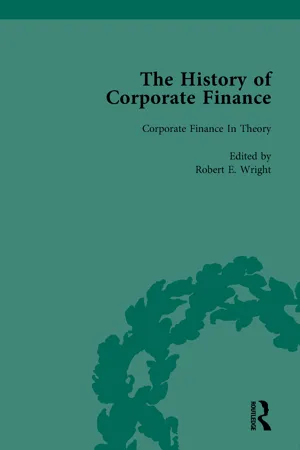
eBook - ePub
The History of Corporate Finance: Developments of Anglo-American Securities Markets, Financial Practices, Theories and Laws Vol 5
- 2,500 pages
- English
- ePUB (mobile friendly)
- Available on iOS & Android
eBook - ePub
The History of Corporate Finance: Developments of Anglo-American Securities Markets, Financial Practices, Theories and Laws Vol 5
About this book
This work contains primary research texts regarding two centuries of the development of corporate finance in the US and Great Britain. It is designed to help scholars, financial managers, and public policymakers to investigate the historical background of issues in contemporary corporate finance.
THE THEORY OF BUSINESS
FOR BUSY MEN*
John Laing
The Theory of Business for Busy Mendedicated toHenry Lancelot Holland, late Governor of the Bank of England.
2nd edn (London: Longmans, Green, and Co., 1868)* This text contains cross-references to original page numbers.See p. 445 for conversions to Pickering & Chatto page numbers.
Dedicated
(BY PERMISSION)
TO
HENRY LANCELOT HOLLAND, ESQ.
LATE GOVERNOR OF THE BANK OF ENGLAND.
THE
THEORY OF BUSINESS
FOR BUSY MEN.
BY JOHN LAING.
SECOND EDITION.
LONDON:
LONGMANS, GREEN AND CO.
1868.
LONGMANS, GREEN AND CO.
1868.
PREFACE
TO
THE SECOND EDITION.
____________________
‘THE Theory of Business’ has been thoroughly revised, rearranged in part, and enlarged by the addition of about one-fifth of new matter.
A conversation held with an eminent authority on railway subjects has led to ‘The Railway Dilemma’ appearing as a chapter, instead of as a short foot note.
In preparing this edition, assistance in the shape of appropriate information and friendly criticism has been received from many, in various industrial and. other departments, to whom the writer begs to return his sincere thanks.
CITY: February 1st, 1868.
THE THEORY
OF
BUSINESS.
OF
BUSINESS.
__________
CHAPTER I.
MODERN PRODUCTION.
MOYHANGER, a New Zealander, who was brought to England, was struck ‘with especial wonder on his visit to London at the mystery, as it appeared to him, how such an immense population could be fed, as he saw neither cattle nor crops.’ Elsewhere in England he might have found cattle and crops and no consumers near them. Accustomed in his own country to see every family growing its own food and providing clothing for its members, he was unable to comprehend what in reality is a feature eminently characteristic of an advanced state of production. In England, the days when each family catered directly for the supply of its own wants have been left far behind. The husband has forsaken his primeval avocation : he has ceased to be the husbandman, growing bread for the household; his unmarried daughters no long-er earn their title by their spinning-wheel; and it is matter of history only that once upon a time ‘the goodwife’s shuttle merrily went glancing through the loom.’ Industries have gradually become separated from one another, and each engages fully the time and energies of an entire section of the community. Husbandry is carried on not in the vicinity of every house or village, but in districts remote from the persons who are to enjoy its products. Spinners have banished their fair rivals of the household, and the weavers of Manchester and other places have relieved the wife1 of a duty shown by the name to have been recognised at one period as peculiarly her own. The many workers now required to produce an article possibly obtain no portion of the result of their labour; ther produce, and others consume the product. ‘Sic vos non vobis mellificatis apes ! Sic vos non vobis nidificatis aves!’ But though workers may not get any of what they themselves help to make, they get what others have made, instead. One set of workers now produces cloth and others bread, or other things; and they interchange, though by a process so easy as to have somewhat obscured the importance of the fact that consinners obtain commodities in the production of which they have expended no energies. Every purchase of any goods made by others bears silent testimony to the separation of industries having taken place. The feeling that has given rise to the separation of industries has also created classes not industrial. Sections of the community perform exclusively the functions among others of soldiers, of sailors, policemen, postmen, lawyers, doctors, and clergymen. A banking class has also sprung up, of which we shall have occasion in the sequel to say a good deal.
Not only are all industries divided and carried on separately—the production, for example, of bread from the production of shoes or wine—but every branch is broken up into trades or groups of workers, each conducting some single part, often an exceedingly small part, of the process, as in the manufacture of playing cards, or, at one time, of pins. Any product, such as a loaf of bread or a piece of calico, is, like pins or playing cards, the result of a series of operations on the part of groups working successively, each furnishing the commodity in hand to the next in order, under the form of selling it for money. Moved onward by one trade to another, it is at length turned out as goods fit for use.
Several of the groups engaged in production, merchants, dealers, and shopkeepers, make no alteration in the nature or form of the goods they deal in, but pass them forward precisely as when they came to hand. These classes, however, really endow commodities with new qualities. To us in England tea in China is practically non-existent. In some parts of South America beef, it is said, can be had almost for the taking, and mutton in certain regions of Australia. Such beef and mutton, as far as consumers in this country are concerned, might as well be in another planet. But merchants quite alter the case when they bring them to this market. A kind of service similar is rendered whenever produce of one district is brought within convenient reach of persons living in others. Distributors thus endow commodities with the eminently serviceable quality of being in the places where they are required. Another service, or rather an extension of this one, is that of making goods available at proper times. Distributors also furnish articles fitly as to quantity, making it possible, for instance, to obtain a joint of beef without buying a whole ox, or a glass of wine without taking a cask.
We apply the term ‘producer’ to merchants as well as to manuf1Lcturers—that is to say, to persons who merely sell goods as well as to those who in. popular language are said to make or produce them. A common principle runs through the operations of both these classes. Merchants’ operations consist in moving goods to suitable localities; and after all is done, manufacturers have only moved materials into particular relations to other materials. As for making, in the sense of creating, it is not in the power either of manufacturer or merchant. Man has no other means of acting on matter than by moving it.’1 Products, in short, are matter invested with certain attributes, those, namely, of being what is wanted, made available when and where wanted. Persons performing any part of the service of investing matter with these attributes are equally entitled to the appellation producers.
It is evident that a highly organised system of production will materially affect the status of individual producers. Each becomes, so to speak, a wheel in a stupendous machine, powerful in combination, but quite useless alone, while in a primitive state every one resembles his own spear or bow, which, while rude and inefficient, is yet complete in itself. Under a svstem which confines the worker to the production of singlearticle, usually indeed of only a portion of one, and where the family, and à fortiori the individual, have ceased to be self-sufficing, exchanges are fundamental. The maker, for example, of pin-heads must for these procure the food and clothing indispensable for himself and his household, should he have one. He does this by first selling his product for as much money as he can get for it, and then giving that money for the particular articles he requires. The sale of goods, by procurint for him money, is commonly said to be the cause of his making profit. It will appear hereafter that profit exists independently of money.
The separation of employments, with their division into trades and sub-trades, is attended with very beneficial results to society. By being enabled to concentrate his attention upon some possibly minute part of a process, the worker acquires a degree of skill and dexterity which otherwise he could not attain. Skill from concentration of mind is often exhibited in articles of every-day use which might well excite surprise. Look, for instance, at the veneering of the joiner; how exquisite is its finish ! It is hard to believe that the block of wood. before us is not a single piece, but consists of a thin coating of costly material spread over a common deal. This is a familiar but striking example of skilled workmanship springing from the division of occupations. Subdivision, by confining attention within narrow limits, has proved fertile in discoveries in the arts and in inventions, leading to the ever extending application of machinery in aid of men’s efforts. The cotton industry exemplifies results which but for subdivision of course could not have existed. In illustration take Messrs. Holdsworth’s factory at Manchester, famous for fine spinning. ‘When it is remembered that “ 32’s “ (i.e., yarn of 32 hanks, each 840 yards in length, to the lb.) is a common-sized yarn for weaving calicoes, the delicacy of this firm’s machinery will be appreciated by the fact that they can spin “ 540’s “ yarn, one pound weight of which would contain a thread long enough to reach from London to Newcastle. In the Exhibition of 1862 they displayed “ 700’s “ yarn, a pound of which would be 588,000 yards in length !’1
Besides admitting of concentration, the separation of industries affords an opportunity for selecting a kind, of occupation for which by natural aptitude or acquired ability the worker is best qualified. Those with aptitudes for special pursuits are enabled to follow their bent. The community thereby profits by the natural gifts of its members. All classes of society in the greater profusion as well as superior quality of the commodities pa ced at their disposal experience the benefit of the development of industry which has occurred especially during the last fifty years. is not necessary to go back much beyond half a century to arrive at the time when prosperous shopkeepers in the leading thoroughfares of London were without that now necessary article of furniture, a carpet, in their ordinary sitting-rooms. Luxury, in this particular, seldom went further with them than a well-scoured floor strewn with sand, and the furniture of the apartment was bv no means inconsistent with this primitive and, as we should now say, comfortless state of things.’1
Many establishments are conducted on too small a scale to admit of separation being fully carried out. In some retail and also wholesale stores the counter hands have, for example, to make out accounts or invoices or to post the books, during the intervals between the visits of customers; or the pay-clerks in country banks to attend to work other than that connected with the counter. The inefficiency of such operations is keenly felt by those who take part in them. The pen is no sooner taken up than an arrival demands attention to another matter, and before a start is again made much time is uselessly expended. One hour without interruption may suffice to get through as much work as many hours with interruption. Small establishments are carried on at a disadvantage compared with large ones. Those in the former must work harder than their rivals merely to keep abreast. The marked superiority of production on a grand scale has been shown by a continued increase in the size of cotton factories and other industrial undertakings.
While, from the view-point of the individual worker, the productive system is one of subdivided industries, from the view-point of society at large it constitutes a vast combination or co-operative organisation. Every article we consume testifies to the existence of a cooperative system. No kind of food or clothing but is found, on reflection, to bear the imprint of many hands. Labour of different descriptions is required to make each piece what it is, and, what with bringing materials not seldom from remote places, probably not less to put it where it is. True, the industrial organisation, though a reality, does not strike the eye of the observer. The scale on which its operations are carried on is much too extensive for it to do so. Those co-operating may not work in one building, or for the same employer, or even in the saine country, but possibly in regions remote from one another. Many indeed have acted in concert with others during a lifetime without ever realising Lite fact of doing so at all. A worker devotes himself to his specific operation, and does not necessarily or usually give himself trouble about what others, virtually his coadjutors, are doing elsewhere. He goes on without entering into any agreement that they shall do their part or persevere in a work entered upon until it is completed. Harmonious and effective co-operation oui the part of millions takes place, but without any such explicit understanding or arrangement. The extent to which this happens is one of the peculiarities of modern production.
The achievements of combined industry, viewed as a whole and on a grand scale, are marvellous. Consider a, little of what is implied in furnishing the teeming populations of towns with stated supplies. What difficulties have to be surmounted by the volunteer commissariat! The number of persons to be provided for is liable continually to alter, and no small proportion of the articles required are such as will not keep any length of time; very many of them spoil if not used at once. Such stocks must never be in excess of actual requirements; but, on the other hand, cessation of supply, even for a day, is out of the question. How difficult it is to provide accurately for the wants of even a small number has been vividly displayed by recent Crimean experiences; yet in the case, for example, of London with its three millions, varying daily often to the extent of many thousands through arrivals and departures, notwithstanding apparently insuperable obstacles, with what precision are supplies furnished, and, withal, daily draughts adjusted to existent stocks, abundant or scanty as these happen to be ! Due regard is likewise had to the interval which must elapse before new sup...
Table of contents
- Cover
- Half Title
- Title Page
- Copyright Page
- Table of Contents
- John Laing, The Theory of Business for Busy Men (1868)
- Arthur Crump, The Theory of Stock Exchange Speculation (1874)
- Page Conversions
Trusted by 375,005 students
Access to over 1.5 million titles for a fair monthly price.
Study more efficiently using our study tools.
Frequently asked questions
Yes, you can cancel anytime from the Subscription tab in your account settings on the Perlego website. Your subscription will stay active until the end of your current billing period. Learn how to cancel your subscription
No, books cannot be downloaded as external files, such as PDFs, for use outside of Perlego. However, you can download books within the Perlego app for offline reading on mobile or tablet. Learn how to download books offline
Perlego offers two plans: Essential and Complete
- Essential is ideal for learners and professionals who enjoy exploring a wide range of subjects. Access the Essential Library with 800,000+ trusted titles and best-sellers across business, personal growth, and the humanities. Includes unlimited reading time and Standard Read Aloud voice.
- Complete: Perfect for advanced learners and researchers needing full, unrestricted access. Unlock 1.5M+ books across hundreds of subjects, including academic and specialized titles. The Complete Plan also includes advanced features like Premium Read Aloud and Research Assistant.
We are an online textbook subscription service, where you can get access to an entire online library for less than the price of a single book per month. With over 1.5 million books across 990+ topics, we’ve got you covered! Learn about our mission
Look out for the read-aloud symbol on your next book to see if you can listen to it. The read-aloud tool reads text aloud for you, highlighting the text as it is being read. You can pause it, speed it up and slow it down. Learn more about Read Aloud
Yes! You can use the Perlego app on both iOS and Android devices to read anytime, anywhere — even offline. Perfect for commutes or when you’re on the go.
Please note we cannot support devices running on iOS 13 and Android 7 or earlier. Learn more about using the app
Please note we cannot support devices running on iOS 13 and Android 7 or earlier. Learn more about using the app
Yes, you can access The History of Corporate Finance: Developments of Anglo-American Securities Markets, Financial Practices, Theories and Laws Vol 5 by Robert E Wright,Richard Sylla in PDF and/or ePUB format, as well as other popular books in Economics & Economic Theory. We have over 1.5 million books available in our catalogue for you to explore.