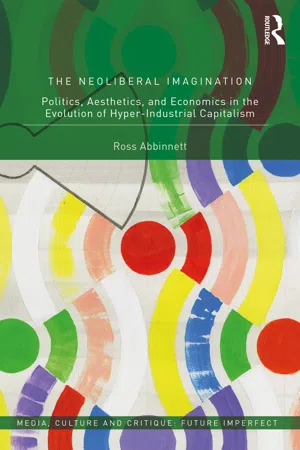
This book presents a polemical account of the historical development of the neoliberal imagination. Inspired by the thought of Frederic Jameson, Bernard Stiegler, and Timothy Morton, it argues that the evolution of virtual and information technologies has transformed the ideological imaginary of capitalism. Owing to the inseparability of the process of commodification from developments in the sphere of media technology – particularly the rise of the digital networks through which information is processed and disseminated – the aesthetic forms of the neoliberal imaginary are not external to the accelerated productivity and adaptability of human beings. Rather, they are essential both to the vision of progress that informs the technoscientific organization of capitalist society and to the practical formation of 'the self' that takes place within its networks. A snapshot of the evolving 'world picture' that is formed in the neoliberal imagination as articulated in its particular regime of capitalization, The Neoliberal Imagination will appeal to scholars of social theory and social philosophy with interests in neoliberalism.
eBook - ePub
The Neoliberal Imagination
Politics, Aesthetics, and Economics in the Evolution of Hyper-Industrial Capitalism
- 244 pages
- English
- ePUB (mobile friendly)
- Available on iOS & Android
eBook - ePub
The Neoliberal Imagination
Politics, Aesthetics, and Economics in the Evolution of Hyper-Industrial Capitalism
About this book
Information
Part 1
Liberalism and modernity
1 Liberalism, Enlightenment, and bourgeois society
Liberalism and modernity
As I said in the Introduction, my aim is to develop a genealogy of the aesthetic forms through which collective ideas of identity, freedom, and progress have been articulated in contemporary liberal democracies and to elaborate the ways in which these ideas are enmeshed in the technoscientific organization of life that has colonized our culture and self-understanding. Such a genealogy is not intended to present a smooth dialectical transition of the ideas, artistic conventions, and technological innovations that have shaped the evolution of Western modernity. Rather, its purpose is to map pivotal contradictions, conflicts, alliances, and complicities that have given rise to the neoliberal worldview, and re-present them as the internal mechanism of a social and economic history whose future direction is always uncertain. In what follows I will return constantly to the antagonisms between rationality and desire, capitalization and labour, technology and intellect, and religion and science that have haunted the cultural and aesthetic life of capitalist states ever since their emergence. I will argue that what we are seeing now, in the cultural, economic, and political hegemony of neoliberalism, is the expression of an aesthetic that has evolved in relation to the profound tensions that have arisen from the process of modernization. This aesthetic has become the form in which ‘the future’ is programmatically configured: for insofar as the virtual media into which the sphere of representation has migrated are now utterly pervasive of everyday life, the neoliberal imagination has become the aesthetic genre in which the purpose of human life is constantly transformed. However, this account of the neoliberal world picture should not be regarded as a kind of paradigm of cultural, aesthetic, and economic interaction that was waiting to emerge from the conflicted development of rational-scientific capitalism. It is not, in other words, the condition of a functional ideal that should be aspired to. Rather, it is a mode of technological representation that is shot through with the psychical, libidinal, cultural, and religious traces it has appropriated, and which it constantly transforms.
In this chapter I will be concerned with elaborating the origins of the liberal worldview or, to be more precise, the way in which the European Enlightenment impacted on the symbolic order of religion, morality, politics, and economy that had formed the substance of the feudal regime. This clearly begs the question of the relationship between the philosophical movements, schools, and ideas that have been grouped together under the term ‘Enlightenment’ and the actual effects that Enlightenment ideas have had on the evolution of modernity. This question, of course, takes us into the province of history, that is, of explaining which groups, which social processes, and which institutions were responsible for impeding and furthering the Universalist ideals of Enlightenment philosophy. As Jonathan Israel put it in his Contested Enlightenment, understanding the revolutionary significance of the new ideas presented by European intellectuals from the middle of the sixteenth century requires us to pursue a ‘cultural sociology’ in which the reciprocal influence of cultural change, political transformation, and philosophical analysis is recognized as a shifting and contentious process (Israel, 2008: 20–21). The concrete social, economic, and political forms in which ‘the struggle of enlightenment with superstition’ was acted out, in other words, were a matter of historical contingency, whose relation to the emancipatory intention of ‘the Enlightenment’ as such is always a matter of post hoc reconstruction. A similar point is made in George Lefebvre’s account of the origins and consequences of the French Revolution. Lefebvre’s narrative presents a complex account of the way in which the philosophical ideals of rational self-determination, popular sovereignty, and economic freedom transformed the struggle of the aristocracy against the reforming intentions of the king into a full-blown assault of the bourgeoisie on the economic privileges of the second estate (Lefebvre, 2001: 98–111). Lefebvre goes on to show how factional interpretations of Enlightenment ideals of liberty were pivotal in the split between the Jacobins and the Girondists, the Jacobin Terror of 1792, and the impact of the French Revolution on Western European states and their colonies. What is important here, it seems to me, is the fundamental insight that ‘intellectual history’ is always enmeshed within the social, technological, economic, and political conditions of life, and that the psychical, biological, and libidinal modes through which individual freedom is expressed are always influenced by the reproduction and dissemination of ideas.
Both Israel and Lefebvre’s analyses (despite the former’s rather tendentious arguments about the influence of Spinoza’s thought on early bourgeois radicalism) seek to establish a strict boundary between, on the one hand, empirical analysis of the reception and practical interpretation of Enlightenment ideals in different states and, on the other, the providentialist tradition in which ‘the Enlightenment’ stands as an event that marks a permanent and progressive change in the direction of human history. So, for example, Immanuel Kant, in his essay ‘The Contest of the Faculties,’ maintained that the French Revolution was a begebenheit, a world historic occurrence, in which the universal significance of the bourgeois petition for formal-legal equality, despite its descent into the violence of the Jacobin Terror, was registered in the sympathetic feelings manifested by those Europeans who watched the Revolution from outside of France. From the perspective of Kant’s philosophical anthropology, in other words, the sovereign rights of rational humanity, which formed the core of Enlightenment thought, shone through the sectarianism into which the actual Revolution descended, and produced a sense of unconditional enthusiasm among those states and individuals who were attuned to the coming universality of human life and culture (Kant, 1991: 182–183). The important thing to recognize here is that the unfolding of Enlightenment ideals of rational insight, scientific explanation, reflexive self-determination, and formal-legal rights is seen as part of an overarching moral teleology in which it is the freedom of rational intelligence that is at stake. In light of the evolution of modernity, of course, it is difficult to defend this kind of philosophical providentialism against claims that it lends itself either to overly optimistic interpretations of the normative power of the public sphere (as in Habermas and Beck’s versions of critical theory) or to an unconditional privilege of the formal-legal freedoms that fails to recognize the monopolistic effects of capital (as in the Mont Pelerin version of laissez faire individualism). My own position, which is teleological but not providentialist, proceeds from an idea that originated in Max Weber’s sociology: that the overall effect of the Enlightenment, and the models of bureaucratic control that arose from it, was a process of religious and symbolic disenchantment which accompanied the development of capitalism as a rational-technological regime (Weber, 1978: 47–78). Thus, the fact that the influence of Enlightenment philosophy was, from the beginning, dispersed among a plurality of different religious, political, moral, and aesthetic movements in different national contexts does not invalidate the claim that its ideals gave rise to certain universal elements of liberal philosophy (rational self-interest, calculable utility, formal freedom, legal recognition, etc.) that have been essential to the evolution of the neoliberal imaginary.
As we saw in the Introduction, the idea of a worldview is important primarily because of the way in which Heidegger brings together the cultural, symbolic, and analytical elements of human experience within the sphere of ‘revealing,’ that is, the dominant mode of representation through which ‘the real’ is constituted for us as human beings. The shift from the traditional forms of religiosity associated with feudal order in Europe therefore does not simply denote a shift in the analytical paradigm through which the world is understood, although this is clearly an essential part of its internal economy. Rather, the emergence of Newtonian mechanics as the conventional scientific regime through which the operations of the material world are understood, and the influence of this regime on the European Enlightenment, had a profound effect on the concept of nature. The idea of ‘matter,’ as an abstract, universal quantum that is open to technological manipulation, came to replace the idea of an organic totality that was central to the Greek idea of physis. This transformation of nature into what Heidegger called the ‘ready to hand’ is important because it marks a radical desacralization of the symbolic order in which we, as human beings, are embedded. The orientation of human activity is no longer governed by religiously consolidated modes of work, satisfaction, and desire, and so the shift from the feudal-monarchical system to the abstract-utilitarian relations of bourgeois society marks the point at which the presence of God begins to depart from the everyday life of human society. Weber’s contention that Protestant theology was essential to the rise of capitalism in Europe, and that its doctrine of responsibility to God was the origin of a practical-utilitarian ethic that legitimized the secular pursuit of wealth, should be read as a crucial transformation in the symbolic order of life in Western European societies. For an essential part of the transition from feudal to modern societies is the emergence of a secular worldview, in which the question of God’s existence is transformed into that of His compatibility with the discursive practices through which nature and humanity have been laid open to the analytical gaze of the sciences. We can therefore infer a certain teleological significance from this reorientation of human life, in which the role of utilitarian philosophy in the evolution of European modernity must be seen as far more significant than just the solicitation of faster, more rationalized relations of production and consumption. From the perspective of the Heideggerian worldview, it marks a fundamental transformation in the ethical life of society and in the way that each individual experiences his or her relationship to the social totality. I will return to this in a moment.
Addressing the question of the transition from the feudal order of European societies to the capitalist mode of production, as Weber pointed out, necessarily involves giving an account of how the affective, religious, and aesthetic relations of the feudal order were transformed, firstly, by the emergence of a new materialist science and, secondly, by the reformation of religious belief that took place through the spread of Protestant theologies (Weber, 1978: 95–154). This question echoes through the German Enlightenment, and particularly Kant’s and Hegel’s attempts to address the question of God’s place within an increasingly secularized social and economic order. Kant’s system is perhaps the classic expression of the antagonism of faith and knowledge that emerged from Enlightenment philosophy and of the attempt to delineate their respective spheres of legitimacy. The idea of theoretical reason he presents in the first Critique maintains that the coherence of our ‘outer experience’ of the world is underwritten by a set of a priori categories that spontaneously integrate the data that are represented in the ‘aesthetic’ modes of space and time (Kant, 1982a: 65–91). The world we know, in other words, is a world of ‘phenomena,’ in the sense that the discrete objects and events we experience are deducible from the categorical structure of our understanding. The question that arises from this concerns the human capacity for self-determination: how, if we are subject to laws of matter that apply to our bodily existence and are expressed in the form of non-rational appetitive desire, is it possible for us to act freely? Kant’s argument in the second Critique is that the concept of freedom must be understood ‘by analogy’ with the order that underlies the apparent contingency of nature (Kant, 1993: 52–59). The human will’s autonomy consists not in its random pursuit of desire, but rather in acting in conformity with universal rules that ought to hold in all human societies. These rules are ‘given’ in a form that is independent of all tradition and particularity, that is, through the logical self-consistency of moral maxims whose obverse would result in the destruction of those institutions that are essential to social life as such (the right to hold private property, the right to life, the right to pursue one’s trade, the right to publically pronounce one’s opinion, etc.). Thus, the evolution of human civilization has a dual aspect to it. It unfolds, on the one hand, through the progress of sciences, which leads to the development of technical means that improve human economy (production, consumption, etc.) and, on the other, through the development of a shared subjective sensibility to the ultimate purpose of God’s creative act, to which each citizen contributes as an exemplar of morally autonomous action (Kant, 1993: 130–139).
So, to return to the relationship between the rational-utilitarian unfolding of modernity and the affective traditions that comprise the substance of ethical culture, the question that Kant bequeaths to modern critical theory concerns the place of aesthetic feeling within the totality of social life. Kant’s answer to this question was to appeal to the subjective-universal structure of the aesthetic judgements he expounded in his analytics of the beautiful and the sublime. In the former case, it is the conformity sustained between our faculties of apprehension and certain objects that are distinguished by their exemplary form, that gives us a feeling of delight and prompts us to the declarative judgement: ‘this object is beautiful.’ In the latter, it is the overwhelming magnitudes found in nature (the storm at sea, the avalanche, etc.) that produce the simultaneous feelings of pleasure and fear that mark the presence of the sublime. In both cases, the origin of the aesthetic judgement is a sense of transcendence that is in the world but not of it – the trace of God as a creator who made the world so that human beings, in the course of their history, would overcome their demeaning closeness to the violence of nature (Kant, 1982b: 221–225). This sense of a transcendental purpose that is implicit in the created world is the fulcrum on which Kant’s political philosophy turns. For insofar as he conceives the abstract principles on which liberalism is based (formal-legal freedoms, individual liberty of thought and speech, rights of self-determination, etc.) as the expression of a republic of distinctively human ends, the idea of ‘nature,’ as the instrument of human history, retains something of its relationship to the act of divine creation. The feeling of aesthetic enthusiasm that is provoked by world-historical events like the French Revolution therefore has its fulfilment in a moral culture whose figuration of the implicit harmony of freedom and organic life is the sensory analogue of liberal democracy (Kant, 1991: 176–190). So, if we follow Kant’s arguments about the utilitarian value of political economy in shaping aesthetic taste and the moral life of the modern citizen, we can infer that, for him, the art of the bourgeois epoch should seek to re-present the symmetrical, ordered life that is realized both in the harmony of nature and through the freedom of autonomous citizens of enlightened states.
The force of this demand for an instructive art that would symbolize the moral community of human beings, however, is problematic for a number of reasons. Firstly, Kant’s designation of who counts as human undergoes a series of limiting modifications in his political and anthropological writings, specifically through the narrowing of the set of races who are capable of exercising rational control over their biological desires (Kant, 1996). Secondly, the assumption that the telos of bourgeois society can be truthfully depicted through the aesthetic register of the beautiful is clearly open to question. For as Marx pointed out, the practical consequences of Kant’s architectonic of experience were, on the one hand, to justify the endemic self-interest of the bourgeois citizen and, on the other, to endorse the generic forms of art through which the bourgeoisie ascended to their position of cultural hegemony (Marx, 1977a: 97–100). Thirdly, Kant’s argument that the Christian mythos, in which the practical morality of Christ reveals the purpose of divine creation to human beings, expresses the austere concept of belief that runs throughout his philosophy. Kant saw the connection between God, religious feeling, and the experience of ethical life that had underpinned the feudal order as the primary target of the Enlightenment. The motto of every free individual should be ‘have the courage to use your own understanding!’ which, in essence, means forsaking the literal aesthetics of religious community and conducting one’s life on the basis of the moral principles that are exemplified in the life of Christ (Kant, 1991: 54). The crucial point here concerns the relationship between morality, aesthetics, and desire that took shape in the emerging European capitalist economies at the start of the nineteenth century. For insofar as the Kantian system stands as the exemplary form in which life as utility is mediated with the discourse of moral self-determination and the formative power of the aesthetic, it marks the emergence of the founding contradiction of liberal philosophy. Marx understood this in terms of the limits of the ideological power of the commodity form. For him, the reflexive sensibilities of the bourgeois subject are simply the archetype of a form of social hypocrisy that refuses to accept responsibility for the dehumanizing consequences of its actions. In light of the history of capitalist modernity, however, it is perhaps closer to the truth to say that the independence Kant attributed to the moral and aesthetic faculties of human beings has proved far more susceptible to the schema of industrial culture than he and his inheritors could allow. This argument is systematized in Stiegler’s account of Kant’s subjective idealism. He maintains that, in the end, the faculties Kant identified as essential to rational intelligence as such, reflect the processes of mathematical-technological ordering that facilitated the transition to capitalist modernity (Stiegler, 2011a: 40–47). In the following section, I will set out the genealogical relationship between the liberal inflection of modernity as the expression of formal freedom and the emergence of ‘culture’ as a technological figuration of time, identity, and capitalization.
The concept of Enlightenment (after Horkheimer and Adorno)
The argument I will develop in this section concerns the relationship between Enlightenment philosophy and the emergence of liberalism as a moral, political, and economic doctrine. This is important in the history of the neoliberal imagination, as it marks the point at which the evolving philosophical conceptions of life, morality, community, and economy found their way into the political debates and contestations that formed what we now know as civil society (Habermas, 1992). As I have indicated, my argument is essentially genealogical, and so I want to begin by clarifying its terms of reference. The idea of genealogy as a mode of cultural-historical explanation originated in Nietzsche’s work, and is given its fullest treatment in The Genealogy of Morals. Speaking of the evolution of the morally sovereign individual, whose freedom Kant had deduced from the concept of rational intelligence, Nietzsche remarked that if we consider this concentration of psychical power from a historical perspective, we would see that this ‘ripest fruit’ of human civilization has actually been formed through a regime of barbarous degradations and mortifications of our animality. The ‘human spirit’ has separated itself from the warmth of symbolic life through a history of violent transformation that we can now piece together from ‘the terminal point of the process’ (Nietzsche, 1990: 191). The logic of Nietzsche’s argument draws together three different strands. First, there is the idea that the truth of any given social phenomenon (the formation of the sovereign individual, the evolution of different artistic genres, the development of technological regimes) is revealed through its unforeseen consequences. Second, there is the idea that historical epochs should be differentiated by their relationship to the transformative potential of ‘man,’ that is, to the horizon of human self-transformation. And third, there is the idea that ‘civilization,’ which Nietzsche identifies with the rationalization of technology, economy, and culture, should be seen as being permanently at odds with the ‘will to power’ of those who possess the ability to extend the boundaries of human existence. Indeed, the final part of Nietzsche’s analysis of conscience in The Genealogy, ‘What Do Ascetic Ideals Mean,’ is concerned with the way in which the resentment of those individuals who have been subject to the brutal discipline of the strong have channelled their resentment into regimes of damaging and unworkable equality (Nietzsche, 1990: 231–299).
So, how should we understand the ‘genealogy of liberalism,’ or, more precisely, how should we understand the futural effects of the original ideals of equality, freedom, and utili...
Table of contents
- Cover
- Half-Title
- Series
- Title
- Copyright
- Dedication
- Contents
- Introduction: What is the neoliberal imagination?
- PART 1: Liberalism and modernity
- PART 2: Neoliberal transformations
- Conclusion: Alternative imaginaries
- References
- Index
Trusted by 375,005 students
Access to over 1.5 million titles for a fair monthly price.
Study more efficiently using our study tools.
Frequently asked questions
Yes, you can cancel anytime from the Subscription tab in your account settings on the Perlego website. Your subscription will stay active until the end of your current billing period. Learn how to cancel your subscription
No, books cannot be downloaded as external files, such as PDFs, for use outside of Perlego. However, you can download books within the Perlego app for offline reading on mobile or tablet. Learn how to download books offline
Perlego offers two plans: Essential and Complete
- Essential is ideal for learners and professionals who enjoy exploring a wide range of subjects. Access the Essential Library with 800,000+ trusted titles and best-sellers across business, personal growth, and the humanities. Includes unlimited reading time and Standard Read Aloud voice.
- Complete: Perfect for advanced learners and researchers needing full, unrestricted access. Unlock 1.5M+ books across hundreds of subjects, including academic and specialized titles. The Complete Plan also includes advanced features like Premium Read Aloud and Research Assistant.
We are an online textbook subscription service, where you can get access to an entire online library for less than the price of a single book per month. With over 1.5 million books across 990+ topics, we’ve got you covered! Learn about our mission
Look out for the read-aloud symbol on your next book to see if you can listen to it. The read-aloud tool reads text aloud for you, highlighting the text as it is being read. You can pause it, speed it up and slow it down. Learn more about Read Aloud
Yes! You can use the Perlego app on both iOS and Android devices to read anytime, anywhere — even offline. Perfect for commutes or when you’re on the go.
Please note we cannot support devices running on iOS 13 and Android 7 or earlier. Learn more about using the app
Please note we cannot support devices running on iOS 13 and Android 7 or earlier. Learn more about using the app
Yes, you can access The Neoliberal Imagination by Ross Abbinnett in PDF and/or ePUB format, as well as other popular books in Social Sciences & Criminology. We have over 1.5 million books available in our catalogue for you to explore.