This book offers a comprehensive study of regional industrialization in Europe and Asia from the early nineteenth century to the present. Using case studies on regional industrialization, the book provides insights into similarities and differences in industrialization processes between European, Eurasian and Asian countries. Important factors include the transition from traditional to modern industrial production, industrial policy, agglomeration forces, market integration, and the determinants of industrial location over time. The book is an invaluable reference that attempts to bridge the fields of economic history, political history, economic geography, and economics while contributing to the debates on economic divergence between Europe and Asia as well as on the role of economic integration and globalization.
eBook - ePub
An Economic History of Regional Industrialization
- 284 pages
- English
- ePUB (mobile friendly)
- Available on iOS & Android
eBook - ePub
An Economic History of Regional Industrialization
Part I
Regional industrialization in Europe
3Regional industrialization in Belgium and the Netherlands1
3.1 Introduction
In 1815, the Congress of Vienna combined the Netherlands and Belgium into one state named the United Kingdom of the Netherlands. Both constituent areas had quite a different backstory, however, which eventually contributed to the Belgian secession in 1830. The Netherlands inherited an advanced economy from the Dutch Golden Age of the seventeenth century: in per capita income, it had only been surpassed by Britain. Belgium, on the contrary, recovered only slowly from the dislocations of the wars of Louis XIV. At the beginning of the nineteenth century, gross domestic product per capita in Belgium was about one-third lower than that of its northern neighbour. Nevertheless, it was Belgium that became the second industrializer after Britain, while the Netherlands fell behind its southern neighbour for the rest of the nineteenth century (Mokyr 1976). To a certain extent, the publications in the Low Countries over the last decades reflect the relative importance of the Industrial Revolution in both countries; whereas the industry sector in Belgium has been the subject of many monographs (e.g. Olyslager 1947; De Brabander 1983, 1984; Pluymers 1992; Wautelet 1995), publications in the Netherlands are somewhat less abundant (e.g. De Jonge 1968; Jansen 1999; De Jong 1999).
If we compare the employment structure of Belgium and the Netherlands (see Figure 3.1), we immediately notice that industrial activities continued to take a relatively larger share in the economy of Belgium than that of the Netherlands throughout the 1820–2010 period, although the Netherlands overtook Belgium in absolute employment numbers during the 1990s. Instead, the labour structure in the Netherlands focused more on commerce, a tradition they had held since the early modern period, and on agriculture, most prominently dairy (De Jong and Van Zanden 2014: 95–96). In contrast, the Belgian labour structure started out with a significant larger industry sector in 1820 due to its strong focus on mining and textiles production. Nonetheless, both the Netherlands and Belgium experienced increasing employment in industry during the nineteenth century, continuing in the first half of the twentieth century, a period in which the Netherlands saw the rapid expansion of its industry base. An absolute peak was reached in the 1950s for Belgium and in the 1960s for the Netherlands, followed by a deindustrialization process that continues even today.
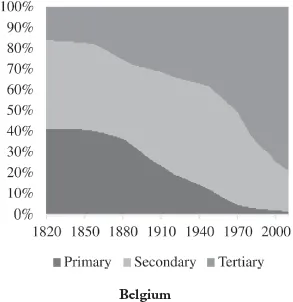
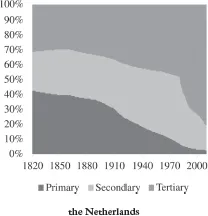
Figure 3.1 Employment in Belgium and the Netherlands, by sector (1820–2010)
Source: For Belgium, we used the censuses of Population of 1846–1991, supplemented with the labour structure in 1819 as estimated by Buyst (forthcoming) and the statistics of the RSZ and RSVZ for 2000 and 2010. For the Netherlands, we used the Centraal Bureau voor Statistiek (CBS) statistics (2001) and the LISA dataset.
Although these national patterns of industrialization have been thoroughly studied, this is far less the case for the regional dimension (e.g. De Brabander 1983, 1984). Yet, starting in the 1980s, scholars started stressing that the rate and timing of industrialization not only differed between countries, but even more across regions within the same country. For instance, O’Brien (1986: 297) argued that “industrialization […] was a regional and not a national process”, and Sidney Pollard (1981: VII) noted that “this [industrialization] process is essentially one of regions”. Subsequently, since the late 1990s, spatial patterns have increasingly come to the forefront in studies on industrialization (e.g. Kim 1995; Crafts and Mulatu 2005; Missiaia 2019). Notwithstanding this change in the international research agenda, a systematic account of the location of industry throughout the nineteenth and twentieth centuries has been lacking for the Low Countries. Nonetheless, anecdotal evidence about the relevance of these regional processes exists. In Belgium, the social and political alienation between the northern Dutch-speaking and southern French-speaking populations poses an important friction in the country. Similarly, in the Netherlands, the view that the Dutch western regions, or Randstad, benefit disproportionally from political attention is a popular and longstanding belief.
Therefore, in this chapter, we explore the regional dimension behind the industrialization process in both countries. For a long time, such an exploration was hindered by the absence of a standardized dataset. Therefore, we draw upon a recently constructed dataset by Philips (2020), which allows us to reconstruct the location of industrial activities ...
Table of contents
- Cover
- Half Title
- Series
- Title
- Copyright
- Contents
- List of figures
- List of tables
- Notes on contributors
- Preface
- Introduction
- Part I Regional industrialization in Europe
- Part II Regional industrialization in Asia
- Part III Theories on regional industrialization
- Index
Trusted by 375,005 students
Access to over 1.5 million titles for a fair monthly price.
Study more efficiently using our study tools.
Frequently asked questions
Yes, you can cancel anytime from the Subscription tab in your account settings on the Perlego website. Your subscription will stay active until the end of your current billing period. Learn how to cancel your subscription
No, books cannot be downloaded as external files, such as PDFs, for use outside of Perlego. However, you can download books within the Perlego app for offline reading on mobile or tablet. Learn how to download books offline
Perlego offers two plans: Essential and Complete
- Essential is ideal for learners and professionals who enjoy exploring a wide range of subjects. Access the Essential Library with 800,000+ trusted titles and best-sellers across business, personal growth, and the humanities. Includes unlimited reading time and Standard Read Aloud voice.
- Complete: Perfect for advanced learners and researchers needing full, unrestricted access. Unlock 1.5M+ books across hundreds of subjects, including academic and specialized titles. The Complete Plan also includes advanced features like Premium Read Aloud and Research Assistant.
We are an online textbook subscription service, where you can get access to an entire online library for less than the price of a single book per month. With over 1.5 million books across 990+ topics, we’ve got you covered! Learn about our mission
Look out for the read-aloud symbol on your next book to see if you can listen to it. The read-aloud tool reads text aloud for you, highlighting the text as it is being read. You can pause it, speed it up and slow it down. Learn more about Read Aloud
Yes! You can use the Perlego app on both iOS and Android devices to read anytime, anywhere — even offline. Perfect for commutes or when you’re on the go.
Please note we cannot support devices running on iOS 13 and Android 7 or earlier. Learn more about using the app
Please note we cannot support devices running on iOS 13 and Android 7 or earlier. Learn more about using the app
Yes, you can access An Economic History of Regional Industrialization by Bas van Leeuwen, Robin C.M. Philips, Erik Buyst, Bas van Leeuwen,Robin C.M. Philips,Erik Buyst in PDF and/or ePUB format, as well as other popular books in Business & Management. We have over 1.5 million books available in our catalogue for you to explore.