Industry 4.0 โ€“ Shaping The Future of The Digital World
eBook - ePub

Industry 4.0 โ€“ Shaping The Future of The Digital World

Proceedings of the 2nd International Conference on Sustainable Smart Manufacturing (S2M 2019), 9โ€“11 April 2019, Manchester, UK

  1. 356 pages
  2. English
  3. ePUB (mobile friendly)
  4. Available on iOS & Android
eBook - ePub

Industry 4.0 โ€“ Shaping The Future of The Digital World

Proceedings of the 2nd International Conference on Sustainable Smart Manufacturing (S2M 2019), 9โ€“11 April 2019, Manchester, UK

About this book

The City of Manchester, once the birthplace of the 1st Industrial Revolution, is today a pioneering hub of the 4th Industrial Revolution (Industry 4.0), offering Industry 4.0 solutions in advanced materials, engineering, healthcare and social sciences. Indeed, the creation of some of the city's greatest academic institutions was a direct outcome of the industrial revolution, so it was something of a homecoming that the Sustainable Smart Manufacturing (S2M) Conference was hosted by The University of Manchester in 2019.

The conference was jointly organised by The University of Manchester, The University of Lisbon and The Polytechnic of Leiria โ€“ the latter two bringing in a wealth of expertise in how Industry 4.0 manifests itself in the context of sustainably evolving, deeply-rooted cities.

S2M-2019 instigated the development of 61 papers selected for publication in this book on areas of Smart Manufacturing, Additive Manufacturing and Virtual Prototyping, Materials for Healthcare Applications and Circular Economy, Design Education, and Urban Spaces.
Frequently asked questions

Yes, you can cancel anytime from the Subscription tab in your account settings on the Perlego website. Your subscription will stay active until the end of your current billing period. Learn how to cancel your subscription.
No, books cannot be downloaded as external files, such as PDFs, for use outside of Perlego. However, you can download books within the Perlego app for offline reading on mobile or tablet. Learn more here.
Perlego offers two plans: Essential and Complete
  • Essential is ideal for learners and professionals who enjoy exploring a wide range of subjects. Access the Essential Library with 800,000+ trusted titles and best-sellers across business, personal growth, and the humanities. Includes unlimited reading time and Standard Read Aloud voice.
  • Complete: Perfect for advanced learners and researchers needing full, unrestricted access. Unlock 1.4M+ books across hundreds of subjects, including academic and specialized titles. The Complete Plan also includes advanced features like Premium Read Aloud and Research Assistant.
Both plans are available with monthly, semester, or annual billing cycles.
We are an online textbook subscription service, where you can get access to an entire online library for less than the price of a single book per month. With over 1 million books across 1000+ topics, weโ€™ve got you covered! Learn more here.
Look out for the read-aloud symbol on your next book to see if you can listen to it. The read-aloud tool reads text aloud for you, highlighting the text as it is being read. You can pause it, speed it up and slow it down. Learn more here.
Yes! You can use the Perlego app on both iOS or Android devices to read anytime, anywhere โ€” even offline. Perfect for commutes or when youโ€™re on the go.
Please note we cannot support devices running on iOS 13 and Android 7 or earlier. Learn more about using the app.
Yes, you can access Industry 4.0 โ€“ Shaping The Future of The Digital World by Paulo Jorge da Silva Bartolo,Fernando Moreira da Silva,Shaden Jaradat,Helena Bartolo in PDF and/or ePUB format, as well as other popular books in Technology & Engineering & Manufacturing. We have over one million books available in our catalogue for you to explore.

Additive manufacturing and virtual prototyping

3D printing for sustainable construction

Y.W.D. Tay, B.N. Panda, G.H.A. Ting, N.M.N. Ahamed, M.J. Tan & C.K. Chua
Singapore Centre for 3D Printing (SC3DP), School of Mechanical and Aerospace Engineering, Nanyang Technological University (NTU), Singapore
ABSTRACT: Sustainability is interpreted as the effective use of resources as well as the preservation of the environment. A sustainable building is giving back to the environment more than it takes and ensuring that the resources is being used in an effective way that would benefit the community. A combination of smart design, efficient technology and designing buildings with sustainability in mind from the start of the designing phase is therefore necessary. 3D concrete printing can be a sustainable solution because of its ability to manufacture complex shapes to enable passive design thus reducing energy consumption. This article presents an overview on the sustainability of 3D concrete printing in terms of printable green materials as well as sustainable architectural design to achieve passive system.

1 INTRODUCTION

3D concrete printing, also known as additive manufacturing in the building industry, is expected to be a true game-changer in Industry 4.0. The potential of this technology when it reaches maturity can revolutionize the construction market and make major changes such as shorter building time, cheaper construction, freedom of shape and integration of functionality (Kothman & Faber 2016). In addition, the correct use of green materials and selection of sustainable complex architectural design can amplify the sustainability of this technology. s

1.1 3D concrete printing and printable material

3D concrete printing has two main different techniques to create complex structure: Binder jetting and material deposition method (Tay et al. 2019a). Both of these methods create a complex structure by adding small layers of material over the previous layer. However, the latter technique seems to be more favourable in the field of research in terms of publication (Tay et al. 2019a). Its paradoxical rheological property is one of the challenges to be addressed before successful printing can be possible.
The rheological performance of a printable concrete material is different from the conventional casted material. For material to be printable, it has to be flowable so that it can be delivered to the nozzle by a pump (Roussel 2018). Furthermore, after extrusion, it has to be stiff enough to hold its shape and the weight of the subsequent layers (Tay et al. 2019a). Whereas, in the conventional casting technique, the formwork will hold the fresh concrete in place. Lastly, the interlayer bonding between the layers, which is a distinct feature compared with conventional casted concrete, should be strong enough to sustain the structures. These interfaces between layers tend to be the weakness of the whole structure (Tay et al. 2019b).

1.2 Sustainable construction

Sustainable construction is the aim to meet present-day needs for infrastructure, housing and working environments without compromising the ability of future generations to meet their own needs in times to come. This means ensuring that resources are being used in an efficient way that would benefit the community and the world.
Several sustainable materials that have a low carbon footprint can be used for 3D printing. Fly ash, geopolymer and recycled glass are some of the green material that has been used by the industry (Panda et al. 2018). Although these sustainable materials have been used in conventional casting methods, the rheological behaviour for printing is different. The mixtures have to be tailored to this new manufacturing process for printing to be successful. Apart from printing sustainable materials, printing passive design maximizes the potential of 3D printing to create comfortable space for the users. A passive system is a combination of energy-efficient design to take advantage of the climate to maintain the comfort level in an infrastructure. Such an approach reduces energy consumption during operation. However, the passive design has to be implemented during the design phase.
Sustainable construction is a broad term and can involve different types of issues (Tan et al. 2011). The focus of this paper is the sustainability of 3D concrete printing in terms of construction material and architectural design to improve the way people build and live in the building sector.

2 SUSTAINABLE PRINTABLE MATERIALS

The materials presented below are the green materials currently under research at SC3DP, NTU, Singapore. The usage of these materials is considered sustainable since dumping to a landfill will cause a negative environmental impact. These researches revolve around investigating a suitable mixture ratio to fulfil the required behaviour for printing.

2.1 High volume fly ash concrete

Fly ash-based materials are one of the possible alternatives for printing sustainable concrete structures. Fly ash is a by-product from the coal industry and is considered as a waste product. It contains some toxic metals that will degrade the soil and will cause air pollution. As such, a research carried out SC3DP, NTU offers suitable high-volume fly ash based formulation for 3D printing application which can reduce the environmental impact instead of disposing them to an open environment (Panda et al. 2018). Hence, a high volume of fly ash was incorporated in the formulation and it was found to improve long term strength performance of the building materials.
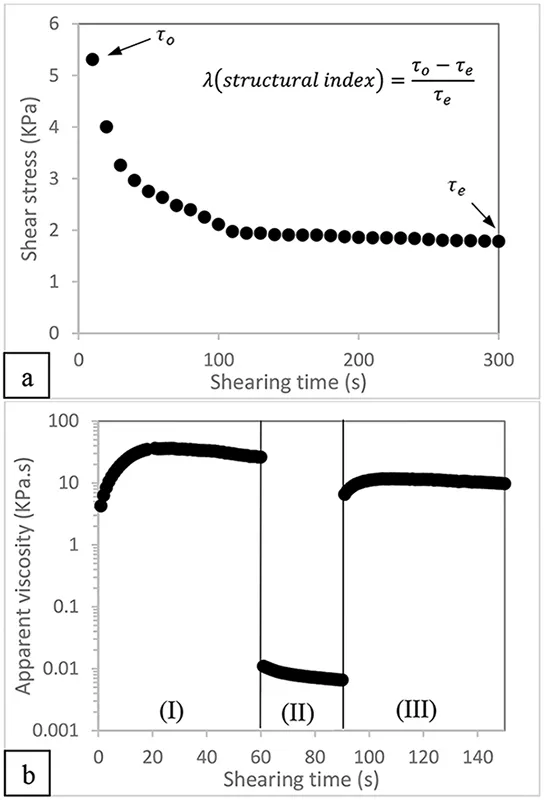
The rheological properties of the printable material in its fresh state is crucial. High thixotropy behaviour allows the material to become less viscous when stress is applied and allow it to return to its more viscous state when at rest. It can be measured in terms of structural breakdown and recovery. A shear-thinning protocol was used to calculate a structural index, ฮป, by shearing the mortar at 300 s-1 for 300 seconds. In general, the higher the ฮป, the higher the thixotropy. The result is shown in Figure 1a. It can be seen that the structural index of the material increased with resting time. This phenomenon was linked to both the physical interaction of the particles and the hardening process (Panda et al. 2019).
Figure 1. Thixotropy behaviour of 3D printed concrete (a) structural breakdown (b) structural recovery.
Additionally, the viscosity recovery was measured to investigate the fresh property of the mortar after the extrusion process. If the original viscosity of the initially deposited layer has not recovered before the deposition of the second layer, it may cause deformation in the printed structure. the protocol for this second test is as follows: (i) 0.01s-1 for 60 seconds; (ii) 300s-1 for 30 seconds and; (iii) 0.01s-1 for 60 seconds. These three different intervals correspond to the material state (i) initially at rest; (ii) extrusion and (iii) at rest after extrusion. The result is shown in Figure 1b. Almost 80% of fly ash was utilized to formulate the mix design that exhibits excellent thixotropic behaviour and achieving 35Mpa mechanical compressive strength, which is suitable for non-structural application (Biranchi Panda et al. 2019).
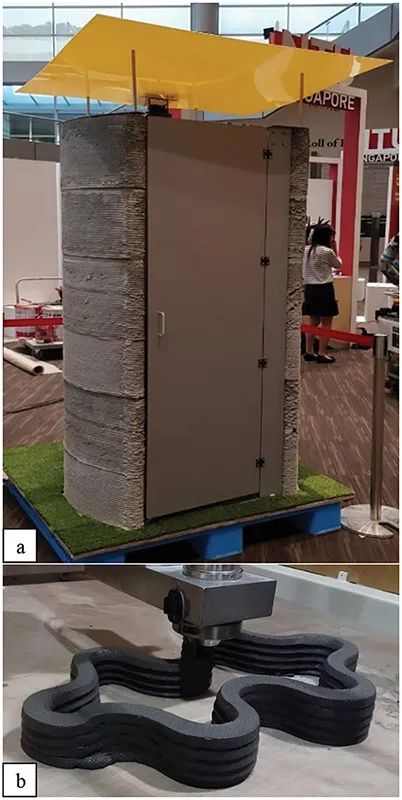
Furthermore, this mixture is used to print a modular toilet shown in Figure 2a. The toilet was printed in three parts and later assembled on site. Comparing to the conventional method of creating concrete structures, 3D concrete printing can save the material wastage, production time, cost and ultimately fetch sustainability in our built environment.
Figure 2. (a) 3D printing of modular toilet with high volume fly ash at SC3DP, NTU. (b) 3D printing of geopolymer.

2.2 Geopolymers

3D printing with high volume fly ash is a challenge as the strength development in an early age is not quick enough to support subsequent layers. To avoid this problem, fly ash was activated with an alkali solution according to geopolymerization mechanism. Figure 2b shows an example 3D printing o...

Table of contents

  1. Cover
  2. Half Title
  3. Title Page
  4. Copyright Page
  5. Table of Contents
  6. Preface
  7. Committee members
  8. Keynote speaker
  9. International scientific committee
  10. Smart manufacturing
  11. Additive manufacturing and virtual prototyping
  12. Materials for healthcare applications and circular economy
  13. Design education
  14. Urban spaces
  15. Author Index