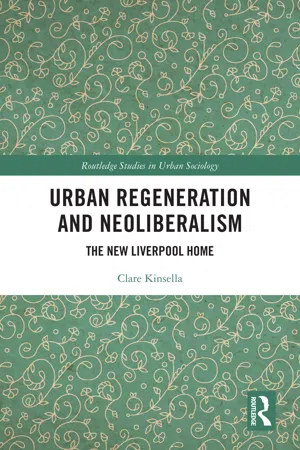
This book explores the concept of 'home' in Liverpool over phases of 'regeneration' following the Second World War. Using qualitative research in the oral history tradition, it explores what the author conceptualises as 'forward-facing' regeneration in the period up to the 1980s, and neoliberal regeneration interventions that 'prioritise the past' from the 1980s to the present. The author examines how the shift towards city centre-focused redevelopment and 'event-led' initiatives has implications for the way residents make sense of their conceptualisations of 'home', and demonstrates how the shift in regeneration focus, discourse, and practice, away from Liverpool's neighbourhood districts and towards the city centre, has produced changes in the ways that residents identify with neighbourhoods and the city centre, with prominence being given to the latter. Employing Pierre Bourdieu's concepts of habitus and field as mechanisms for understanding different senses of home and shifts from localised views to globalised views, this book will appeal to those with interests in urban sociology, regeneration, geography, sociology, home cultures, and cities.
- 228 pages
- English
- ePUB (mobile friendly)
- Available on iOS & Android
eBook - ePub
About this book
Information
1 Introduction
Regeneration and the making of home in Liverpool
The city of Liverpool is currently enjoying a phase of prosperity and good fortune: A period of renaissance characterised by renewal, prosperity, and success. The 2003 announcement that Liverpool had secured the accolade of European Capital of Culture (ECOC) for 2008 was, for many, confirmation that the city had turned a corner; the bad old days of industrial decline and its various associated problems, and the negative reputations that accompanied them, were well and truly in the past. Contemporarily, Liverpool presents itself as a city on the up – the city centre has been ‘made over’ as a retail, culture, and leisure hub (Kinsella, 2011) and the city region attracts over 60 million visitors per year, creating a revenue in excess of £4 billion1 (North West Research, 2019).
The post-ECOC ‘bounce’ continues, with plans afoot to further develop the waterfront to the north of the city centre, including a new stadium for Everton Football Club at the site of the old Bramley Moore Dock (Liverpool Waters, 2019), and the creation of new, or the resurrection of defunct, railway lines and stations throughout the area (Murphy, 2016). Liverpool is earmarked to benefit from the so-called ‘Northern powerhouse’ (Parr, 2017), whereby Liverpool and Leeds would mark the outer reaches of a mega city to rival London, incorporating Manchester and having its centre at Hebden Bridge (Davis, 2014). Further, after a 27-year battle, survivors and relatives of the 96 people who died at the Hillsborough disaster in 1989 have finally been rewarded for their efforts with the vindication of the Liverpool fans and the verdict that the victims were unlawfully killed as a result of various police errors (Conn, 2016).
However, just as a coin has two sides, Liverpool has two distinct and opposing images – the face of prosperity, looking outwards towards the rest of the world, and another face, hidden and obscured by the first, which reveals the new, prosperous Liverpool to be a fiction when all factors are considered. Although levels of multiple deprivation in the Liverpool area have gradually been improving since 2004, both Liverpool and nearby Knowsley remain in the top four most deprived local authority areas in England (Ministry of Housing, Communities and Local Government, 2019). Violent crime and, specifically, gun crime, persists as a feature of Liverpool’s gang culture and ‘county lines’2 drug markets (Thomas, 2019; McLean et al., 2020), and past events, from political militancy to child criminality, continue to cast a long shadow (Boland, 2008; Furmedge, 2008; Taylor, 2010; Kinsella, 2011; Kelly, 2015; Platt, 2016; Butler, 2020).
New destabilising processes continue to emerge and jeopardise ‘new’ Liverpool’s prosperity, and the status, well-being, and opportunities of people for whom Liverpool is home. The UNESCO3 world heritage status, ascribed to the “Maritime mercantile city” (Gaillard and Rodwell, 2015, p24) of Liverpool in 2004, has been under threat since 2006 due to the World Heritage Committee’s “serious concerns” (ibid.) about new buildings erected at the Pier Head deemed unsympathetic to the existing skyline. Only in June 2019, UNESCO requested a moratorium on further large-scale development, threatening that Liverpool “could lose its highly prized heritage status if it fails to comply” (Kirby, 2019). Meanwhile, housing in Liverpool is “in crisis” (Parry, 2016) as “only one new home is being built for every EIGHT new arrivals in Liverpool” (ibid., emphasis in original), yet there are currently thousands of empty properties in the Liverpool area (Liverpool City Council, 2016), most of which are in populated and settled streets, though in some cases entire streets have been empty for several years (Foster, 2016). The emergence of the ‘gig economy’ based on the rise of the zero hours contract (Standing, 2011; Getting By?, 2015; Snider, 2018; Koumenta and Williams, 2019), together with restrictions on mortgage provision since the global financial crash of 2007/2008 (Scanlon et al., 2011) mean that securing a home in Liverpool is becoming increasingly more difficult. Already high rentals increase every six months as properties are revalued, tenancies are short, and landlords can be everything from absent and disinterested to deceitful and criminal (Cosslett, 2015; Getting By?, 2015; Paton and Cooper, 2017).
This book is about Liverpool and home. More specifically, the book focuses on the experiences of home within the Liverpool setting, and how they have been moulded by the changing fortunes of the city, particularly in relation to the various regenerative processes that Liverpool and its people have been exposed to. After the Second World War, much of the built environment in Liverpool has been subject to some form of regeneration, whether as a result of ‘slum’4 clearance, road system restructuring, or more nebulous processes such as renaming or repackaging of an area or phenomenon in a bid to change attitudes and/or image (Leeson, 1970; Muchnick, 1970; Broomfield, 1971; Topping and Smith, 1977; Wilson and Womersley, 1977; Pooley and Irish, 1984; Hayes, 1987; Couch, 2003; Balderstone et al., 2014). Contemporarily, regeneration initiatives in Liverpool, conceived very much in the fading glow of ECOC 2008, have undergone a shift away from physical regeneration of the city towards attempts to regenerate the city’s image, reputation, and standing in comparison to other cities. Recent trends have been towards a cultural revival of the city, with an emphasis on Liverpool’s maritime heritage and the many historic buildings in the area, particularly in the city centre. Put very simply, the main thrust of the argument presented is that changes in regeneration emphasis over time, moving from a focus on the districts – inner areas to overspill estates and new towns – to a focus on the city centre (documented by Coleman, 2004) and, most specifically, the waterfront, have led Liverpool people to conceptualise ‘their’ Liverpool home in the contemporary context as synonymous with the city centre rather than the districts where they live, or used to live.
Thinking about home
Home at first sight appears as a very straightforward concept; everyone knows what a home is, and everybody knows what having a home means. Yet home as a concept is deceptive; its surface simplicity hides a very deep and complex abstraction, which is multi-layered, multi-faceted, and interpreted in different ways contingent on a range of factors including time, place, epoch, culture, geographical setting, privacy, and power relations. In short, home is a social construction – an abstract idea rather than a uniform concept which manifests itself in the same way at all times (Tuan, 1977; Dovey, 1985; Rybczynski, 1986; Wright, 1991; Somerville, 1992; Massey, 1994a, 1994b; Wood and Beck, 1994; Waghorn, 2009). Born from the human need for both shelter and roots, home is variously understood to mean a place to ‘be’, that is, a place where one can ‘house’ their human existence (Rykwert, 1991; Kearon and Leach, 2000), belonging (Windsong, 2010), acceptance (Kidd and Evans, 2011), security (Despres, 1991; Waghorn, 2009), memories (Dovey, 1985), and rules (Douglas, 1991; Morley, 2000). However, it is important to recognise that home operates on different levels – home can mean the dwelling within which one lives; equally, though, it can mean the immediate environs or neighbourhood surrounding one’s dwelling, hometown, or home nation (Hayward, 1977; Morley, 2000; Lewicka, 2005, 2010; Manturuk et al., 2010; Mac an Ghaill and Haywood, 2011). Depending on a range of variables, home can connote feelings of both ‘having space’ and ‘being placed’, and be representative of freedom, imprisonment, or both (Morley, 2000; Mallett, 2004; Waghorn, 2009).
This book takes the concept of home and locates it within a Liverpool context. All aspects of home in Liverpool, whether related to dwelling, neighbourhood or hometown, feelings, experiences or memories, have been touched by regeneration initiatives and processes in one way or another. Some people for whom Liverpool is home have experienced significant impact on their versions of home via these processes; others meanwhile experience them in a more abstract and opaque way. From an exploration of the literature on home as a concept, and the literature on Liverpool’s sometimes tumultuous relationship with regeneration, I have been able to conceptualise ‘regenerating Liverpool’ into two distinct, yet overlapping, eras. The first identifiable era, from the end of the Second World War to the late 1970s/early 1980s, I have termed the ‘forward-facing era’; a period when regeneration focused on the future, based on the belief that Liverpool would continue to develop and prosper and, consequently, needed to be ‘modernised’ to cope with the demands of an increasing population, a strong workforce, and a buoyant, flourishing economy. The second identifiable period I have termed the ‘backward-facing era’; emerging towards the end of the 1970s, a disastrous decade for the city, this era represents an about face in terms of understandings of where prosperity lies for Liverpool, and a 180-degree change of direction from prosperity based on an insecure, uncertain future, to prosperity based on the city’s past – its history, heritage, and status as maritime city of empire.
To summarise: The post-war period up until the late 1970s/early 1980s I have characterised as forward facing, due to its optimism and focus on the future; the period from the late 1970s/early 1980s I have characterised as backward facing, due to its prioritisation of the past. Thus, regeneration initiatives during the first era are understood to be anticipating a future whereby Liverpool remains on the same trajectory as it always has been – pushing forward and modernising to create a city ready for the 21st century. Regeneration initiatives during the backward-facing era, however, abandon the existing trajectory because of continued setbacks and false dawns, and adopt a new trajectory which relies heavily on the certainties of the past as a resource which can be continually mined for prosperity-creating history, legacy, heritage, and culture.
The volte-face from focus on the future to prioritisation of the past arguably emerged with the restoration of the derelict, historic Albert Dock, kick-started by the attentions of the ‘Minister for Merseyside’, Michael Heseltine, in the early 1980s (Crick, 1997; Couch, 2003; Avery, 2007; Taylor, 2010). Contemporarily, though, backward-facing regeneration manifests itself predominantly as event-led regeneration, which relies on the premise that ‘mega-events’ like, for example, the London Oly...
Table of contents
- Cover
- Half-Title
- Series
- Title
- Copyright
- Dedication
- Contents
- Acknowledgements
- 1 Introduction: Regeneration and the making of home in Liverpool
- 2 The meaning(s) of home
- 3 Introducing Liverpool and the Liverpool home
- 4 1950s and 1960s regeneration: Obliterating obsolescence and building a Liverpool for the future
- 5 Back in time for the future: ‘Backward-facing’ regeneration in Liverpool from 1980
- 6 The Liverpool home in the ‘forward-facing’ era
- 7 The Liverpool home in the ‘backward-facing’ era
- 8 Pierre Bourdieu, habitus, and the ‘new’ Liverpool home
- 9 Conclusion
- Pen Pen portraits
- Index
Trusted by 375,005 students
Access to over 1.5 million titles for a fair monthly price.
Study more efficiently using our study tools.
Frequently asked questions
Yes, you can cancel anytime from the Subscription tab in your account settings on the Perlego website. Your subscription will stay active until the end of your current billing period. Learn how to cancel your subscription
No, books cannot be downloaded as external files, such as PDFs, for use outside of Perlego. However, you can download books within the Perlego app for offline reading on mobile or tablet. Learn how to download books offline
Perlego offers two plans: Essential and Complete
- Essential is ideal for learners and professionals who enjoy exploring a wide range of subjects. Access the Essential Library with 800,000+ trusted titles and best-sellers across business, personal growth, and the humanities. Includes unlimited reading time and Standard Read Aloud voice.
- Complete: Perfect for advanced learners and researchers needing full, unrestricted access. Unlock 1.5M+ books across hundreds of subjects, including academic and specialized titles. The Complete Plan also includes advanced features like Premium Read Aloud and Research Assistant.
We are an online textbook subscription service, where you can get access to an entire online library for less than the price of a single book per month. With over 1.5 million books across 990+ topics, we’ve got you covered! Learn about our mission
Look out for the read-aloud symbol on your next book to see if you can listen to it. The read-aloud tool reads text aloud for you, highlighting the text as it is being read. You can pause it, speed it up and slow it down. Learn more about Read Aloud
Yes! You can use the Perlego app on both iOS and Android devices to read anytime, anywhere — even offline. Perfect for commutes or when you’re on the go.
Please note we cannot support devices running on iOS 13 and Android 7 or earlier. Learn more about using the app
Please note we cannot support devices running on iOS 13 and Android 7 or earlier. Learn more about using the app
Yes, you can access Urban Regeneration and Neoliberalism by Clare Kinsella in PDF and/or ePUB format, as well as other popular books in Politics & International Relations & Conservatism & Liberalism. We have over 1.5 million books available in our catalogue for you to explore.