This volume re-examines traditional interpretations of the rise of modern aesthetics in eighteenth-century Britain and Germany. It provides a new account that connects aesthetic experience with morality, science, and political society. In doing so, it challenges long-standing teleological narratives that emphasize disinterestedness and the separation of aesthetics from moral, cognitive, and political interests.
The chapters are divided into three thematic parts. The chapters in Part I demonstrate the heteronomy of eighteenth-century British aesthetics. They chart the evolution of aesthetic concepts and discuss the ethical and political significance of the aesthetic theories of several key figures: namely, the third Earl of Shaftesbury, David Hume, and Adam Smith. Part II explores the ways in which eighteenth-century German, and German-oriented, thinkers examine aesthetic experience and moral concerns, and relate to the work of their British counterparts. The chapters here cover the work of Kant, Moses Mendelssohn, Alexander Gottlieb Baumgarten, and Madame de Staël. Finally, Part III explores the interrelation of science, aesthetics, and a new model of society in the work of Goethe, Johann Wilhelm Ritter, Friedrich Hölderlin, and William Hazlitt, among others.
This volume develops unique discussions of the rise of aesthetic autonomy in the eighteenth century. In bringing together well-known scholars working on British and German eighteenth-century aesthetics, philosophy, and literature, it will appeal to scholars and advanced students in a range of disciplines who are interested in this topic.
The Introduction and Chapters 2, 10, and 12 of this book are freely available as downloadable Open Access PDFs at http://www.taylorfrancis.com under a Creative Commons Attribution-Non Commercial-No Derivatives (CC-BY-NC-ND) 4.0 license.
Aesthetic Concepts, Morality, and Society in the British Tradition
1 The Evolution of Aesthetic Concepts 1700–1800
Peter de Bolla
It has long been held that the term “aesthetics” in its modern sense first came into widespread use during the eighteenth century.1 Sometimes, a more problematic claim is also made: namely, that the concept of the aesthetic was invented during this century. Caveats are often entered here as to the natural language context in which such an invention is taken to have occurred or the distinctions between, say, classical understanding of beauty and its connections (or misconnections) to the Enlightenment, but I shall leave the question of origin or precursors to one side in the following chapter.2 I shall also park to one side the question regarding the use of the word “concept” and simply assume that readers of this contribution will find no problem with the proposition that there are “aesthetic concepts,” and the terms we often find in eighteenth-century treatises that deal with what is taken to be “aesthetics,” such as “beauty”; “harmony”; and, for the purposes of the following, most significantly, “sublime,” are indeed the labels for some of these concepts.3 The aim of this chapter is to explore the ways in which the affordances of digital scholarship may help us understand the changes in use and conceptual structure that occurred over the course of the English-language eighteenth century to aesthetic concepts.
The restriction to the English language is based on the fact that the digital resource I will interrogate extensively is Eighteenth Century Collections Online (ECCO). Comprising some 180,000 titles, 200,000 volumes, and more than 33 million pages of text, ECCO is well-known as the world’s largest digital archive of books from the eighteenth century, containing “every significant English-language and foreign-language title printed in the United Kingdom between the years 1701 and 1800.”4 Unsurprisingly, the number of non-English language texts in this dataset is too small to accurately reflect lexical behavior in, say, French or German during the period; for this reason, inter-lingual comparisons cannot be constructed using this resource. The tools I will utilize for the following have been developed specifically for the purpose of ascertaining the structure of conceptual forms from the distribution of lexis in massive datasets of language use, and they are available in the Cambridge University Library. This form of analysis is called “distributional concept analysis,” and its protocols and methods have been set out in a paper already published.5 For the present purposes, it is enough to register that the scope and reach of this kind of analysis enables us to discern what, heretofore and without the computational tools developed by the Cambridge Concept Lab, has been impossible to grasp: the precise changing lexical environments in which terms operated over time.
Within work on the history of concepts, these environments are sometimes called “semantic fields” since they comprise the most strongly associated lexis with any search query (say, the term “sublime”), thereby enabling us to capture the immediate contexts (determined by variable widths or windows of proximate terms) in which words operate.6 The following account, however, is less interested in local semantic drift since it exploits the graphical interface designed by the Cambridge Concept Lab in order to plot the moving elements and structures within these environments. These structures might be thought of as the underlying architecture of a conceptual constellation, which is to note that the following enquiry seeks to expose and explore the constellations of lexis within which aesthetic terms operated and their alterations over time. One can think of them as snapshots of linked or associated lexis which provide us with transverse sections of the larger semantic field (one might model this analogously to the sectioning of organic matter, say, a very thin slice through the complex tissue of the human brain). In the following, I will direct attention to the shapes and structures of these sections as well as to the semantic indices that populate them. It is these alterations in what below are called “network plots,” and, within them, communities of associated concepts that, for the first time, trace the evolution of aesthetic concepts across the anglophone eighteenth century by reading the total archive computationally.
Developing Data from Raw Frequency
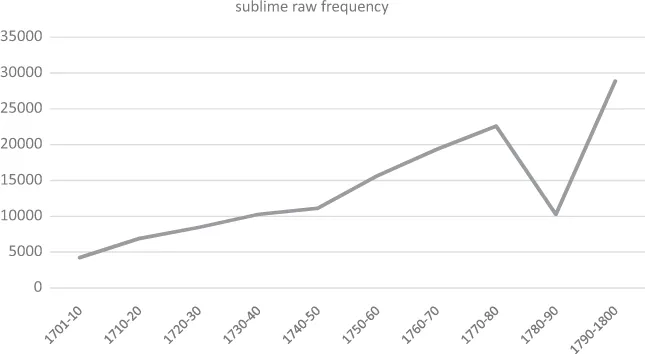
I shall begin very simply by tracking some elementary data on the frequency of specific terms. Starting here is useful because it highlights the fact that the more complex statistical operations which feed into the graphical interpretation of the data developed within the Concept Lab tools are based upon the identification of patterns and frequencies of lexical use. The following graph, then, captures quite simply the raw frequency of the term “sublime” during the eighteenth century (Figure 1.1).
Figure 1.1 Sublime raw frequency.
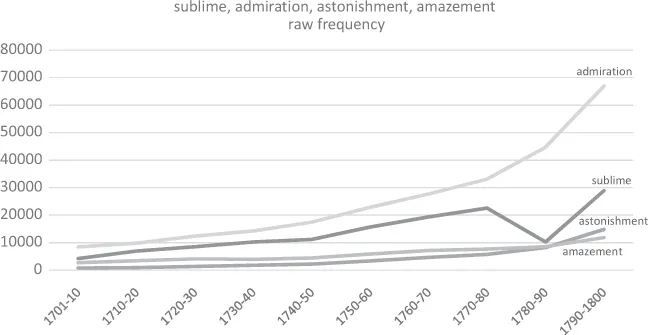
The first most notable aspect of this trend, the sharp decline in usage from 1780 to 1790, cannot be explained by something as simple as an overall fall in the number of printed texts since the total number of texts in the ECCO dataset for the decade 1770–1780 is 26,637, compared to the 31,621 for the following decade. For the moment, I will leave this hanging. This raw frequency of usage can be compared with some other related terms (Figure 1.2).
Figure 1.2 Sublime, admiration, astonishment, amazement raw frequency.
Here, one can see that the aberrant decline in frequency of the term “sublime” over the decade 1780–1790 is confirmed, and one can note that “admiration” was used much more frequently than “sublime” by the end of the century. The relevance of the selection of this comparison will become clear below.
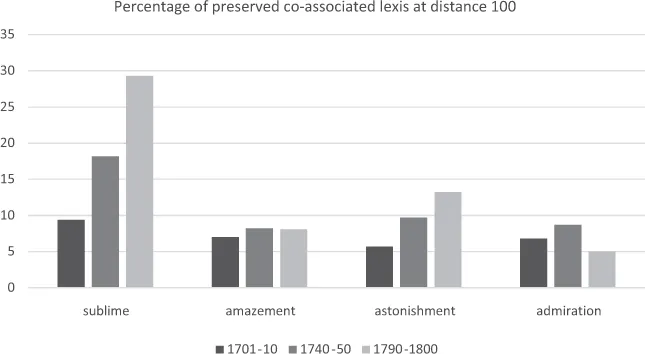
One of the measures developed by the Concept Lab assesses the extent to which co-associated terms “stick” to the search query as a window of proximity lengthens. In the following analyses, the width of the window moves from five words away to one hundred words away, both before and after the query (a so-called “donut” plot). The “stickiness” of a particular term gives us an indication of the closed or open behavior of a term: where the lexis is preserved as the proximity window increases, such “stickiness” indicates that a term operates in a very stable lexical environment, essentially keeping company with the same co-associates as the window widens. The purpose in gathering data on co-association by moving from close up (five words away) to far away (one hundred words away) is to dampen the strong binding that we expect to find in close proximity on account of grammar or syntax. The aim, then, is to capture data that might help us build a picture of a conceptual architecture that wears the word-concept imbrication lightly.7 This measure of “stickiness” can also be inspected diachronically, as shown in the above bar chart (Figure 1.3), comparing the same terms as earlier.
Figure 1.3 Percentage of preserved co-associated lexis at distance 100.
Here is the first evidence of a distinctive shape to the concept of the sublime over the course of the century: its “stickiness” significantly increases through the last decade of the century, to a considerably larger extent than these comparator concepts. It can also be noted that over the course of the century, the stickiness of “admiration” declines—the only one of these four to do so. Comparing these stickiness profiles indicates that over the course of the century, the concept of the sublime “hardens”; put differently, it develops a very pronounced coherence as, over time, it becomes less likely to find company with new and different lexis. The opposite is true of “admiration”: as the window increases out to one hundred words away, we find it keeping company with a random collection of terms from the natural language English.
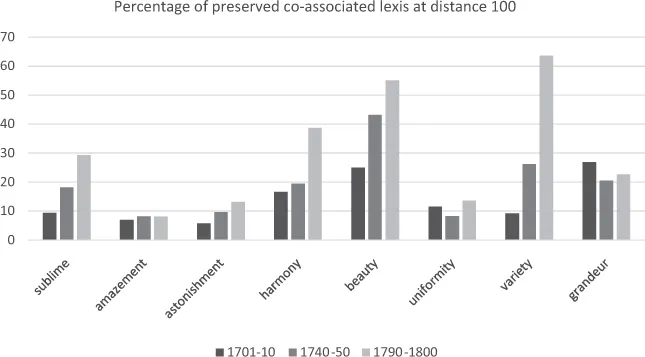
This “stickiness” data can be obtained for a number of other aesthetic terms in order to begin to determine how unusual this shape or structure might be. The chart in Figure 1.4 presents a comparative set.
Figure 1.4 Percentage of preserved co-associated lexis at distance 100.
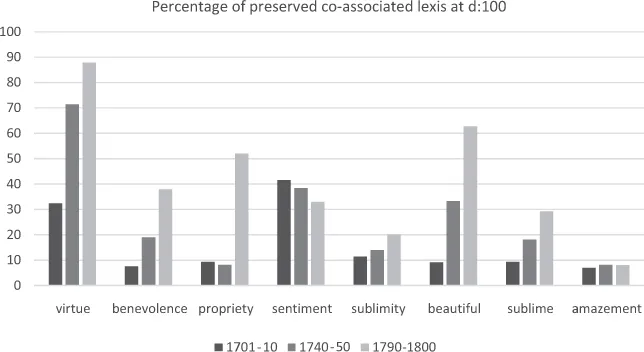
As can be seen, these concepts do not all have the same shape of evolution: “grandeur,” for example, a key term in the discourse on the sublime, decreases in stickiness over time.8 “Variety” has a stickiness of over 60% in the final decade of the century, twice that of “sublime.” In the next bar chart (Figure 1.5), the relative “hardness” of exemplary aesthetic concepts in comparison to moral (the reasoning behind the selection of these terms will become clear below) is plotted.
Figure 1.5 Percentage of preserved co-associated lexis at d:100.
Here, one can note the significant stickiness of the concept “virtue”: by the last decade of the century, it operates in a remarkably stable and consistent lexical environment. In contrast, “amazement” has very weak stickiness as its co-associations come from a very wide range of lexis, and one can see that this profile hardly alters over the century. In the first decade of the century, the stickiness for “sublimity,” “sublime,” and “beautiful” is almost identical, but by the century’s end, “beautiful” has around twice the stickiness of “sublime” and over three times that of “sublimity.” The data is similar if we compare the nouns “sublimity” and “beauty”: “beauty” has a value of 25% of preserved lexis in the first decade, which rises to 55% in the last. These profiles begin to provide shape and structure for these exemplary concepts; they allow inspection of the diachronic features of conceptual formation and the beginnings of a comparison between aesthetic and moral concepts over the course of the eighteenth century.
Using Statistical Measures to Create Lexical Environment
The tools developed by the Concept Lab enable us to calculate the relative likelihood of one term co-associating with any other in the dataset at varying distances from the search query, having taken into account the raw frequency of all terms (in other words, discounting the fact that very frequent terms ...
Table of contents
Cover
Half Title
Series Page
Title Page
Copyright Page
Table of Contents
List of Contributors
Acknowledgments
Introduction
Part I Aesthetic Concepts, Morality, and Society in the British Tradition
Part II British and German Liaisons
Part III Science and a New Model of Society Around 1800
Index
Trusted by 375,005 students
Access to over 1.5 million titles for a fair monthly price.
Study more efficiently using our study tools.
Frequently asked questions
Yes, you can cancel anytime from the Subscription tab in your account settings on the Perlego website. Your subscription will stay active until the end of your current billing period. Learn how to cancel your subscription
No, books cannot be downloaded as external files, such as PDFs, for use outside of Perlego. However, you can download books within the Perlego app for offline reading on mobile or tablet. Learn how to download books offline
Perlego offers two plans: Essential and Complete
Essential is ideal for learners and professionals who enjoy exploring a wide range of subjects. Access the Essential Library with 800,000+ trusted titles and best-sellers across business, personal growth, and the humanities. Includes unlimited reading time and Standard Read Aloud voice.
Complete: Perfect for advanced learners and researchers needing full, unrestricted access. Unlock 1.5M+ books across hundreds of subjects, including academic and specialized titles. The Complete Plan also includes advanced features like Premium Read Aloud and Research Assistant.
Both plans are available with monthly, semester, or annual billing cycles.
We are an online textbook subscription service, where you can get access to an entire online library for less than the price of a single book per month. With over 1.5 million books across 990+ topics, we’ve got you covered! Learn about our mission
Look out for the read-aloud symbol on your next book to see if you can listen to it. The read-aloud tool reads text aloud for you, highlighting the text as it is being read. You can pause it, speed it up and slow it down. Learn more about Read Aloud
Yes! You can use the Perlego app on both iOS and Android devices to read anytime, anywhere — even offline. Perfect for commutes or when you’re on the go. Please note we cannot support devices running on iOS 13 and Android 7 or earlier. Learn more about using the app
Yes, you can access Beyond Autonomy in Eighteenth-Century British and German Aesthetics by Karl Axelsson,Camilla Flodin,Mattias Pirholt in PDF and/or ePUB format, as well as other popular books in Philosophy & Medieval & Early Modern Literary Criticism. We have over 1.5 million books available in our catalogue for you to explore.