- 392 pages
- English
- ePUB (mobile friendly)
- Available on iOS & Android
eBook - ePub
Near-Infrared Applications in Biotechnology
About this book
This volume explores developments in techniques in diagnostics, DNA sequencing, bioanalysis of immunoassays, and single-molecule detection. It promotes the measurement, identification, monitoring, analysis, and application of near-infrared spectroscopy (NIR) to medical and pharmaceutical advances. The text also considers noninvasive methods of NIR for successful, cost-effective, and prompt diagnoses of diseases.
Information
1
Introduction
Ramesh Raghavachari*
Promega Corporation, Madison, Wisconsin
Promega Corporation, Madison, Wisconsin
I. DEFINITION OF NEAR INFRARED
The ultraviolet and visible spans of the electromagnetic spectrum have been the wavelengths most often utilized for bioanalytical techniques for the past several decades. Wavelengths from 190 to 650 nm are those that most biomolecules absorb and fluoresce. The region beyond 650 nm has more recently captured the attention of many pioneers in the field of bioanalytical applications. This region, called the near infrared (NIR) which interfaces the visible and infrared portions of the electromagnetic spectrum, is gaining rapid importance in the area of biotechnology.
In this book we define the near-infrared as constituting wavelengths of 650-2500 nm. This region is often further divided into the deep red or far red (650-730 nm) and the near infrared (730-2500 nm). This differentiation arises from the physiology of the human eye [1-4], which has three types of visual photoreceptor cones that have different spectral responses. The response of these three types of visual cones peak at 445 nm (blue cone), 535 nm (green cone), and 570 nm (yellow cone) (Fig. 1). The combinations of the responses of these cones represent various colors that are seen by the human eye. The yellow cone response extends up to 730 nm, beyond which the human eye cannot see. In principle, the near-infrared region starts from where the human eye has no visual response. However, with wavelengths of 650 nm and higher, the response of the human eye is so low that this tail end of the visible spectrum is included as part of the near-infrared region. More often the span of wavelengths between 650 and 730 nm is called the far-red or deep red region. Some experts further divide the NIR into two ranges 650-1100 nm and 1100-2500 nm based on the different detectors that solid-state technology provides for detection in several types of instrumentation. For example, silicon avalanche diode detectors have a range from 650 to 1100 nm, and lead sulfide based detectors from 1100 to 2500 nm. Many schools of thought are represented in the literature [5-7] (see also Stoyanov, Chapter 3, this volume), suggesting various ranges starting from 650 nm where the near infrared begins and ends. For all practical purposes, this book will use this range for the near-infrared region based on both fluorescenceand absorption-related applications (Fig. 2).
* Current affiliation: Corning Microarray Technology, Corning, New York.
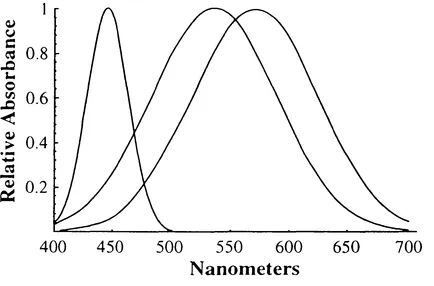
Figure 1 The wavelength response factors of the three types of visual photoreceptor cones of the human eye.
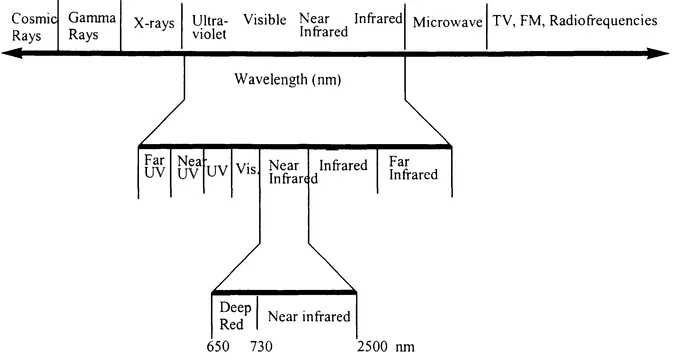
Figure 2 Position of NIR region in the electromagnetic spectrum.
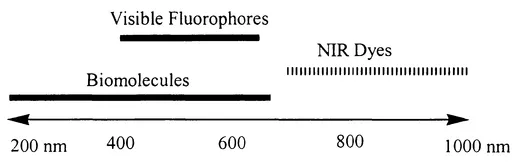
Figure 3 Absorbance and fluorescence of biomolecules in relation to visible and NIR fluorophores.
II. WHY NEAR INFRARED?
Most biological substances and impurities in bioprocesses absorb and fluoresce between 190 and 650 nm (Fig. 3). Their relative sensitivity to detect biomolecules at these wavelengths is highly reduced due to high background caused by the molecules themselves (autofluorescence) or the impurities within the ultraviolet-visible (UV-Vis) region. The near-infrared wavelength region, being away from these interferences, provides high sensitivity for detection of biomolecules and hence better signal-to-noise ratio. Large sample sizes (analytes) are required for a high background in order to maintain the accuracy and unambiguous detection level of signal to noise even if the absorptivity or quantum yields are high. In contrast, low background enables minimum sample sizes and high detectability even if the quantum yields are low [5]. The near infrared region provides these advantages. Time and again researchers have observed that many dyes absorbing and fluorescing in the near infrared do not have a high fluorescence quantum yield like their visible counterparts, especially the rhodamine and fluorescein family of dyes, which exhibit very high quantum yields. In spite of the low quantum yields, the sensitivity exhibited by near-infrared dyes is far superior to that of the visible dyes. The detectability in this region is on the order of a few molecules (about 15 atomoles, 10-18 mol), whereas the visible counterparts are 400-800-fold less sensitive despite their high quantum yields [8,9]. This consideration is based on the electronics and detector technology that are currently available for both kinds of systems.
III. ABSORPTION VS. FLUORESCENCE
This book deals with both absorption-based and fluorescence-based applications that are being explored or that are already available as technologies. Each has its advantages and disadvantages. However, it is a well-known fact that fluorescence is far more sensitive than absorption. A minimum sample for which fluorescence spectra can be measured may not be sufficient for the measurement of its absorption spectra. In almost every chapter in Part A of this book the authors express that the advantage of the near infrared is that most biological substances have minimal absorption in this region and hence greater sensitivity. In simple terms, absorption in the near-infrared is observed as overtones. Exploitation of these functions with the use of modem algorithms has made possible all the applications mentioned in Part B of this book. The fundamental principles are embedded in the chapter by Mark in Part B. This has been possible only due to the advances in both electronics and solid-state physics along with the software algorithms that are at the center of today's technology.
In dealing with the importance of both absorption-based and fluorescencebased applications in the near infrared region in biotechnology, this volume gives the reader a tip of the iceberg of this young field of science. Many areas of applications are still in the developmental phase, so not enough data are available in the public domain for their inclusion here.
REFERENCES
- 1. H Davson, ed. The Eye, Vol. 1b, Vegetative Physiology and Biochemistry. New York: Academic Press, 1984.
- 2. H Davson. Physiology of the Eye. 5th ed. New York: Pergamon Press, 1990.
- 3. http://ucrwcu.rwc.uc.edu/koehler/biophys/6d.html
- 4. http://w3.ime.net/%7Ephillips/iknow_pages/humanvision/light/light.html
- 5. G Patonay. Near-infrared fluorescence: An emerging new method. In: G Patonay, ed. Advances in Near-Infrared Measurements, Vol. 1 Greenwich, CT: JAI Press, 1993, pp 114-138.
- 6. M...
Table of contents
- Cover
- Half Title
- Series Page
- Title Page
- Copyright Page
- Dedication Page
- Foreword
- Preface
- Contents
- Contributors
- Part A: Applications Based on Near-Infrared Fluorescence
- Part B: Applications Based on Near-Infrared Absorbance
- Index
Trusted by 375,005 students
Access to over 1.5 million titles for a fair monthly price.
Study more efficiently using our study tools.
Frequently asked questions
Yes, you can cancel anytime from the Subscription tab in your account settings on the Perlego website. Your subscription will stay active until the end of your current billing period. Learn how to cancel your subscription
No, books cannot be downloaded as external files, such as PDFs, for use outside of Perlego. However, you can download books within the Perlego app for offline reading on mobile or tablet. Learn how to download books offline
Perlego offers two plans: Essential and Complete
- Essential is ideal for learners and professionals who enjoy exploring a wide range of subjects. Access the Essential Library with 800,000+ trusted titles and best-sellers across business, personal growth, and the humanities. Includes unlimited reading time and Standard Read Aloud voice.
- Complete: Perfect for advanced learners and researchers needing full, unrestricted access. Unlock 1.5M+ books across hundreds of subjects, including academic and specialized titles. The Complete Plan also includes advanced features like Premium Read Aloud and Research Assistant.
We are an online textbook subscription service, where you can get access to an entire online library for less than the price of a single book per month. With over 1.5 million books across 990+ topics, we’ve got you covered! Learn about our mission
Look out for the read-aloud symbol on your next book to see if you can listen to it. The read-aloud tool reads text aloud for you, highlighting the text as it is being read. You can pause it, speed it up and slow it down. Learn more about Read Aloud
Yes! You can use the Perlego app on both iOS and Android devices to read anytime, anywhere — even offline. Perfect for commutes or when you’re on the go.
Please note we cannot support devices running on iOS 13 and Android 7 or earlier. Learn more about using the app
Please note we cannot support devices running on iOS 13 and Android 7 or earlier. Learn more about using the app
Yes, you can access Near-Infrared Applications in Biotechnology by Ramesh Raghavachari in PDF and/or ePUB format, as well as other popular books in Biological Sciences & Diagnostics Imaging. We have over 1.5 million books available in our catalogue for you to explore.