The book highlights the biotechnological advancement in the area of food adulterants and outlines the current state of art technologies in the detection of food adulterants using omics and nanobiotechnology.
The book provides insights to the most recent innovations, trends, concerns, and challenges in food adulterants. It identifies key research topics and practical applications of modern cutting-edge technologies employed for detection of food adulterants including: expansion of food adulterants market, potential toxicity of food adulterants and the prevention of food adulteration act, cutting-edge technology for food adulterants detection, and biosensing and nanobiosensing based detection of food adulterants. There is need for new resources in omics technologies for the application of new nanobiotechnology. Biotechnological Approaches in Food Adulterants provides an overview of the contributions of food safety and the most up-to-date advances in omics and nanobiotechnology approaches to a diverse audience from postgraduate students to researchers in biochemical engineering, biotechnology, food technologist, environmental technologists, and pharmaceutical professionals.
Chapter 1 Overview of Food Adulteration from the Biotechnological Perspective
Hui Li,1 Wenbo Chen,1 Yong Wang,2 Benu Adhikari3 and Bo Wang4,*
1 China-Australia Joint Research Center for Dairy Future Technology, Beijing Key Laboratory of Nutrition, Health & Food Safety, COFCO Nutrition & Health Research Institute, Beijing, China.
2 Department of Chemical Engineering, Monash University, 18 Alliance Lane, Clayton, VIC 3800, Australia.
3 School of Science, RMIT University, Melbourne, VIC 3028, Australia.
Humans started altering the state and composition of food to extend its longevity and/or improve the taste since prehistoric times. However, the act of adulterating food for economic gain began to emerge over time. During the Middle Ages, some merchants blended numerous cheap substances, such as groundnut shell, pits, seeds, stone and even dust with imported species and sold this adulterated product at a high price. In the food industry, ‘food fraud’ is generally defined as illegal deception for economic gain (Spink et al., 2019) and these fraudulent activities can pose threats to both consumer confidence, food safety, and public health. Moreover, the reputation of the particular food industry in a specific country/region may be compromised due to the occurrence of food safety incidents or food scandals, which finally lead to economic loss. It is estimated that global trade in fraudulent food may be worth as much as $50 billion per year and affects nearly 10 per cent of all commercially sold food products (Johnson, 2014). Thus, food authentication has been receiving increasing attention from both regulators and the food industry (Everstine et al., 2018).
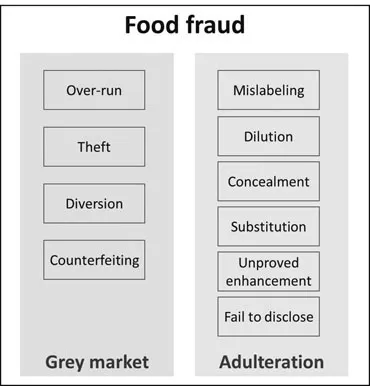
Briefly, food fraud can be categorised into adulteration (also known as economically motivated adulteration, EMA), tampering, over-run, theft, diverting, simulation and counterfeit (Spink et al., 2019), as Fig. 1 shows. Among all the fraudulent activities, food adulteration breaches food safety legislation, thereby disrupting the food industry the most (Everstine, 2013). Johnson (Johnson, 2014) suggested that among product frauds in the food, beverage, and consumer product industries, food adulteration is the most commonly observed fraudulent activity. Furthermore, public health might be also compromised due to consumption of the adulterated food product. The US Food and Drug Administration (FDA) has defined food adulteration as the “fraudulent, intentional substitution or addition of a substance in a product for the purpose of increasing the apparent value of the product or reducing the cost of its production, i.e., for economic gain” (Johnson, 2014; Spink et al., 2019). Generally, food adulteration can be performed through unapproved enhancement, dilution with a lower-grade ingredient, concealment of damage or contamination, mislabeling of a product or ingredient, substitution of a lower-grade ingredient or failing to disclose the required product information (Bansal et al., 2017; Carcea et al., 2009; Primrose et al., 2010; van Ruth et al., 2017), as Fig. 1 shows.
Figure 1. Illustration of food fraud and food adulteration.
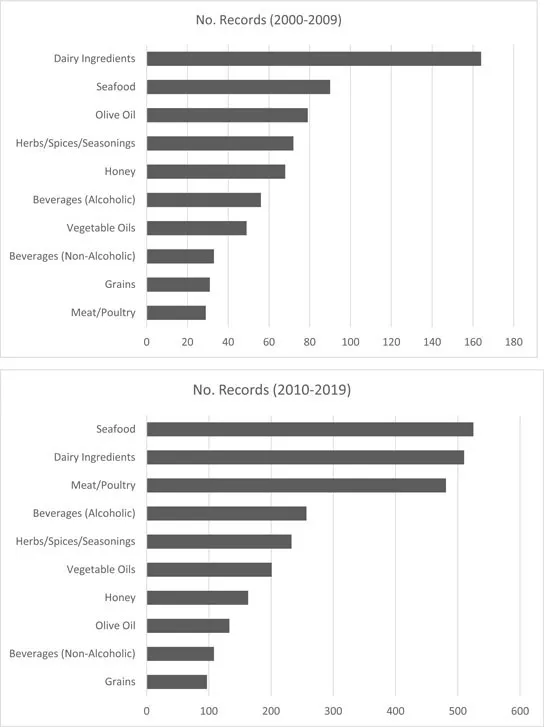
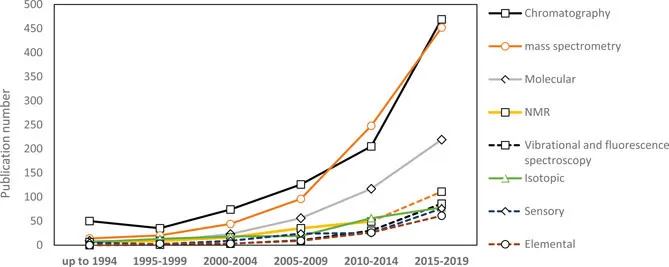
In 2018, the US Pharmacopeial Convention (USP)’s Food Fraud Database was acquired by Decernis LLC. (http://www.decernis.com), a leading provider of technology and content solutions for product compliance. The number and types of food adulterations collected by Decernis Food Fraud Database until October 2019 and the data is provided in Fig. 2, where the dilution/substitution of food products in multiple ways is the prime fraudulent activity. While the Food Fraud Database has records dating back to the 1800s, the focus of the database is on information since 1980. Although a wide range of analytical/biotechnical methods have been developed and used to detect the presence of food adulterants in the food products, it is still quite challenging to curb food adulteration due to the complexity of the food supply chain and the manufacturing process of food products, increasing international trade and huge economic gain from these illegal deceptions. Thus, fraudulent activities in the common food products, such as bovine milk, beef meat, honey, extra-virgin olive oil and milk powder, etc. are reported quite often, as Fig. 3 and Table 2 show (Uncu et al., 2019). Accordingly, the numbers of published research works aiming to detect food adulterants using various analytical/biotechnical methods have been increasing fast, as revealed by Fig. 4.
Figure 2. The number of records for different food fraud types as shown in Decernis Food Fraud Database till October 2019 from 1980.
Figure 3. The number of food adulteration records for each food ingredient group in the “Decernis Food Fraud Database”.
Table 1. Food fraud types, definitions and examples in Spink et al. (2019) (reused with permission).
Type of Food Fraud (Defined and Collected by Global Food Safety Initiative, GFSI)
Definition (from Safe Secure and Affordable Food for Everyone Organization, SSAFE)
Examples (from GFSI Food Fraud Think Tank)
General Type of Food Fraud
Dilution
“The process of mixing a liquid ingredient with high value with a liquid of lower value.”
Aqueous product diluted using non-potable/unsafe water
Olive oil diluted using potentially toxic tea tree oil
Adulterant-substance (Adulterant)
Substitution
“The process of replacing an ingredient or part of the product of high value with another ingredient or part of the product of lower value.”
Sunflower oil partially substituted with mineral oil
Hydrolysed leather protein in milk
Adulterant-substance or tampering
Concealment
“The process of hiding the low quality of food ingredients or product.”
Poultry injected with hormones to conceal the disease
Harmful food colouring applied to fresh fruit to cover defects
Adulterant-substance or tampering
Unapproved enhancements
“The process of adding unknown and undeclared materials to food products in order to enhance their quality attributes.”
Melamine added to enhance protein value
Use of unauthorised additives (Sudan dyes in spices)
Adulterant-substance or tampering
Mislabelling
“The process of placing false claims on the packaging for economic gain.”
Expiry and/or provenance (unsafe origin)
Toxic Japanese star anise labelled as Chinese star anise
Mislabelled recycled cooking oil
Tampering
Gray market production/ theft/diversion
Outside scope of SSAFE tool.
Sale of excess unreported product
Over-run, theft, or diversion
Counterfeiting
“The process of copying the brand name, packaging concept, recipe, processing method, etc. of food products for economic gain.”
“Copies of popular foods not produced with acceptable safety assurances”
Counterfeiting
Note: Gray Market: A market employing irregular but not illegal methods; Theft: Something stolen; Diversion/Parallel Trade: The act or an instance of diverting or straying from a course, activity, or use (Spink and Moyer, 2011).
Table 2. The number of total food fraud record, number of incidents and number of inferences during 2010–2019 as recorded in the “Decernis Food Fraud Database”*.
Ingredient
No. Records
No. Incidents
No. Inferences
Dairy products
Milk (Fluid, cow)
184
48
136
Milk (Fluid, goat)
21
0
21
Milk powder
45
8
37
Beef meat
84
28
56
Beef (grounded)
20
5
15
Chicken meat
27
13
14
Sheep meat
22
0
22
Lamb
19
11
8
Cooking oils
Olive oil (extra virgin)
76
20
56
Olive oil (other than extra virgin)
36
8
28
Other edible cooking oil
21
14
7
Camellia seed oil
23
0
23
Sesame oil
18
2
16
Ghee
26
16
10
Spices
Chili powder
39
19
20
Turmeric
32
15
17
Beverages and drinks
Alcoholic beverage
25
23
2
Liquor (unspecified)
16
13
3
Whisky
22
14
8
Vodka
42
35
7
Coffee and confectionaries
Coffee (Arabica)
24
1
23
Honey
84
17
67
* Based on the definition of Decernis Food Fraud Database, an ‘incident’ is a documented occurrence of food fraud in a food ingredient or product within a defined time frame. Incidents are often reported in the media and tend to include contextual and supporting information about the perpetrator, motive, geographic location and/or other characteristics. An ‘inference’ record is an indication of probable knowledge of food fraud adulteration without sufficient documentation to be classified as an incident. ‘Record’ includes all types of information in the database including incident, inference, surveillance, method, etc.
Figure 4. Numbers of publications for food authentication using analytical/biotechnical methods on Scopus.
2.Types of Food Adulteration
2.1Substitution
This refers to the complete or partial substitution of food ingredients or valuable authentic ingredients with lower-grade or cheaper alternatives. The substitution also includes false claims and unclear statements based on geography, animal species, plant species, various origins and production processes (Rahmati et al., 2016; Spink et al., 2019). Again, the goal of substitution is to derive economic benefits.
2.1.1Products of Plant Origin
Generally, it is quite difficult to distinguish the origin of specific food ingredients from the appearance of the plant origin product after processing (Fritsche, 2018), particularly when the manufacturers of counterfeit food usually deliberately imitate the morphological and sensory characteristics of the original source. Thus, sometimes certain plant origin food products can be adulterated using ingredients from different types of plant sources and these adulterations might affect the further application of food products, for example, a common adulteration in the monofloral honey products. The monoflor...
Table of contents
Cover
Title Page
Copyright Page
Preface
Contents
1. Overview of Food Adulteration from the Biotechnological Perspective
2. An Overview of Potential Toxicity of Food Adulterants and Food Adulteration Act
3. Advances in Technologies used in the Detection of Food Adulteration
4. Food Colours: The Potential Sources of Food Adulterants and their Food Safety Concerns
5. Innovative and Emerging Technologies in the Detection of Food Adulterants
6. Contributions of Omics Approaches for the Detection of Food Adulterants
7. Advances in Proteomics Approaches for Food Authentication
8. Contributions of Fingerprinting Food in the Detection of Food Adulterants
9. Nanosensors as Potential Multisensor Systems to Ensure Safe and Quality Food
10. Global Perspective of Sensors for the Detection of Food Adulterants
11. Application of Nanoscience and Nanotechnology in Advancement of Safety Issues of Foods
12. Computing in Biotechnology for Food Adulterants
Index
Trusted by 375,005 students
Access to over 1.5 million titles for a fair monthly price.
Study more efficiently using our study tools.
Frequently asked questions
Yes, you can cancel anytime from the Subscription tab in your account settings on the Perlego website. Your subscription will stay active until the end of your current billing period. Learn how to cancel your subscription
No, books cannot be downloaded as external files, such as PDFs, for use outside of Perlego. However, you can download books within the Perlego app for offline reading on mobile or tablet. Learn how to download books offline
Perlego offers two plans: Essential and Complete
Essential is ideal for learners and professionals who enjoy exploring a wide range of subjects. Access the Essential Library with 800,000+ trusted titles and best-sellers across business, personal growth, and the humanities. Includes unlimited reading time and Standard Read Aloud voice.
Complete: Perfect for advanced learners and researchers needing full, unrestricted access. Unlock 1.5M+ books across hundreds of subjects, including academic and specialized titles. The Complete Plan also includes advanced features like Premium Read Aloud and Research Assistant.
Both plans are available with monthly, semester, or annual billing cycles.
We are an online textbook subscription service, where you can get access to an entire online library for less than the price of a single book per month. With over 1.5 million books across 990+ topics, we’ve got you covered! Learn about our mission
Look out for the read-aloud symbol on your next book to see if you can listen to it. The read-aloud tool reads text aloud for you, highlighting the text as it is being read. You can pause it, speed it up and slow it down. Learn more about Read Aloud
Yes! You can use the Perlego app on both iOS and Android devices to read anytime, anywhere — even offline. Perfect for commutes or when you’re on the go. Please note we cannot support devices running on iOS 13 and Android 7 or earlier. Learn more about using the app
Yes, you can access Biotechnological Approaches in Food Adulterants by Madan L Verma in PDF and/or ePUB format, as well as other popular books in Technology & Engineering & Biology. We have over 1.5 million books available in our catalogue for you to explore.