- 293 pages
- English
- ePUB (mobile friendly)
- Available on iOS & Android
eBook - ePub
Soviet Propaganda
About this book
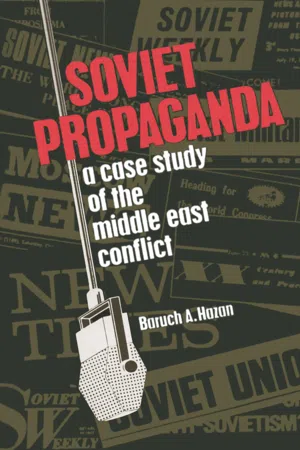
This book encompasses the period since the establishment of the State of Israel (1948-75), which marked the peak of Soviet involvement in the Middle East. It introduces new concepts in the study of propaganda, and describes and analyzes Soviet propaganda as it relates to the Middle East conflict.
Chapter One
The Definition
Propaganda is a term which has many definitions. It is also a term which has often been misused, overused and misunderstood. As in every subject which deals with human beings, there is a wide margin of error in the study of propaganda. While almost all definitions appear to agree that propaganda attempts to influence the thinking of people, there is nevertheless a considerable diversity of opinion as to what propaganda really is. That diversity of opinion is the result of emphasis on different aspects of propaganda. Some definitions emphasize the deliberate attempt of the propaganda initiator to influence the thinking and behavior of a certain audience according to a previously determined line, conforming to the interests and aims of the propagandist or his employers. Thus, the Propaganda Analysis Institute viewed propaganda as “the expression of opinion or action by individuals or groups deliberately designed to influence opinions or actions of other individuals or groups with reference to predetermined ends.”1 H.L. Childs defined propaganda along similar lines as “an attempt deliberately to influence the minds of other people.”2
Two objections can be raised against these definitions. One is the separation of action from opinion (opinion or action in the first definition, and the omission of action in the second. It is our opinion that propaganda is an action- oriented process, its aim being to control the behavior of its audience by changing or preserving its attitudes and opinions on a certain subject, or by implanting an entirely new set of attitudes or opinions. A second objection has been raised by those who consider at least some aspects of propaganda to be unplanned and unintentional. Leonard Doob, for instance, ignores the intent of the propagandist, and employs the term propaganda “in a neutral sense to describe the influence of one person upon other persons.”3 He offers the following definition:
Propaganda can be called the attempt to affect the personalities and to control the behavior of individuals toward ends considered unscientific or of doubtful value in a society at a particular time. . . . The dissemination of a viewpoint considered by a group to be “bad,” “unjust,” “ugly” or “unnecessary” is propaganda in terms of that group’s standards.4
Again, two objections can be raised. The first relates to the fact that according to Doob each group or society is to decide which viewpoint is to be disseminated as propaganda. If that assumption were true, then the possibility of reaching a generally accepted, objective definition of propaganda would not exist, for every group will define “propaganda” differently. Furthermore (and this is the second objection), if every influence aiming at diverting a group away from society’s standards or values is considered propagandistic, then Doob’s definition calls for social conservatism. Every new idea which does not conform to the old, established standards and values will be considered propaganda!
Other scholars of propaganda choose to focus on the instruments and means employed by the propagandist. The most prominent among them is Harold Lasswell. According to him propaganda is an instrument of social control:
Not bombs nor bread, but words, pictures, songs, parodies, and many similar devices are the typical means of making propaganda. Not the purpose, but the method distinguished propaganda from the management of men by violence, boycott, bribery, and similar means of social control. Propaganda relies on symbols to attain its end; the manipulating of collective attitudes.5By choosing to concentrate on propaganda’s means and techniques — as he sees them — Lasswell neglected or ignored many modern means of propaganda, especially those employed in order to create a positive attitude toward the propagandist slowly and gradually, without any reference to specific developments or ends.
Other scholars choose to concentrate on the differences between propaganda and other noncoercive instruments of social control, such as education. One of them is E.D. Martin. In his opinion, the main difference between propaganda and education lies in the final result sought in both processes.
Education aims at independence of judgment, propaganda offers ready-made opinions for the unthinking herd. Education and propaganda are directly opposed both in aim and method. The educator aims at a slow process of development, the propagandist, at quick results. . . . The educator fails unless he achieves an open mind; the propagandist unless he achieves a closed mind.6
Obviously, this is not an attempt to define propaganda, but only to explain some of its objectives. No conclusions are drawn concerning differences in methods - or common methods and techniques — used both by education and propaganda.
T.H. Qualter’s definition also concentrates on propaganda’s ends:
Propaganda is. . . . the deliberate attempt by some individual or group to form, control, or alter the attitudes of other groups by the use of the instruments of communication, with the intention that in any given situation the reaction of those so influenced will be that desired by the propagandist.7
While Qualter’s definition encompasses more aspects of propaganda than other definitions previously cited, still it seems that concentration on the ultimate product of propaganda is misleading. Furthermore, propaganda today is an elaborate and complicated process, which employs much more than “the instruments of communication” to drive home its message.
Many other definitions of propaganda can be found. Some of them emphasize factors or characteristics mentioned in the above definitions. Others stress additional characteristics of propaganda, such as concealment, deception (an end in itself), the impossibility of evaluating its effects, etc. However, we think that the definitions cited suffice to demonstrate the disagreement between the scholars.
At the risk of adding to the disagreement, we offer the following definition of propaganda:
Propaganda is the preconceived, systematic and centrally coordinated process of manipulating symbols, aimed at promoting uniform behavior of large social groups, a behavior congruent with the specific interests and ends of the propagandist.
Some of the elements of this definition should be elaborated.
I. Propaganda is A Process.
It is an interplay of changes, analyzable into unchanging or more slowly changing elements - which might themselves be complex subprocesses or patterns of action - arranged in a specific structure, governed, at least partially, by discoverable laws. Since propaganda has become one of the major instruments for conducting international relations, each and every available medium has been exploited and every known technique has been utilized to produce the effect desired by the propagandist.
Each medium penetrates in its own specific way. Each medium is suited to a certain type of propaganda, and reaches different audiences. Each audience reacts in a different way to different media and displays different degrees of vulnerability, resistance, intelligence, etc. All this must be taken into account by those who activate the propaganda process. What makes it a preconceived and systematic process is not only its clearly defined final goals, the audiences it aims at, and the subjects with which it deals, but also the tremendous effort to synchronize all techniques, means and media of propaganda so that the entire process produces the optimal effect. In other words, the propagandist has to decide in advance (and sometimes even in the midst of the propaganda process) which techniques are to be employed, which media activated, which audiences are to be subjected to propaganda, to what degree, and for how long. All decisions must be coordinated and subjected to a scientific system, so that the final product displays a combination of overall integration, synchronization and uniformity, which in turn characterize propaganda as a systematic and preconceived process.
It is obvious that such a process requires a tremendous amount of organization and control. The multiplicity of decisions, preferences and calculations, the profusion and variety of media instruments and techniques, the diversity and complexity of the factors involved — all these demand a rigid, effective organization, capable of controlling the process of propaganda. Consequently, every modern state has constructed an administrative framework whose task is to conduct, control and evaluate propaganda. Since the concept of propaganda carries negative connotations (often being associated with lying, deceit, etc.), few states have had the courage to call that framework The Ministry of Propaganda. Most prefer neutral, more euphemistic, and innocuous concepts, such as Information (U.S.A.), Explanation or Clarification (Hasbarah: Israel), etc. Nevertheless, they all have more or less the same structure, and employ the same “specialists of influence” - from sociologists and psychologists to politicians and theoreticians, all of them expected to coordinate propaganda, and to turn it into a preconceived, well-organized, and systematic process.
II. Manipulating Symbols.
It it is impossible to enumerate all the media and instruments used by propaganda. Furthermore, since there is no agreement as to what propaganda is, - there certainly can be no agreement as to whether or not a certain event or communication is propaganda. We intend to show later that Soviet propaganda employs media and means such as ballet and sport which have not generally been considered to be vehicles of propaganda, and this will probably add to the confusion which marks the study of the subject. Therefore, instead of an unsuccessful attempt to enumerate all means and media of propaganda, we prefer to use “manipulation of symbols” or “manipulation of representation” - both phrases being already used by H.D. Lasswell to describe the propaganda technique of persuasion.8 “Manipulating symbols,” an all- inclusive phrase, also implies the manipulative character of propaganda — clearly, one of its basic characteristics. Lasswell perceptively indicates the triple appeal of the ideal propagandist symbol - to the reason (ego), to the love of pleasure (id), and to self-esteem (super-ego) - rational, pleasing and righteous.
III. Uniformity of Behavior.
The propagandist tries to create specific attitudes which will in turn lead to a specific, preconceived action. He aims at concrete results, usually defined in terms of a special, uniform behavior which accords with the propagandist’s goals. To put it simply: the propagandist hopes that his audience will do what he wants them to do. He consciously attempts to control his audience’s attitudes — to strengthen, change or eradicate them — according to his interests, so that the final product will hopefully be the uniform behavior of his audience, necessary for promoting the implementation of the propagandist’s goals.
IV. Large Social Group.
This aspect of propaganda will be clarified at some length in Chapter Two. However, a short explanation is essential at this point.
The propagandist does not usually address himself to the individual, mainly because when addressed exclusively - the individual intensifies his resistance apparatus and penetration by the propaganda message becomes very difficult. Furthermore, it is impossible to take into consideration the specific characteristics of each individual and thus strive for “personal influence.” Such concern for personal details and characteristics is time-consuming, useless and anyway, technically impossible. Consequently, propaganda considers individuals in terms of their common denominator. That denominator can be defined in terms of attitudes, emotions, motivations, common history and traditions, myths, language, etc., which reduce the individuals to an average, weaken their resistance apparatus, and lower their “absorption screen” (see Chapter Two). It is the mass mentality, the common characteristics, the collective emotions, impulses, values and attitudes that interest the propagandist. Thus, the basic propaganda target is the group and not the individual.
Nevertheless, within every society there are various groups whose characteristics, interests, attitudes, etc. differ. Systematic, well-organized propaganda takes these differences into account, and adapts its message to accommodate, and to conform to, the different characteristics of each social group. What follows is differentiation within propaganda, the criteria for differentiation being education, language, income, etc. There is no doubt that this differentiation of propaganda adds to its sophistication, power of penetration and effectiveness.
Thus far, we have tried to define and explain the concept of propaganda. We will now proceed to describe the process of propaganda.
Notes
1. Bulletin of the Propaganda Analysis Institute, Vol. I, No. 1, p. 1, Oct. 1937.
2. H.L. Childs, Introduction to Public Opinion, John Wiley & Sons,...
Table of contents
- Cover
- Title Page
- Copyright Page
- Table of Contents
- Foreword by Prof. M. Z. Kaddari
- Preface
- Introduction
- Chapter One The Definition
- Chapter Two The Formation of Opinion
- Chapter Three The Development of the Soviet Propaganda Apparatus: The Instruments
- Chapter Four The Impregnational Propaganda of the Soviet Union
- Chapter Five Soviet Operational Propaganda: The Themes
- Chapter Six Means and Techniques of Soviet Propaganda
- Chapter Seven Conclusions
- Index
Trusted by 375,005 students
Access to over 1.5 million titles for a fair monthly price.
Study more efficiently using our study tools.
Frequently asked questions
Yes, you can cancel anytime from the Subscription tab in your account settings on the Perlego website. Your subscription will stay active until the end of your current billing period. Learn how to cancel your subscription
No, books cannot be downloaded as external files, such as PDFs, for use outside of Perlego. However, you can download books within the Perlego app for offline reading on mobile or tablet. Learn how to download books offline
Perlego offers two plans: Essential and Complete
- Essential is ideal for learners and professionals who enjoy exploring a wide range of subjects. Access the Essential Library with 800,000+ trusted titles and best-sellers across business, personal growth, and the humanities. Includes unlimited reading time and Standard Read Aloud voice.
- Complete: Perfect for advanced learners and researchers needing full, unrestricted access. Unlock 1.5M+ books across hundreds of subjects, including academic and specialized titles. The Complete Plan also includes advanced features like Premium Read Aloud and Research Assistant.
We are an online textbook subscription service, where you can get access to an entire online library for less than the price of a single book per month. With over 1.5 million books across 990+ topics, we’ve got you covered! Learn about our mission
Look out for the read-aloud symbol on your next book to see if you can listen to it. The read-aloud tool reads text aloud for you, highlighting the text as it is being read. You can pause it, speed it up and slow it down. Learn more about Read Aloud
Yes! You can use the Perlego app on both iOS and Android devices to read anytime, anywhere — even offline. Perfect for commutes or when you’re on the go.
Please note we cannot support devices running on iOS 13 and Android 7 or earlier. Learn more about using the app
Please note we cannot support devices running on iOS 13 and Android 7 or earlier. Learn more about using the app
Yes, you can access Soviet Propaganda by Baruch A. Hazan in PDF and/or ePUB format, as well as other popular books in History & European History. We have over 1.5 million books available in our catalogue for you to explore.