This research collection explores the ongoing interaction between sports, media, and society throughout important periods in history, from the nineteenth century to the present day. It examines both historical moments and broader trends in sports, with an emphasis on the media's role.
Encompassing a variety of research approaches and perspectives, the book looks at the individuals, mass media outlets and communication technologies that have affected societies on a global scale, including print, photography, broadcast (radio and television), Internet-based media, and public relations/marketing. It presents fascinating new case studies covering topics as diverse as sports journalism and the Third Reich, Argentina at the Mexico World Cup, post-9/11 sports reporting, Martina Navratilova and women's tennis, the growth of fantasy sport, and the significance of Joe Louis and Jackie Robinson in the history of US sports reporting.
This is essential reading for any researcher, student or media professional with an interest in the relationships between sports, culture, and society or in the history of media, culture, or technology.
The development of visual baseball journalism in Frank Leslie’s Illustrated Newspaper
Scott D. Peterson
Introduction: Frank Leslie’s Illustrated Weekly and the development of sport journalism
Although sporting publications had begun calling for baseball to become America’s national pastime by the late 1850s, daily and illustrated newspapers were slow to cover the sport extensively. A digital keyword search of Frank Leslie’s Illustrated Newspaper (FLIN) conducted by the author generated only two references to baseball in 1856: the first as a child’s game and the second as an activity that took place at the Elysian Fields, an open space across the river from New York City in Hoboken, New Jersey (February 9, 1856, p. 138; October 11, 1856, p. 278). Almost fifty years later, FLIN published over one hundred illustrations of baseball alone in 1910 – including an eight-photo montage of “The Championship of New York” between the Giants and the Yankees and a weekly “Sporting Gossip” column edited by A. Goewey, who was identified under his photo as “The Old Fan” (October 27, 1910, p. 448). The foregoing examples illustrate how baseball transitioned from an incidentally mentioned child’s activity to a regularly featured subject worthy of a full-page photomontage that Rowe (2007, p. 387) might describe as “Toy Department” coverage.
Following Brown’s (2002, p. 5) identification of FLIN as a repository of the social history of the nineteenth century, the overall purpose of this chapter is to examine the development of visual baseball coverage in the illustrated weekly from its beginnings to the end of the nineteenth century and to advance two arguments. First, the chapter argues that the slow development of baseball journalism in FLIN mirrored the reluctant acceptance of the game by the middle and upper classes across that period. Second, the chapter argues that the degree of actuality used in the visual baseball coverage reflected a change in editorial stance toward sports in general and professional sporting pursuits in particular. Three editorial stances will be defined in the next section and used throughout the paper to illustrate the arguments: the initial “Curiosity Shop” attitude that transitioned slowly to a “Toy Department” approach and the social, economic, and political references to baseball that went “Beyond the Toy Department.”
Early nineteenth-century American sports enthusiasts had to rely on imported British publications for sporting news until the appearance of The American Turf Register (1829) and William T. Porter’s Spirit of the Times (1831). As their titles suggest, these publications focused on the upper-class leisure sports of hunting and thoroughbred horse racing. When Walt Whitman and Henry Chadwick began to promote baseball in the late 1840s and 1850s, their efforts met with resistance from editors who were unfamiliar with baseball and readers who did not have time for athletic pursuits (Folsom 1994, p. 35). Although both journalists recognized the benefits of such exercise, middle-class artisans and firemen were the primary takers, who responded by forming clubs and amateur leagues (Davies 2007, p. 38; Rader 1983, p. 110). These leagues grew through the 1850s and 1860s to the point where star players were paid under the table to secure their services (Davies 2007, p. 44; Rader 1983, p. 112). The 1867 tour of the Washington Nationals through Ohio, Kentucky, Indiana, and Illinois may have prompted the development of the first professional baseball team in 1869 in Cincinnati, which in turn contributed to the development of the first professional league in 1871 (Seymour and Seymour 1960, p. 44). The questions of game-fixing were addressed by the National League when it usurped the National Association in 1876, but the taint of professional athletic pursuit kept the game in a negative light in the minds of middle- and upper-class audiences well into the late nineteenth century (Seymour and Seymour 1960, p. 76; Rader 1983, p. 113).
Types of coverage: “Curiosity Shop,” “Toy Department,” and “Beyond”
As noted earlier, “Curiosity Shop” (CS) coverage reflected an editorial stance that adopted an indifferent, critical, or unsympathetic attitude toward sports in general and baseball in particular. Characteristics of CS coverage included discussion of only the biggest games instead of regular daily or weekly stories. Editors might express a lack of familiarity with the sport or actively avoid mentioning it due to the taint of gambling and potential game-fixing. Editors working in CS mode might view baseball as a source of physical danger for children, as noted in Elizabeth Cady Stanton and Susan B. Anthony’s publication The Revolution: “Croquet is becoming as fatal as base-ball. A nice girl was sun-struck the other day while at that game” (September 22, 1870, p. 177). Other CS editors saw the game as an unhealthy fixation, as indicated by these lines from the Vincennes Weekly Western Sun: “Well, the epidemic has at last reached us, with the danger of proving fatal to some of its victims. We allude to the ‘base ball’ (otherwise known as ‘break-bone’) fever” (August 31, 1867, p. 1). Contrary to Garrison and Sabljak’s “Era of Acceptance” timeline for professional sports, the CS editorial stance toward baseball lasted almost to the end of the nineteenth century (1993, p. 224; Peterson 2019, in press).
By the early twentieth century, however, some editors and readers had come to embrace baseball enough that the coverage of the game expanded dramatically. The nature of that coverage was typically unproblematic, reporting scores and ignoring the negative actions of the players. By 1890, baseball owners recognized the power of positive coverage, and by the 1910s, they were working consciously with the sporting press to the benefit of both, which prompted critics to label the sports section the “Toy Department” (TD) of journalism (Peterson 2015, p. 14; Anderson 2003, p. 14). This editorial stance became prominent in the late nineteenth century (Rowe 2007, p. 387).
At moments during the nineteenth century, sports coverage did go “Beyond the Toy Department” (BTD) to bring readers information that they needed to know because of the larger social, economic, or political implications of sports. With the advent of “Muscular Christianity” and “Social Darwinism in the late nineteenth century,” sports became a source of individual development and spiritual nourishment (Baker 2007, p. 73; Pendergast 2000, p. 130). With the advent of collegiate sports, athletic involvement also was recognized as a training ground for the (male) leaders of the future, thus freeing such activities from the taint of professionalism (Riess 1999, p. 52).
Method: Sampling, visual coverage, and actuality
Starting with 1855, FLIN was sampled at five-year intervals in search of visual baseball coverage that took the form of an illustration of any kind related to baseball, including game action, portraits of players, advertising, scenes from baseball audiences, and cartoons. For the years 1860, 1885, 1890, and 1895, the illustrated weekly was examined page by page for visual baseball coverage. For the years 1855, 1865, 1870, 1875, and 1880, FLIN was searched electronically using the variations “base ball,” “base-ball,” and “baseball.”
To aid in the analysis of the visual baseball coverage, this chapter will employ the actuality scale developed by Peterson and Moore (2015), which was based on Thomas Connery’s paradigm of actuality thesis and Stuart Hall’s representation theories. The scale identified four levels of actuality:
A0: No attempt to represent “the actual.” An example would be a cartoon about a sport or an athlete.
A1: A minimal attempt to represent an actual event, person, or place. This category provides viewers with a small amount of usable or reliable information.
A2: This type of pictorial representation is an attempt to capture the actual by an eyewitness account and not by a camera. An example would be an on-the-spot sketch drawn to imply movement, such as horses at a race.
A3: This category represents a photographic image or a sketch credited as a reproduction of a photograph, providing the highest degree of “actuality.”
In addition to the scale defined here, the categories identified in Peterson and Moore’s article will be used as well: specifically, scene, action, portrait, and documentary (Peterson and Moore 2015, p. 132; Connery 2011, p. 7).
1855 and 1860: zero instances of visual baseball coverage
When FLIN started publication in December of 1855, baseball was not among the “sports in general” covered, but there was weekly coverage of upper-class field and turf sports: hunting, fishing, and horse racing (Everett 1985, p. 293). As noted earlier, another electronic search turned up only two references to baseball in 1856 to demonstrate FLIN’s early indifference to the game (December 22, 1855, p. 30). The absence of visual baseball coverage in 1860 further illustrated FLIN’s Curiosity Shop (CS) editorial stance toward the game. FLIN did cover an illegal bare-knuckle boxing match extensively and profitably from mid-March to mid-May, thus proving Frank Leslie was willing to feature sports when he could make money (Peterson 2019, in press).
1865: “Curiosity Shop” and “Toy Department”
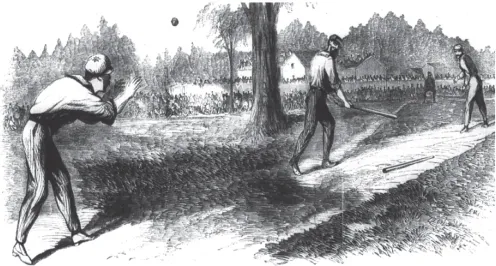
FLIN covered baseball visually just twice in 1865. The first instance was an A1 sketch (Figure 1.1) of the Brooklyn Atlantics “catching out” the New York Mutuals at Elysian Fields in Hoboken, New Jersey, for the “Championship of the City.” As with the boxing championship discussed earlier, FLIN’s coverage of this “big game” reflected a CS editorial stance in which only significant contests were covered, and even then, the mention was not much more than incidental in scope and depth. Beyond the final score (Atlantics 13, Mutuals 12), the low-actuality A1 sketch failed to provide avid baseball fans with the names of the players depicted and offered no clue whether the illustration depicted a play key to the outcome of the game. Even the language used in the brief write-up suggested the distance of a CS editorial stance:
After some splendid play, which lasted one hour and a half, a heavy rainstorm put a stop to the sport. Five innings having been played according to the rules of the National Association, the game was decided in the favor of the Atlantics.
(August 26, 1865, p. 356)
Figure 1.1 “Curiosity Shop” coverage for an 1865 “big game”
The game’s amateur status may explain why it was covered at all in FLIN, yet the story contained little to please die-hard baseball enthusiasts in search of Toy Department (TD) coverage.
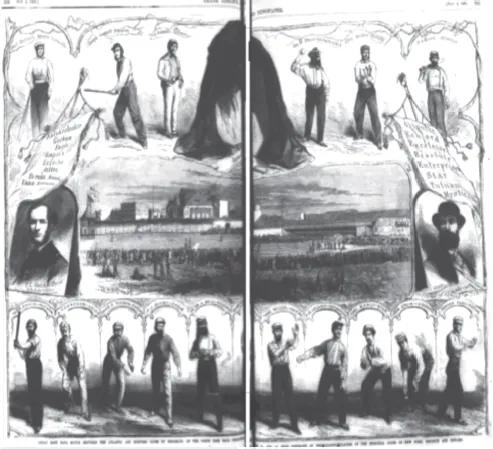
In contrast, the two-page montage in Figure 1.2 provided the kind of “want to know” information that characterized TD coverage (November 4, 1865, pp. 104–105). In addition to highly accurate A2 portraits of noted players that anticipated baseball cards, the full-spread montage included a black-crepe homage to a deceased player, Jim Creighton, and a portrait of Henry Chadwick, the “Father of Baseball” (at right in the bowler hat). As an early star who may also have been one of the first to be a surreptitiously paid professional, Creighton died from an injury he incurred while playing cricket, a death that would have provided momentum for CS-stance editors who felt ball-and-bat games were too dangerous (Seymour and Seymour 1960, pp. 47–48). In contrast to the crude A1 sketch of the city championship (Figure 1.1), the high degree of accuracy found in the montage of A2 portraits could have provided a TD audience with enough visual details to recognize their favorite players and thus indicated a change in editorial stance to win over baseball fans in a similar manner to the boxing audiences Frank Leslie catered to in 1860 (Peterson 2019, in press). That TD stance continued when FLIN carried a series of player profiles illustrated with A2 portraits in 1866, but the series was discontinued at the end of the year.
Figure 1.2 1865 Example of “Toy Department” coverage
1875: development of a commercial “Toy Department” audience
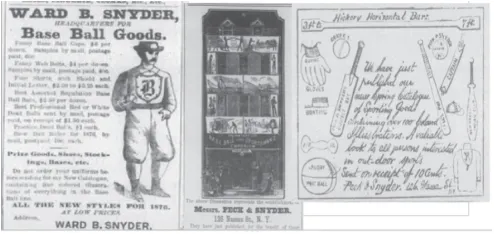
Although keyword searches revealed that there was no visual baseball coverage in 1870, 1875, or 1880, the presence of baseball-themed ads (Figure 1.3) alluded to a TD audience that was interested enough in the game to buy such equipment. This interest coincided with the period of the young men (primarily) who grew up playing baseball in the 1870s and 1880s and began to call for more information about the game in the 1890s and early 1900s (Story 2001, p. 21). This era also corresponded with the entry of Albert Spalding, a former player and eventual team owner, into the sporting goods business about the time he helped found the National League in 1876 (Levine 1985, p. 74). Given FLIN’s bias against professional sports, it was not a surprise that the National Association and National League were not covered, yet it is unclear why college baseball was ignored over the same period. Two possible explanations are that Mrs. Frank Leslie, who had taken over publication of the newspaper after her husband’s death, focused on fashion and literature, leaving no room – physically or aesthetically – for the low-culture activity of professional baseball and the fact that she delegated news gathering to her staff, who may have had more interest in politics after their boss used FLIN’s coverage of Garfield’s assassination to put the newspaper on a more secure economic footing in 1881 (Everett 1985, pp. 299, 301).
Figure 1.3 1875 baseball-themed ads pointing to a “Toy Department” audience
1885: from “Curiosity” to “Toy Department” and “Beyond”
FLIN published four instances of visual baseball coverage in 1885, which illustrated all three editorial stances identified in this chapter. Taken from a montage depicting a...
Table of contents
Cover
Half Title
Series
Title
Copyright
Dedication
Contents
List of figures
List of tables
List of contributors
Introduction
Part I Early influences, early developments
Part II Sports, media, and evolving identity issues
Part III The global reach of sports and media’s influence
Part IV A first look at emerging sports media history topics
Index
Trusted by 375,005 students
Access to over 1.5 million titles for a fair monthly price.
Study more efficiently using our study tools.
Frequently asked questions
Yes, you can cancel anytime from the Subscription tab in your account settings on the Perlego website. Your subscription will stay active until the end of your current billing period. Learn how to cancel your subscription
No, books cannot be downloaded as external files, such as PDFs, for use outside of Perlego. However, you can download books within the Perlego app for offline reading on mobile or tablet. Learn how to download books offline
Perlego offers two plans: Essential and Complete
Essential is ideal for learners and professionals who enjoy exploring a wide range of subjects. Access the Essential Library with 800,000+ trusted titles and best-sellers across business, personal growth, and the humanities. Includes unlimited reading time and Standard Read Aloud voice.
Complete: Perfect for advanced learners and researchers needing full, unrestricted access. Unlock 1.5M+ books across hundreds of subjects, including academic and specialized titles. The Complete Plan also includes advanced features like Premium Read Aloud and Research Assistant.
Both plans are available with monthly, semester, or annual billing cycles.
We are an online textbook subscription service, where you can get access to an entire online library for less than the price of a single book per month. With over 1.5 million books across 990+ topics, we’ve got you covered! Learn about our mission
Look out for the read-aloud symbol on your next book to see if you can listen to it. The read-aloud tool reads text aloud for you, highlighting the text as it is being read. You can pause it, speed it up and slow it down. Learn more about Read Aloud
Yes! You can use the Perlego app on both iOS and Android devices to read anytime, anywhere — even offline. Perfect for commutes or when you’re on the go. Please note we cannot support devices running on iOS 13 and Android 7 or earlier. Learn more about using the app
Yes, you can access Sports Media History by John Carvalho in PDF and/or ePUB format, as well as other popular books in Social Sciences & Media Studies. We have over 1.5 million books available in our catalogue for you to explore.