- 242 pages
- English
- ePUB (mobile friendly)
- Available on iOS & Android
eBook - ePub
About this book
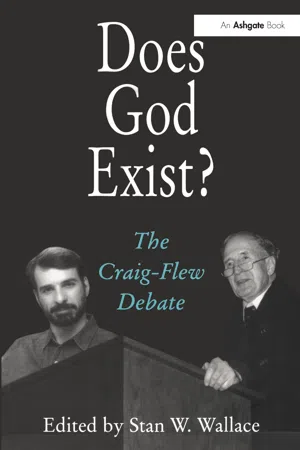
This book presents the most recent debates by leading contemporary philosophers of enduring themes and issues concerning the question of God's existence. William Craig and Antony Flew met on the 50th anniversary of the famous Copleston/Russell debate to discuss the question of God's existence in a public debate. The core of this book contains the edited transcript of that debate. Also included are eight chapters in which other significant philosophers - Paul Draper, R. Douglas Geivett, Michael Martin, Keith Parsons, William Rowe, William Wainwright, Keith Yandell and David Yandell - critique the debate and address the issues raised. Their substantial and compelling insights complement and further the debate, helping the reader delve more deeply into the issues that surfaced. In the two final chapters, Craig and Flew respond and clarify their positions, taking the debate yet one step further. The result of these many contributions is a book which provides the reader with a summary of the current discussion and allows one to enter into the dialogue on this central question in the philosophy of religion.
Information
Chapter 1
Some Issues in Theism and Atheism: Setting the Context
Keith Yandell
Preface
The purpose here is to set the debate, and the discussion to which it gave rise, in philosophical context. Antony Flew and William Lane Craig start from very different philosophical perspectives, and it is helpful to understand something of their overall viewpoints before considering the specifics of their debate.
Furthermore, as the commentators range over a wide variety of issues as the debate unfolds, it seems appropriate to provide a roadmap to most of these issues, and occasionally to comment on the views they hold. This chapter is therefore divided into two principal sections:, ‘Perspectives of the Debaters’ and ‘Roadmap to Issues in the Commentaries’.
Perspectives of the Debaters
I begin by noting some differences in Antony Flew’s and William Craig’s philosophical perspectives, mentioning some varieties of atheism and theism, and emphasizing the debaters’ agreement on whose existence they are debating.
The Humean Theory of Meaning
Antony Flew is a well-known scholar on the philosophy of David Hume (171176) and is significantly influenced by his views.
His position is atheistic in what is apparently a ‘broad sense’ of atheism. An atheist in the broad sense may hold that the proposition ‘God exists’ is meaningless, that it is false, or that it is neither known nor reasonably believed.
Much of Flew’s argument apparently rests on certain views of meaning and verification – an empiricism regarding meaning and verification similar to that of the philosopher David Hume. Hume ties the meaning of words closely to sensory and introspective experience. Broadly, on his view, an indefinable descriptive word gains its sense by corresponding to a perceptual quality (a colour, shape, sound, taste, odour or the like) or else by corresponding to some psychological state. Definable descriptive terms gain their meaning from the meaning of the indefinable descriptive terms that define them. Any mark or sound that supposedly is a descriptive word – that is said to express a descriptive meaning – is then checked to see if its supposed meaning can be defined by reference only to terms that correspond to some perceptual or introspective feature. If it cannot, it is declared to be meaningless.
We have noted that a Hume-like empiricist theory of meaning tells us that the meaning of a descriptive term is given by its association with things that we perceive or introspect. We are offered an account of perception on which what we perceive is sensory qualities. To this an account of introspection is added according to which what we introspect is mental states and never anything that has these states. Colour, shape, taste, odour and tactile words gain meaning, we are told, by being associated with (used as names of?) colour, shape, taste, odour and tactile qualities. That pain, pleasure and emotion words have meaning is explained by their being associated with (used as names of?) pains, pleasures and emotions. If one holds (as Hume did not) that we perceive enduring objects, then the possession of meaning by such physical object words as ‘rock’ or ‘tree’ will be explained, on this sort of theory, by (say) ‘rock’ being associated with observed rocks and ‘tree’ with observed trees. If one holds (as Hume did not) that we introspect an enduring self, then the possession of meaning by such terms as ‘person’, ‘self, and ‘I’ will be explained, on this sort of theory, by ‘person’ being associated with the conscious mind that one is aware of over time. What sort of meaningful terms this sort of theory can explain depends on what sorts of thing it holds that we can be aware of.1 A narrow, sparse theory of the objects2 of sense perception and introspection gives a sparse range of meaningful terms. Advocates of the theory will take the theory as a criterion of meaning and dismiss purported counterexamples as instances of terms that some mistakenly take to have meaning. One problem with this sort of theory is that such terms as ‘theory’, ‘meaning’ and ‘explain’ cannot be defined in the terms it accepts. (Looking ahead, the same holds for ‘verifies’ and ‘confirms’.) So one cannot say what the theory means in terms that are allowed by the theory.
The Humean Theory of Verification
A Hume-like theory of verification will contend that a descriptive sentence is verified only if it says that something that can be experienced exists or has some observable property. To verify such a statement is simply to experience the thing in question or to experience it as having the quality in question. A doctrine of experience is required to give the theory of verification specific content, and, for Hume, experience is limited to introspection and sense perception. Hume thus limits the range of what we can verify to matters capable of confirmation by sensory or introspective experience.3 A problem for this theory of verification is that the proposition can only verify what can be confirmed by reference to sensory or introspective experience cannot itself be verified by reference to sensory or introspective experience. So that proposition, which expresses what meaning the theory has is meaningless on the theory that it expresses.
Flew is a Hume scholar who is also significantly influenced by Hume’s views. In line with the general tradition of Humean, empiricist theories of meaning and verification, Flew holds that we experience neither disembodied created persons nor God, and so there is no evidence that either exist. Further, he contends, it is doubtful whether the concepts of such things are clear enough even to give sense to the claim that they do exist. Here, Flew walks along a thin line; if we know that we don’t experience disembodied minds or God, we must have enough grasp of the relevant concepts for this knowledge to be available. To the degree that we do not have such a grasp, it is not clear that we know we don’t experience disembodied created persons or God. To the degree that we do grasp the concepts of God and disembodied minds, it is at least possible that we can tell whether we experience God or disembodied minds, but then the concepts in question must be clearer than Flew wants to grant. This illustrates some of the tension between a Hume-like empiricist theory of meaning and a Hume-like empiricist theory of verification when both are applied to philosophical and religious matters. Flew’s appeal to the existence of evil as evidence against the existence of God also requires that one be able to attach meaning to the word ‘God’.
Experience of God is ruled out by a Hume-like theory of verification. To be consistent with the theory, anything that seems to be an experience of God can only be a God-hallucination because God cannot be an object of sense perception or of introspection. Experience of God, if such occurs, is not sensory or introspective because God is not a physical object, a sensory content, a mental state or the content of a mental state. Genuine experiences of God are simply excluded by definition in a Hume-like theory of verification. This is, of course, no argument that they do not occur.4
William Craig rejects Hume-like theories of meaning and verification. Given Hume-like theories of meaning and verification, the sort of enterprise in which Craig is engaged cannot get off the ground. There will be no cards dealt to a player like Craig in a Hume-like game; he can only challenge the game’s rules.
In a sense, then, Craig and Flew (I take Flew to play by Hume-like rules) do not directly meet each other’s perspectives. (A respect in which they do directly meet each other’s perspectives is noted shortly.) That would require at least a pair of debates: first, one concerning basic philosophical perspectives; and second, one concerning the existence of God. It is hence particularly useful that there be, as there are here, comments on the debate in which some of the ‘first debate’ issues also arise.
One of the ways in which Craig’s rejection of a Hume-like perspective manifests itself is in his use of the claim that whatever has a beginning must have a cause. Craig takes this to be a necessary truth – a proposition that cannot be false under any conditions. He would grant that it is not true by definition and that it cannot be established by appeal to sensory experience or introspection. He notes that we nonetheless take it to be true in our everyday reasoning and sees no reason why it is not perfectly justified to use it regarding such matters as whether the universe, if it had a beginning, must have a cause. Flew’s sympathy with a Humean perspective expresses itself in his scepticism about using such a claim so far outside the context of reasoning about the specific items of everyday experience as is required by Craig’s argument.
Varieties of Atheism and Theism
Atheism, like theism, has many varieties. One can be an idealist and an atheist, holding (like the philosopher McTaggert) that there exist only uncreated minds and their experiences. One can hold that among the fundamental, not-dependent-on-anything-else items there are inherently conscious things and inherently non-conscious things – souls and physical atoms – that beginning-lessly exist, but no God, as do the Jains.5 Neither perspective is theistic. One can hold that there are only physical things, perhaps in a sense of ‘physical’ on which to be physical is (i) to be a spatially extended thing or to be capable of being part of a spatially extended thing, or else (it) to be a property of, or a relation among, things that are physical by (i). Such physicalism or materialism is the most common sort of contemporary academic atheism, and apparently is the form favoured by Flew.
Theism, too, comes in more than one form. Typically, theists have not been materialists; Craig is not a materialist.6 Some theists have held that God is creator in the sense that non-divine minds and physical items beginninglessly depend for their existence on God. Other theists hold that God created nondivine things and thereby also created time. Still others hold that time exists independent of created things and, after much time had passed, God created non-divine things. Craig’s view is that, in creating a world, the eternal God became temporal.
A different way in which atheism and theism have varieties concerns modality. The modalities are:
- necessary truth: a proposition Ñ is a necessary truth if, and only if, it is impossible that Ñ be false
- necessary falsehood: a proposition Ñ is a necessary falsehood if, and only if, P’s contradictory not-P is a necessary truth
- contingency: proposition Ñ is contingent if and only if Ñ is neither a necessary truth nor a necessary falsehood
- possibility: proposition Ñ is possible if and only if Ñ is not a necessary falsehood (that is, Ñ is either a necessary truth or is contingent).
Regarding modality there are two varieties of atheism: one that holds that Necessarily, God does not exist and one that holds That God does not exist is contingent and true. Flew, insofar as he grants that the word ‘God’ has meaning, apparently holds that the proposition God exists is contingent and false. It is not logically impossible that there be a God, just as it is not logically impossible that there have been unicorns. There just isn’t any God, so far as we know.
Regarding modality, theism’s versions are Necessarily, God exists and That God exists is contingent and true. Craig’s position is that it is a necessary truth that God exists, but for the purposes of the debate it would not, so far as I can see, matter if Craig held the view That God exists is contingent and true. There is one proviso here. On Craig’s view it must be logically impossible that God be caused to exist. Otherwise, one could argue as follows:
- Necessarily, what can have a cause of existence does have a cause of existence.
- God can have a cause of existence.So:
- God does have a cause of existence.7
Craig would reject propositions 2 and 3. If Craig’s cosmological argument can be offered by theists who hold 2 That God exists is contingent and true, then it must be impossible that an omnipotent, omniscient, morally perfect being be caused to exist – it must be impossible that such a being exist dependently, even if it does not exist necessarily.
While both atheism and theism come in various sizes and shapes, there is a broad range of agreement between the debaters concerning the being whose existence they are debating.
‘God’
Craig’s type of theism concerns an eternal God who becomes temporal by the act of creating, and Flew’s atheism concerns a material universe which is all there is. Both mean by ‘God’ a being who is personal, omnipotent, omniscient and morally perfect, who created the world and governs it providentially. Thus both use the term ‘God’ in a sense recognizable to monotheistic traditions, and in a manner that is not deistic. It would be otiose to protest that they do not include in the meaning of the term various idiosyncrasies current in the academy. Their use of the term is both that established in popular culture and that embraced by typical recognized representatives of the world’s monotheistic religions. Agreement on the use of the term is, of course, a precondition of a debate in which the parties are not arguing past one another. Happily, that condition is met here.
Roadmap to Issues in the Commentaries
It is time to turn from the perspectives of the debaters to a consideration of some of the basic issues that are raised by those who comment on the debate. What follows tracks the course of the comments topic-by-topic and can be read as a prologue to, or as a review of, the arguments of the commentators.
The Cosmological Argument
Craig offers, and Flew critiques, a version of the cosmological argument that runs as follows: the universe has a beginning, whatever has a b...
Table of contents
- Cover
- Half Title
- Dedication
- Title Page
- Copyright Page
- Contents
- Contributor
- Original Half Title
- Chapter 1 Some Issues in Theism and Atheism: Setting the Context
- Chapter 2 The Craig-Flew Debate
- Chapter 3 Reflections on the Explanatory Power of Theism
- Chapter 4 Reflections on the Craig-Flew Debate
- Chapter 5 The Burden of Proof and the Presumption of Theism
- Chapter 6 Comments on the Craig-Flew Debate
- Chapter 7 Theism, Atheism and Cosmology
- Chapter 8 The Universe is Probable; The Resurrection is Not
- Chapter 9 Infinity and Explanation, Damnation and Empiricism
- Chapter 10 Craig’s Case for God’s Existence
- Chapter 11 Reply to Objections
- Chapter 12 A Reply to my Critics
- Bibliography
- Subject Index
Trusted by 375,005 students
Access to over 1.5 million titles for a fair monthly price.
Study more efficiently using our study tools.
Frequently asked questions
Yes, you can cancel anytime from the Subscription tab in your account settings on the Perlego website. Your subscription will stay active until the end of your current billing period. Learn how to cancel your subscription
No, books cannot be downloaded as external files, such as PDFs, for use outside of Perlego. However, you can download books within the Perlego app for offline reading on mobile or tablet. Learn how to download books offline
Perlego offers two plans: Essential and Complete
- Essential is ideal for learners and professionals who enjoy exploring a wide range of subjects. Access the Essential Library with 800,000+ trusted titles and best-sellers across business, personal growth, and the humanities. Includes unlimited reading time and Standard Read Aloud voice.
- Complete: Perfect for advanced learners and researchers needing full, unrestricted access. Unlock 1.5M+ books across hundreds of subjects, including academic and specialized titles. The Complete Plan also includes advanced features like Premium Read Aloud and Research Assistant.
We are an online textbook subscription service, where you can get access to an entire online library for less than the price of a single book per month. With over 1.5 million books across 990+ topics, we’ve got you covered! Learn about our mission
Look out for the read-aloud symbol on your next book to see if you can listen to it. The read-aloud tool reads text aloud for you, highlighting the text as it is being read. You can pause it, speed it up and slow it down. Learn more about Read Aloud
Yes! You can use the Perlego app on both iOS and Android devices to read anytime, anywhere — even offline. Perfect for commutes or when you’re on the go.
Please note we cannot support devices running on iOS 13 and Android 7 or earlier. Learn more about using the app
Please note we cannot support devices running on iOS 13 and Android 7 or earlier. Learn more about using the app
Yes, you can access Does God Exist? by Stan W. Wallace in PDF and/or ePUB format, as well as other popular books in Theology & Religion & Atheism. We have over 1.5 million books available in our catalogue for you to explore.