eBook - PDF
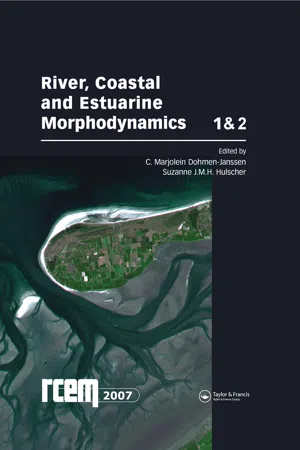
River, Coastal and Estuarine Morphodynamics: RCEM 2007, Two Volume Set
Proceedings of the 5th IAHR Symposium on River, Coastal and Estuarine Morphodynamics, Enschede, NL, 17-21 September 2007
- 1,183 pages
- English
- PDF
- Available on iOS & Android
eBook - PDF
River, Coastal and Estuarine Morphodynamics: RCEM 2007, Two Volume Set
Proceedings of the 5th IAHR Symposium on River, Coastal and Estuarine Morphodynamics, Enschede, NL, 17-21 September 2007
About this book
This book brings together contributions from some 200 scientists from more than 20 countries who present and discuss the latest scientific research developments on this topic. It is organized around the general themes of relations between scales and long-term morphodynamics such as biogeomorphology, small-scale processes and grain sorting, morphodynamic free behavior, human interferences in morphodynamics. The book provides an excellent overview of the state of the art knowledge on River, Coastal and Estuarine Morphodynamics and will be of interest to academics, engineers, planners, national and local authorities and all those involved in managing river, estuarine and coastal habitats.
Information
Table of contents
- Table of contents
- Preface
- Topic A: Longterm morphodynamics Longterm morphodynamics of tidal inlets, ebb-tidal deltas and continental shelves
- Process-based approach on tidal inlet evolution – Part 1
- Sensitivity analysis of a morphodynamic modeling system applied to a Portuguese tidal inlet
- Trends of bathymetric variations at a tidal inlet
- Influence of bed slope related sediment fluxes on morphodynamic equilibria in tidal embayments
- Effects of amplitude differences on equilibrium and stability of a two-inlet bay system
- Time-scales of morphological change of the former ebb-tidal deltas of the Haringvliet and Grevelingen (The Netherlands)
- The role of suspended load transport for the equilibrium of tide-dominated ebb-tidal deltas
- Response of hyperpycnal deltas to a steady rise in base level
- The formation of submarine gullies on continental shelves with arbitrary shapes by turbidity currents
- Longterm morphodynamics of coasts
- Q2D-morfo: A medium to long term model for beach morphodynamics
- Long-term beach profile variations under wave and wind actions
- Study on the evolution of sand barriers in Taiwan coast
- Longterm morphodynamics of estuaries
- Estuarine evolution using a numerical, process-based approach
- On the parameter setting of semi-empirical long-term morphological models for estuaries and tidal lagoons
- Morphodynamic Multi-model Approach for the Elbe estuary
- Morphological behaviour of UK estuaries under conditions of accelerating sealevel rise
- Planform development of the Meghna Estuary in Bangladesh
- A conceptual model for the long term evolution of tidal flats in the Venice lagoon
- Long-term evolution of tidal channels flanked by tidal flats
- Morphodynamics of tidal flats – A case study from the mouth of the estuary Elbe, Germany
- Long-term morphodynamics and hydrodynamics of tidal meandering channels
- Longterm morphodynamics rivers
- Regime modelling of morphology
- Experimental investigation of the response of an alluvial river to a vertical offset of its bed
- Variations of channel migration rates in two meander models
- A simple mathematical model of channel bifurcation
- Spatial scales in braided networks: Experimental observations
- Bedrock incision: An analysis of rivers in the Versilia basin (Tuscany, Italy)
- General aspects of longterm morphodynamics
- A dynamical systems approach to analyzing morphodynamic states
- A discontinuous Galerkin finite element model for morphological evolution in shallow flows
- Topic B: Biogeomorphology
- KEYNOTE Biomorphodynamics in river, coastal and estuarine settings
- Landscape evolution in tidal embayments: Modeling the interplay of erosion, sedimentation, and vegetation dynamics
- Modeling large scale cohesive sediment transport by including biological activity
- Multiple equilibria in tidal eco-geomorphology
- Planform geometry of peat meanders
- The influence of root systems on the geomorphology of a tidal creek: Exbury Marsh, Southern England
- Plant growth strategies directly affect biogeomorphology of estuaries
- The effect of sediment transport on eelgrass development – and vice versa
- Species response to climate change could affect the fate of fine sediment in the Wadden Sea
- Synoptic techniques for monitoring the response of intertidal benthic biota to an alternative dredging strategy
- Effects of spatial vegetation roughness parameterization on flow characteristics
- Topic C: Small-scale processes and grain sorting Sediment transport in coastal regions
- The effect of sediment characteristics in littoral transport evaluation
- Surface wave effects on sheet-flow sand transport
- A sensitivity study of sediment transport rates in accelerated skewed waves
- Experimental approach study of the interaction water-sediments in the swash zone by Ultrasonic Doppler Velocimetry (UDV)
- Bedload transport in an inlet channel during a tidal cycle
- Suspended sediment dynamics under strong currents and waves on a gravelly ebb-tidal delta
- Wave ripples
- Temporal evolution of ripple pattern generated by regular waves
- Sand ripples dynamics and degradation under oscillatory flow and turbulence
- Wave current interaction over a rippled bed: Preliminary results of an experimental and numerical campaign
- Sediment transport in estuaries
- A new approach for prediction of estuary flow-sediment variation at the downstream end of a reach
- An analytical model of the equilibrium distribution of suspended sediment in an estuary
- A model comparison of flow and lateral sediment trapping in estuaries
- Erosion and sediment sorting in floodplains
- Numerical and field study of sediment budgets on an intertidal flat at the mouth of the Shirakawa River
- Sediment transport in rivers
- The influence of spatial variability in the near-bed flow field on 1-D calculations of fluvial bedload transport
- Experimental study of sediment pattern at river confluence
- A numerical model to store and access the stratigraphy of non-cohesive sediment as an alluvial bed aggrades and degrades in a flume
- Features of parallel lamination related to the bed-aggradation rates: An experimental study
- General sediment transport processes
- Comparison between a St-Venant–Exner model and a two-layer model for transient flows
- Self-accelerating turbidity currents at laboratory scale
- The variation of the water’s density due to sedimentation processes and its role in modelling open channel flow
- Dispersion process of suspended sediment in turbulent shear flow
- Comparative results of tidal and intertidal numerical simulation of dispersion processes
- Detailed measurements of suspended sediment transport in a turbulent open channel flow
- Modelling of laboratory created highly concentrated sediment transport flow
- Two-phase theoretical and numerical models for sediment-laden, open-channel flow
- Sediment mobility
- Critical condition of sediment entrainment by sediment-water mixture flow
- Reducing uncertainty in the prediction of uniform sediment threshold conditions
- Laboratorial and theoretical study of the mobility of gravel and sand mixtures
- Effects of particle exposure, near-bed velocity and pressure fluctuations on incipient motion of particle-size mixtures
- Development of fictitious-domain simulations of erodible particle beds in liquid
- Non-uniform sediment transport processes
- The equilibrium concept applied to flows over non uniform gravel beds sediments
- Experimental study of bed load transport on steep slopes with a two-size mixture of spherical particles
- Physically-based model of downstream fining in bedrock streams with side input and verification with field data
- Sediment transport and bed forms
- Sediment transport and underwater bar migration
- Study of sediment transport rate over dune-covered beds
- Linear stability analysis of fluvial dunes and antidunes incorporating nonequilibrium bedload transport
- Turbulence shear flow characteristics over a 2-D large symmetric dune
- Suspended sediment in the presence of dunes
- A bed-material load criterion to delineate between ripples and dunes forming in riverbeds
- New imaging technique for measuring fluid and solid velocities in sand-laden flows over dunes in an open channel
- Predicting the occurrence of dunes under supply limited conditions
- Estimating bed form height from sorting preserved in sedimentary records of river dunes, deltas and bars
- Grain size sorting over offshore sandwaves: Observations and modelling
- Influence of grain size on sandbanks dynamics
- Topic D: Morphodynamic free behaviour Large-scale offshore morphodynamics
- A numerical algorithm to compute the morphodynamics of shallow tidal seas
- Investigating plan-view asymmetry in wave-influenced deltas
- Coastal morphodynamics
- Finite amplitude dynamics of shoreface-connected ridges: Role of waves
- Observation of morphological development on the tsunami-affected coast of Banda Aceh using multi-temporal Digital Elevation Models
- Predictability experiments of surf zone bathymetry using a process-based numerical model
- Comparing observed surfzone transverse finger bars with model results
- Morphodynamical modeling: Impact of the tide and seasonal conditions on characteristic bar systems of the Aquitanian Coast, France
- Analysis of the morphodynamical development of crescentic bed patterns at Duck over two months in 1998
- Video-observations of shoreward propagating accretionary waves
- The role of initial bathymetry on rip channel formation
- Estuarine morphodynamics
- Simulation of morphology in the tidal environments
- Meandering channel dynamics in highly cohesive sediment on an intertidal mud flat
- Morphological characteristics of laboratory generated tidal networks
- Flood/ebb tidal dominance in an estuary: Sediment transport and morphology
- On the formation and migration of free bars in finite tidal channels
- River morphodynamics
- Process of channel formation at low flow on a bar created at high flow
- Comparisons of morphology and flow structure at two braid-bar confluences in a large river
- Evolution of a new tidal river bifurcation: Numerical modelling of an avulsion after a catastrophic storm surge
- Autogenic cycles of sheet and channelised flow on fluvial fan-deltas
- Flume experiment of debris flow confluence formed alluvial fan in the main channel
- River meandering
- Long-term behaviour of meandering rivers
- A non linear model for river meandering
- Bend theory of river meanders with channel width variations
- Numerical analysis of meandering channel with a new boundary fitting coordinate system
- Bed morphology in Kinoshita meandering channels: Experiments and numerical simulations
- General aspects of morphodynamics
- Estimation of nature systems morphodynamics
- Formation process of depositional landform over a permeable flat plain
- Correlation decay and dynamic equilibria in sandy transport systems
- Quasi-two-dimensional enhancement of the De Saint Venant-Exner coupled model for unsteady simulations in natural channels
- Bed forms – general
- Spectral analysis of compound dunes
- Evaluation of statistical properties of dune profiles
- Variability in bedform characteristics using flume and river data
- Modelling the interaction between transverse and crescentic bar systems
- Simulating temporal response of bedform characteristics to varying flows
- Bifurcation patterns in dune and antidune instability
- Offshore bed forms
- Spatio-temporal variability of currents and sediment fluxes over a dune field in the Dover Strait
- Morphodynamic evolution of sand banks: A weakly nonlinear analysis
- Prediction of sand wave migration with a non-linear spectral model
- Sand waves characteristics: Theoretical predictions versus field data
- San Francisco Bay sand waves: Modelling and observation
- Computer simulations of megaripples in the nearshore
- River dunes and antidunes
- Froude number conditions associated with full development of 2D bedforms in flumes
- Gravel dunes and antidunes in fluvial systems
- Weakly nonlinear analysis of the dune-flat bed transition with the mixing length turbulent model
- Morphodynamics in reservoirs
- Effect of a reservoir release on the morphology of a gravel bar: Field observations and 2Dh modeling
- Evolution of sediment deposition and flow patterns in a rectangular shallow reservoir under suspended sediment load
- KEYNOTE Human interferences in morphodynamics
- Human impacts offshore and near coasts
- Seabed morphodynamics due to offshore wind farms
- Explicit formulae of shoreline change under time-varying forcing
- Human interference in estuaries
- Long term process-based morphological model of the Western Scheldt Estuary
- Concept of a sustainable development of the Elbe estuary
- The Walsoorden pilot project: A first step in a morphological management of the Western Scheldt, conciliating nature preservation and port accessibility
- Assessing the sustainability of estuarine barrages
- Predicting morphodynamic response of a coastal plain estuary using a Boolean model
- Numerical modeling of the bed evolution downstream of a dike in the Gironde estuary
- Impact of setbacks on the estuarine morphology
- Human interference in rivers
- Channel stability assessment in a meander cut-off
- Morphologic and sediment transport adjustments around an artificial point constriction in a large meandering river (Bermejo River, Argentina)
- Behavior of a river bifurcation
- The failure of the Fonte Santa mine tailing dam (Northeast Portugal)
- Beach and river nourishments
- Long-term simulation with 2DH and 3D models for nourishment on Mediterranean beaches
- Model assessment of sediment nourishment in rivers with graded sediment
- Sedimentation and effect of structures
- Mathematical modelling of silting in the Kugart River, Kyrgyzstan
- Feasibility study for implementation of sedimentation reduction measures in river harbours
- A method to predict sediment transport process in drainage basin with dams
- Fundamental properties of suspended sediment transport in open channel flows with a side cavity
- One-dimensional numerical scheme to model bed evolution in presence of a side overflow
- Groynes and scour
- Application of intelligent system of Artificial Neural Network to predict the scour process in coastal engineering
- Local scour downstream of stilling basins
- A Large Eddy Simulation study of the bed shear stress distributions around isolated and multiple groynes
- Shear stress enhancement to account for increased turbulence in mixing layers along river groynes
- Numerical simulation on local scouring around a spur dike using equilibrium and non-equilibrium sediment transport models
- Study on morphodynamics around stone-lined spur dikes in the Akashi river
Trusted by 375,005 students
Access to over 1.5 million titles for a fair monthly price.
Study more efficiently using our study tools.
Frequently asked questions
Yes, you can cancel anytime from the Subscription tab in your account settings on the Perlego website. Your subscription will stay active until the end of your current billing period. Learn how to cancel your subscription
No, books cannot be downloaded as external files, such as PDFs, for use outside of Perlego. However, you can download books within the Perlego app for offline reading on mobile or tablet. Learn how to download books offline
Perlego offers two plans: Essential and Complete
- Essential is ideal for learners and professionals who enjoy exploring a wide range of subjects. Access the Essential Library with 800,000+ trusted titles and best-sellers across business, personal growth, and the humanities. Includes unlimited reading time and Standard Read Aloud voice.
- Complete: Perfect for advanced learners and researchers needing full, unrestricted access. Unlock 1.5M+ books across hundreds of subjects, including academic and specialized titles. The Complete Plan also includes advanced features like Premium Read Aloud and Research Assistant.
We are an online textbook subscription service, where you can get access to an entire online library for less than the price of a single book per month. With over 1.5 million books across 990+ topics, we’ve got you covered! Learn about our mission
Look out for the read-aloud symbol on your next book to see if you can listen to it. The read-aloud tool reads text aloud for you, highlighting the text as it is being read. You can pause it, speed it up and slow it down. Learn more about Read Aloud
Yes! You can use the Perlego app on both iOS and Android devices to read anytime, anywhere — even offline. Perfect for commutes or when you’re on the go.
Please note we cannot support devices running on iOS 13 and Android 7 or earlier. Learn more about using the app
Please note we cannot support devices running on iOS 13 and Android 7 or earlier. Learn more about using the app
Yes, you can access River, Coastal and Estuarine Morphodynamics: RCEM 2007, Two Volume Set by C. Marjolein Dohmen-Janssen,Suzanne J.M.H. Hulscher in PDF and/or ePUB format, as well as other popular books in Technology & Engineering & Civil Engineering. We have over 1.5 million books available in our catalogue for you to explore.