- 24 pages
- English
- ePUB (mobile friendly)
- Available on iOS & Android
eBook - ePub
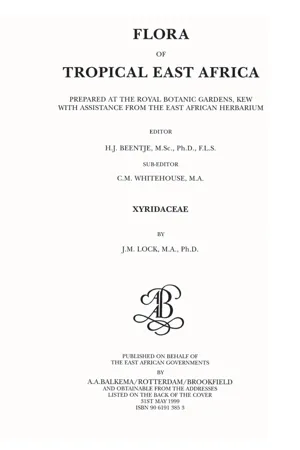
Flora of Tropical East Africa - Xyridaceae (1999)
About this book
The flora is prepared at Royal Botanic Gardens, Kew, in close collaboration with East African Herbarium and in liaison with the University of Dar es Salaam, the University of Nairobi and the Makerere University. Significant contributions are also made by specialists elsewhere. The flora is designed to a high academic standard and should be a useful resource reference for anyone concerned with the identification and utilization of plants in eastern Africa. Each family is published as a separate part.
Information
FLORA OF TROPICAL EAST AFRICA
___________
XYRIDACEAE
Annual or perennial herbs, often in seasonally or permanently wet sites; stems upright, base sometimes swollen in perennial species. Leaves alternate, simple, linear, distichous, few to numerous, basal sheath open, blade flattened to terete. Inflorescence a condensed pedunculate spike; flowers in the axils of densely crowded often coriaceous bracts, forming a spherical, ovoid or elongate head (the spike). Flowers 3-merous, bisexual; calyx-lobes 3, the adaxial at first forming a hood-like structure over the bud, the laterals smaller; corolla tubular, divided above into 3 broad spreading usually yellow but sometimes white, blue or orange petals. Stamens 3, opposite the petals, often with 3 staminodes alternating with them. Ovary (1—) 3-locular, with numerous ovules and axile or parietal placentation; style 1, sometimes divided into 3 at the apex. Fruit a loculicidal or irregularly dehiscent capsule. Seeds numerous, small, with endosperm.
Pantropical, with 5 genera and ± 260 species of which 240 are in Xyris. Most diverse in South America, and extending into the warm temperate parts of North America; ± 25 species in East Africa. A medium-sized family of mostly small annual or perennial herbs.
In South America the inflorescences of a few species are collected and sold as dried flowers; otherwise the only economic importance of the family is as weeds of wet places, particularly rice fields.
L., Sp. Pl.: 42 (1753) & Gen. Pl., ed. 5: 25 (1754); N.E. Br. in F.T.A. 8: 6-25 (1901); Malme in E.J. 48: 287-308 (1912)
Annual or perennial herbs, often forming clumps; rhizomes, when present, short, horizontal or ascending. Leaves virtually all basal; ligule present or not. Inflorescence a condensed bracteate spike at the end of elongated peduncles which are often variously grooved or ridged; lower bracts of the spike sterile, occasionally elongated or reflexed. Flowers borne singly in the axils of the fertile bracts, short-lived; calyx of 3 unequal segments, the adaxial hooded and enclosing the flower-bud, the laterals asymmetric and often keeled, free from one another (sometimes fused basally in American species); corolla yellow (blue in at least one West African species). Stamens alternating with 3 usually bifurcate staminodes divided apically into many moniliform hairs. Ovary with parietal placentation (in East Africa). Fruit a loculicidal capsule.
Useful descriptions and illustrations of character states are given by Kral (Ann. Missouri Bot. Gard. 75: 522-722 (1988)).
All the African species belong to section Xyris, characterised by parietal placentation in a unilocular ovary. Of the other two sections, Pomatoxyris Endl. occurs only in Australia and Nematopus Seub. only in Central and South America. However, Kral has cast doubt on the validity of the sections as intermediate types of placentation occur.
Although the species of the genus generally look rather different, accurate identification usually depends on the observation of small features for which a x 10 or x 20 lens or binocular microscope is essential. Anatomical characters may be useful, but have not been investigated for most African species. Characters of value, which should be borne in mind when collecting, include:
Life-span — annual or perennial? If perennial, is there a swollen bulb-like base? Collect if present.
Leaf sheaths — these should be complete and clean; surface texture and colour useful.
Leaf — make sure these are present and not grazed or broken off.
Leaf surface ornamentation — spare leaves for sectioning.
Peduncles — material for
Bracts of the — a of is useful; include for dissection.
Lateral sepals — the keel may be entire or variously dentate or ciliate; examine dissected sepals from both sides to get a clear view of the keel.
Flowers — do not dry well; material is useful.
Fruits — usually present in mature spikes, but tend to dehisce and lose their seeds; spare mature spikes.
Seed shape and surface ornamentation — seeds must be ripe; use x 20 or x 40.
The flowers of some species have been noted as opening in the morning. Doust & B.J. Conn (Austr. Syst. Bot. 7: 455-484 (1994)) give fairly precise opening times for the flowers of the species they describe; similar data for African species would be welcome.
The family has probably been undercollected in East Africa and this account should be regarded as more preliminary than many in the Flora. Most major recent collecting expeditions have produced either new species or new records for East Africa and there can be no doubt that new taxa remain to be found and described. Areas worthy of special attention include south-western Uganda, the Kitale area in Kenya, and western and southern Tanzania. Various collections mentioned in the notes, and the three taxa here listed as sp. A, B & C may well represent new species but without really good material I hesitate to describe them.
Purseglove 3634 (Uganda, Kigezi District, Kachwekano Farm, June 1951) has the lowest sterile bract greatly elongated so that it is ± 5 x as long as the spike. While the specimen is poor and sparse, and may well be from an abnormal plant, species with similar bracts occur in South America and collectors in SW. Uganda should look for more material.
X. valida Malme occurs in Rwanda and Zaire (Kivu), and is to be expected in SW. Uganda. It is usually a very robust perennial plant of swamps. It would probably key out as X. capensis but the peduncle is 2-winged, and the wings are pilose below the spike.
| Fertile bracts red-brown, papillose, with ciliate-lanate margins; a small annual.... | 20. X. sp. C |
| Bracts not as above; annual or perennial: | |
| Outer (sterile) bracts white, pale grey or pale buff, sometimes with a narrow darker median line: | |
| Leaves and peduncles strongly rugulose; outer bracts erect, thin and papery, more than 10 mm. long.... | 1. X. kornasi ana |
| Leaves and peduncles not rugulose; outer bracts erect or spreading, firmer in texture, smaller: | |
| Fertile bracts irregularly ciliate-dentate on the margins, with a strong dorsal mark.... | 2. X. erosa |
| Fertile bracts with entire margins, with a paler median line but no distinct dorsal mark.... | 3. X. ednae |
| Outer (sterile) bracts yellowish, reddish, brown or black: | |
| Keel of lateral sepals entire: | |
| Inflorescence bracts with a distinct subterminal triangular or rhomboid mark; inflorescence broadly ovoid to subspherical at maturity.... | 9. X. anceps |
| Inflorescence bracts without such a mark; variously shaped when mature: | |
| Inflorescences 5 mm. or more long, ellipsoid or subspherical: | |
| Mature inflorescences ellipsoid; peduncles two- ridged below the inflorescence; plants usually clearly perennial.... | 12. X. makuensis |
| Mature inflorescences subspherical; peduncles ± terete below the inflorescence; plants usually clearly annual (but see notes to text).... | 14. X. capensis |
| Inflorescences less than 5 mm. long (or, if more, then leaf surfaces rugulose at least in the lower parts of the leaf): | |
| Inflorescences dull brown, obtriangular at maturity; small perennial,,,, | 13. X. huillensis |
| Inflorescences brown, straw-yellow or reddish, ellipsoid or subspherical; annuals: | |
| Leaf sheaths rugulose, at least towards the base: | |
| Mature inflorescence ellipsoid; bracts yellowish brown.... | 21. X. straminea |
| Mature inflorescence subspherical; bracts yellowish or reddish: | |
| Fertile bracts pale red-brown with black apiculate apices; lowest sterile bracts arist... |
Table of contents
- Cover
- Title Page
- Copyright Page
- Xyridaceae
- Index to Xyridaceae
Trusted by 375,005 students
Access to over 1.5 million titles for a fair monthly price.
Study more efficiently using our study tools.
Frequently asked questions
Yes, you can cancel anytime from the Subscription tab in your account settings on the Perlego website. Your subscription will stay active until the end of your current billing period. Learn how to cancel your subscription
No, books cannot be downloaded as external files, such as PDFs, for use outside of Perlego. However, you can download books within the Perlego app for offline reading on mobile or tablet. Learn how to download books offline
Perlego offers two plans: Essential and Complete
- Essential is ideal for learners and professionals who enjoy exploring a wide range of subjects. Access the Essential Library with 800,000+ trusted titles and best-sellers across business, personal growth, and the humanities. Includes unlimited reading time and Standard Read Aloud voice.
- Complete: Perfect for advanced learners and researchers needing full, unrestricted access. Unlock 1.5M+ books across hundreds of subjects, including academic and specialized titles. The Complete Plan also includes advanced features like Premium Read Aloud and Research Assistant.
We are an online textbook subscription service, where you can get access to an entire online library for less than the price of a single book per month. With over 1.5 million books across 990+ topics, we’ve got you covered! Learn about our mission
Look out for the read-aloud symbol on your next book to see if you can listen to it. The read-aloud tool reads text aloud for you, highlighting the text as it is being read. You can pause it, speed it up and slow it down. Learn more about Read Aloud
Yes! You can use the Perlego app on both iOS and Android devices to read anytime, anywhere — even offline. Perfect for commutes or when you’re on the go.
Please note we cannot support devices running on iOS 13 and Android 7 or earlier. Learn more about using the app
Please note we cannot support devices running on iOS 13 and Android 7 or earlier. Learn more about using the app
Yes, you can access Flora of Tropical East Africa - Xyridaceae (1999) by J. M. Lock in PDF and/or ePUB format, as well as other popular books in Biological Sciences & Biology. We have over 1.5 million books available in our catalogue for you to explore.