- 544 pages
- English
- ePUB (mobile friendly)
- Available on iOS & Android
eBook - ePub
About this book
Why Programs Fail: A Guide to Systematic Debugging is proof that debugging has graduated from a black art to a systematic discipline. It demystifies one of the toughest aspects of software programming, showing clearly how to discover what caused software failures, and fix them with minimal muss and fuss.
The fully updated second edition includes 100+ pages of new material, including new chapters on Verifying Code, Predicting Erors, and Preventing Errors. Cutting-edge tools such as FindBUGS and AGITAR are explained, techniques from integrated environments like Jazz.net are highlighted, and all-new demos with ESC/Java and Spec#, Eclipse and Mozilla are included.
This complete and pragmatic overview of debugging is authored by Andreas Zeller, the talented researcher who developed the GNU Data Display Debugger(DDD), a tool that over 250,000 professionals use to visualize the data structures of programs while they are running. Unlike other books on debugging, Zeller's text is product agnostic, appropriate for all programming languages and skill levels.
The book explains best practices ranging from systematically tracking error reports, to observing symptoms, reproducing errors, and correcting defects. It covers a wide range of tools and techniques from hands-on observation to fully automated diagnoses, and also explores the author's innovative techniques for isolating minimal input to reproduce an error and for tracking cause and effect through a program. It even includes instructions on how to create automated debugging tools.
The text includes exercises and extensive references for further study, and a companion website with source code for all examples and additional debugging resources is available.
- The new edition of this award-winning productivity-booster is for any developer who has ever been frustrated by elusive bugs
- Brand new chapters demonstrate cutting-edge debugging techniques and tools, enabling readers to put the latest time-saving developments to work for them
- Learn by doing. New exercises and detailed examples focus on emerging tools, languages and environments, including AGITAR, FindBUGS, Python and Eclipse
Information
Subtopic
ProgramaciónCHAPTER 1 How Failures Come to Be
Your program fails. How can this be? The answer is that the programmer creates a defect in the code. When the code is executed, the defect causes an infection in the program state, which later becomes visible as a failure. To find the defect, one must reason backward, starting with the failure. This chapter defines the essential concepts when talking about debugging, and hints at the techniques discussed subsequently—hopefully whetting your appetite for the remainder of this book.
1.1 MY PROGRAM DOES NOT WORK!
Oops! Your program fails. Now what? This is a common situation that interrupts our routine and requires immediate attention. Because the program mostly worked until now, we assume that something external has crept into our machine—something that is natural and unavoidable; something we are not responsible for—namely, a bug.
If you are a user, you have probably already learned to live with bugs. You may even think that bugs are unavoidable when it comes to software. As a programmer, though, you know that bugs do not creep out of mother nature into our programs. (See Bug Story 1 for an exception.) Rather, bugs are inherent parts of the programs we produce. At the beginning of any bug story stands a human who produces the program in question.
The following is a small program I once produced. The sample program is a very simple sorting tool. Given a list of numbers as command-line arguments, sample prints them as a sorted list on the standard output ($ is the command-line prompt).
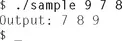
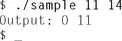
Unfortunately, sample does not always work properly, as demonstrated by the following failure:
BUG STORY 1
The First Bug
We do not know when the first defect in a program was introduced. What we know, though, is when the first actual bug was found. It may have been in search of plant food, or a warm place to lay its eggs, or both. Now it wandered around in this humming, warm machine that constantly clicked and rattled. But suddenly, it got stuck between the metal contacts of a relay—actually, one of 13,000 high-performance relays commissioned for this particular machine. The current killed it instantly—and its remains caused the machine to fail.
This first actual bug was a moth, retrieved by a technician from the Harvard Mark II machine on September 9, 1947. The moth got taped into the logbook, with the comment” 1545 Relay #70 Panel F (moth) in relay. First actual case of bug being found.” The moth thus became the living proof that computer problems could indeed be caused by actual bugs.
Although the sample output is sorted and contains the right number of items, some original arguments are missing and replaced by bogus numbers. Here, 14 is missing and replaced by 0. (Actual bogus numbers and behavior on your system may vary.) From the sample failure, we can deduce that sample has a bug (or, more precisely, a defect). This brings us to the key question of this chapter:
HOW DOES A DEFECT CAUSE A FAILURE, AND HOW CAN WE FIX IT?
1.2 FROM DEFECTS TO FAILURES
In general, a failure such as that in the sample program comes about in the four stages discussed in the following.
1. The programmer creates a defect. A defect is a piece of the code that can cause an infection. Because the defect is part of the code, and because every code is initially written by a programmer, the defect is technically created by the programmer. If the programmer creates a defect, does that mean the programmer was at fault? Not necessarily. Consider the following:

Table of contents
- Cover image
- Title page
- Table of Contents
- Copyright
- Foreword
- Preface
- ACKNOWLEDGMENTS
- Chapter 1: How Failures Come to Be
- Chapter 2: Tracking Problems
- Chapter 3: Making Programs Fail
- Chapter 4: Reproducing Problems
- Chapter 5: Simplifying Problems
- Chapter 6: Scientific Debugging
- Chapter 7: Deducing Errors
- Chapter 8: Observing Facts
- Chapter 9: Tracking Origins
- Chapter 10: Asserting Expectations
- Chapter 11: Detecting Anomalies
- Chapter 12: Causes and Effects
- Chapter 13: Isolating Failure Causes
- Chapter 14: Isolating Cause–Effect Chains
- Chapter 15: Fixing the Defect
- Chapter 16: Learning from Mistakes
- APPENDIX: Formal Definitions
- GLOSSARY
- BIBLIOGRAPHY
- INDEX
Trusted by 375,005 students
Access to over 1.5 million titles for a fair monthly price.
Study more efficiently using our study tools.
Frequently asked questions
Yes, you can cancel anytime from the Subscription tab in your account settings on the Perlego website. Your subscription will stay active until the end of your current billing period. Learn how to cancel your subscription
No, books cannot be downloaded as external files, such as PDFs, for use outside of Perlego. However, you can download books within the Perlego app for offline reading on mobile or tablet. Learn how to download books offline
Perlego offers two plans: Essential and Complete
- Essential is ideal for learners and professionals who enjoy exploring a wide range of subjects. Access the Essential Library with 800,000+ trusted titles and best-sellers across business, personal growth, and the humanities. Includes unlimited reading time and Standard Read Aloud voice.
- Complete: Perfect for advanced learners and researchers needing full, unrestricted access. Unlock 1.5M+ books across hundreds of subjects, including academic and specialized titles. The Complete Plan also includes advanced features like Premium Read Aloud and Research Assistant.
We are an online textbook subscription service, where you can get access to an entire online library for less than the price of a single book per month. With over 1.5 million books across 990+ topics, we’ve got you covered! Learn about our mission
Look out for the read-aloud symbol on your next book to see if you can listen to it. The read-aloud tool reads text aloud for you, highlighting the text as it is being read. You can pause it, speed it up and slow it down. Learn more about Read Aloud
Yes! You can use the Perlego app on both iOS and Android devices to read anytime, anywhere — even offline. Perfect for commutes or when you’re on the go.
Please note we cannot support devices running on iOS 13 and Android 7 or earlier. Learn more about using the app
Please note we cannot support devices running on iOS 13 and Android 7 or earlier. Learn more about using the app
Yes, you can access Why Programs Fail by Andreas Zeller in PDF and/or ePUB format, as well as other popular books in Ciencia de la computación & Programación. We have over 1.5 million books available in our catalogue for you to explore.