- 480 pages
- English
- ePUB (mobile friendly)
- Available on iOS & Android
eBook - ePub
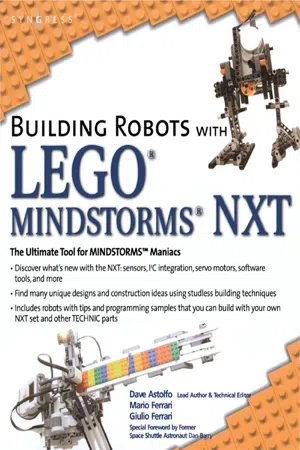
Building Robots with LEGO Mindstorms NXT
About this book
The Ultimate Tool for MINDSTORMS® ManiacsThe new MINDSTORMS kit has been updated to include a programming brick, USB cable, RJ11-like cables, motors, and sensors. This book updates the robotics information to be compatible with the new set and to show how sound, sight, touch, and distance issues are now dealt with. The LEGO MINDSTORMS NXT and its predecessor, the LEGO MINDSTORMS Robotics Invention System (RIS), have been called "the most creative play system ever developed." This book unleashes the full power and potential of the tools, sensors, and components that make up LEGO MINDSTORMS NXT. It also provides a unique insight on newer studless building techniques as well as interfacing with the traditional studded beams. Some of the world's leading LEGO MINDSTORMS inventors share their knowledge and development secrets. You will discover an incredible range of ideas to inspire your next invention. This is the ultimate insider's look at LEGO MINDSTORMS NXT system and is the perfect book whether you build world-class competitive robots or just like to mess around for the fun of it.Featuring an introduction by astronaut Dan Barry and written by Dave Astolfo, Invited Member of the MINDSTORMS Developer Program and MINDSTORMS Community Partners (MCP) groups, and Mario and Guilio Ferrari, authors of the bestselling Building Robots with LEGO Mindstorms, this book covers:Understanding LEGO GeometryPlaying with GearsControlling MotorsReading SensorsWhat's New with the NXT?Building StrategiesProgramming the NXTPlaying Sounds and MusicBecoming MobileGetting Pumped: PneumaticsFinding and Grabbing ObjectsDoing the MathKnowing Where You AreClassic ProjectsBuilding Robots That WalkRobotic AnimalsSolving a MazeDrawing and WritingRacing Against TimeHand-to-Hand CombatSearching for Precision
- Complete coverage of the new Mindstorms NXT kit
- Brought to you by the DaVinci's of LEGO
- Updated edition of a bestseller
Information
Chapter 1 Understanding LEGO® Geometry
Solutions in this chapter:

Introduction
Before you enter the world of LEGO robotics, we want to be sure you know and understand some basic geometric properties of the LEGO bricks and beams. Don’t worry; we’re not going to test you with complex equations or trigonometry. We’ll just discuss some very simple concepts and explain some terminology that will make assembling actual systems easier from the very beginning.
You will discover which units LEGO builders use to express sizes, the proportions of the bricks and beams, and how this affects the way you can combine them with different orientations into a solid structure.
In the past few years, there has been a shift from building with TECHNIC bricks and beams to building with studless beams, pins, and connectors. After we introduce some basic concepts, you will be exposed to these new ideas and see examples of how you can use studless building.
We encourage you to try to reproduce all the examples we show in this chapter with your own LEGO parts. If for any reason, you feel that what we present is too complex or boring, don’t force yourself to read it. Skip the chapter and go to another one. You can always come back and use this chapter as a sort of glossary whenever you need it.
Expressing Sizes and Units
LEGO builders usually express the size of LEGO parts with three numbers, representing width, length, and height, in that order. The standard way to use LEGO bricks is “studs up.” When expressing sizes, we always refer to this orientation, even when we are using the bricks upside down or rotating them in 3D space.
Height is the simplest property to identify. It’s the vertical distance between the top and bottom of the basic brick. Width, by convention, is the shorter of the two dimensions which lie on the horizontal plane (length is the other one). Both width and length are expressed in terms of studs, also called LEGO units. Knowing this, we can describe the measurements of the most traditional brick, the one whose first appearance dates back to 1949, which is 2 × 4 × 1 (see Figure 1.1).

Figure 1.1 The Traditional LEGO Brick
LEGO bricks, although their measurements are not expressed as such, are based on the metric system: A stud’s width corresponds to 8 mm and the height of a brick (minus the stud) to 9.6 mm. These figures are not important to remember. What’s important is that they do not have equal values, meaning you need two different units to refer to length and height. Their ratio is even more important: Dividing 9.6 by 8 you get 1.2 (the vertical unit corresponds to 1.2 times the horizontal one). This ratio is easier to remember if stated as a proportion between whole numbers: It is equivalent to 6:5. Figure 1.2 shows the smallest LEGO brick, described in LEGO units as a 1 × 1 × 1 brick. For the reasons explained previously, this LEGO “cube” is not a cube at all.

Figure 1.2 Proportions in a 1 × 1 × 1 LEGO Brick
The LEGO system includes a class of components whose height is one-third of a brick. The most important element of this class is the plate, which comes in a huge variety of rectangular sizes, and in some special shapes too. If you stack three plates, you get the height of a standard brick (see Figure 1.3).

Figure 1.3 Three Plates Make One Brick in Height
The advent of studless building has thrown a wrench into our understanding and use of the classic brick-and-plate-construction approaches. The new studless components provide a different way to construct LEGO models. The jury is still out regarding which method is better or more preferred—there are proponents on both sides of the fence with this. Figure 1.4 shows the traditional plates and bricks next to a newer TECHNIC beam and a set of three liftarms that are stacked, all to provide some reference on size. You will notice that their stacked heights are not compatible across the studded (left) and studless (right) parts.

Figure 1.4 Comparing Bricks to Studless Beams and Liftarms
The one thing that is undeniable is that LEGO has made a significant shift with its TECHNIC and MINDSTORMS lines toward studless components. If you are a die-hard studded builder, you are encouraged to take the plunge and try building studless. Many found the change in approach a challenge at first, but use it almost exclusively now. Studless building offers countless options for connectivity and even allows for building at odd angles that was difficult to accomplish with traditional beams.
Squaring the LEGO World: Vertical Bracing
Why do we care about all these relationships? To answer this, we must travel back to the late 1970s when the LEGO TECHNIC line was created. Up to that time, LEGO was designed and used to build things made of horizontal layers: Bricks and plates integrate pretty well when stacked together. Every child soon learns that three plates count for a brick, and this is all they need to know. But in 1977, LEGO decided to introduce a new line of products targeting an older audience: LEGO TECHNIC. It turned the common 1 × N brick holes into what ...
Table of contents
- Cover image
- Title page
- Table of Contents
- Copyright
- Lead Author and Technical Editor
- Lead Authors
- Contributors
- Foreword Contributor
- Foreword
- Preface
- Chapter 1: Understanding LEGO® Geometry
- Chapter 2: Playing with Gears
- Chapter 3: Controlling Motors
- Chapter 4: Reading Sensors
- Chapter 5: What’s New with the NXT?
- Chapter 6: Building Strategies
- Chapter 7: Programming the NXT
- Chapter 8: Playing Sounds and Music
- Chapter 9: Becoming Mobile
- Chapter 10: Getting Pumped: Pneumatics
- Chapter 11: Finding and Grabbing Objects
- Chapter 12: Doing the Math
- Chapter 13: Knowing Where You Are
- Chapter 14: Classic Projects
- Chapter 15: Building Robots That Walk
- Chapter 16: Robotic Animals
- Chapter 17: Solving a Maze
- Chapter 18: Drawing and Writing
- Chapter 19: Racing Against Time
- Chapter 20: Hand-to-Hand Combat
- Chapter 21: Searching for Precision
- Resources
- Matching Distances
- Note Frequencies
- Math Cheat Sheet
- Index
Trusted by 375,005 students
Access to over 1.5 million titles for a fair monthly price.
Study more efficiently using our study tools.
Frequently asked questions
Yes, you can cancel anytime from the Subscription tab in your account settings on the Perlego website. Your subscription will stay active until the end of your current billing period. Learn how to cancel your subscription
No, books cannot be downloaded as external files, such as PDFs, for use outside of Perlego. However, you can download books within the Perlego app for offline reading on mobile or tablet. Learn how to download books offline
Perlego offers two plans: Essential and Complete
- Essential is ideal for learners and professionals who enjoy exploring a wide range of subjects. Access the Essential Library with 800,000+ trusted titles and best-sellers across business, personal growth, and the humanities. Includes unlimited reading time and Standard Read Aloud voice.
- Complete: Perfect for advanced learners and researchers needing full, unrestricted access. Unlock 1.5M+ books across hundreds of subjects, including academic and specialized titles. The Complete Plan also includes advanced features like Premium Read Aloud and Research Assistant.
We are an online textbook subscription service, where you can get access to an entire online library for less than the price of a single book per month. With over 1.5 million books across 990+ topics, we’ve got you covered! Learn about our mission
Look out for the read-aloud symbol on your next book to see if you can listen to it. The read-aloud tool reads text aloud for you, highlighting the text as it is being read. You can pause it, speed it up and slow it down. Learn more about Read Aloud
Yes! You can use the Perlego app on both iOS and Android devices to read anytime, anywhere — even offline. Perfect for commutes or when you’re on the go.
Please note we cannot support devices running on iOS 13 and Android 7 or earlier. Learn more about using the app
Please note we cannot support devices running on iOS 13 and Android 7 or earlier. Learn more about using the app
Yes, you can access Building Robots with LEGO Mindstorms NXT by Mario Ferrari,Guilio Ferrari, David Astolfo in PDF and/or ePUB format, as well as other popular books in Computer Science & Cyber Security. We have over 1.5 million books available in our catalogue for you to explore.