- 544 pages
- English
- ePUB (mobile friendly)
- Available on iOS & Android
eBook - ePub
Self-Healing Polymer-Based Systems
About this book
Self-Healing Polymer-Based Systems presents all aspects of self-healing polymeric materials, offering detailed information on fundamentals, preparation methods, technology, and applications, and drawing on the latest state-of-the-art research.
The book begins by introducing self-healing polymeric systems, with a thorough explanation of underlying concepts, challenges, mechanisms, kinetic and thermodynamics, and types of chemistry involved. The second part of the book studies the main categories of self-healing polymeric material, examining elastomer-based, thermoplastic-based, and thermoset-based materials in turn. This is followed by a series of chapters that examine the very latest advances, including nanoparticles, coatings, shape memory, self-healing biomaterials, ionomers, supramolecular polymers, photoinduced and thermally induced self-healing, healing efficiency, life cycle analysis, and characterization. Finally, novel applications are presented and explained.
This book serves as an essential resource for academic researchers, scientists, and graduate students in the areas of polymer properties, self-healing materials, polymer science, polymer chemistry, and materials science. In industry, this book contains highly valuable information for R&D professionals, designers, and engineers, who are looking to incorporate self-healing properties in their materials, products, or components.
- Provides comprehensive coverage of self-healing polymeric materials, covering principles, techniques, and applications
- Includes the very latest developments in the field, such as the role of nanofillers in healing, life cycle analysis of materials, and shape memory assisted healing
- Enables the reader to unlock the potential of self-healing polymeric materials for a range of advanced applications
Information
Chapter 1
Self-healing polymeric systems—fundamentals, state of art, and challenges
Anu Surendran1 and Sabu Thomas1, 2, 11International and Inter University Centre for Nanoscience and Nanotechnology, Mahatma Gandhi University, Kottayam, India, 22School of Chemical Sciences, Mahatma Gandhi University, Kottayam, India
Abstract
The ability of polymeric systems to mimic self-healable biological systems can be traced back to the early 1980s. This chapter focuses on the basic fundamentals of self-healing polymeric systems. The important milestones of developing polymeric smart systems with self-healing ability are reviewed. Among these, various polymeric systems such as elastomers, thermoplastics, thermosets, and supramolecular polymeric systems have gained considerable significance in various applications such as structural components, coatings, and various other applications. Discussing of both chemical and nonchemical self-mendable polymeric systems, the recent reports in their related fields are also emphasized. The future perspectives and challenges toward designing self-mendable polymeric systems have serious implications on material safety, performance, and life time.
Keywords
Polymeric system; self-healing; nanofiller; hollow fiber; Diels–Alder; healing action
1.1 Introduction
The potential applications of the polymeric systems are fast advancing in the recent years in various structural applications such as aerospace, defense, and construction industries. The damage triggered by various factors such as mechanical, thermal, and chemical factors has serious implications on the structural integrity, performance, and life span of the material. A visible failure could be easily detected, whereas structural level microcracks remained undetected. A surge in the present understanding of the microstructure and failure mechanism has effected in exploring strategies for addressing the fatigue response of the material [1]. The prerequisite for self-healing is that damage triggers self-healing by generating a mobile phase which covers the damage zone by either physical or chemical interactions. One of the milestones was the development of smart materials where the “damage could automate a healing response in the material” [2]. The damage repair costs are higher, time consuming, and sometimes difficult to monitor if it occurs in the microstructure level.
Self-healing occurs by either autonomic or nonautonomic based on the type of response to damage. Autonomic response does not require any external stimuli; damage itself initiates the healing process. Nonautonomic healing requires an external stimulus such as light or heat for initiation of self-healing process. Another way to express the class of self-healing materials is as “extrinsic” and “intrinsic” self-healing materials. Extrinsic self-healing implies the encapsulation of micro- or nanocapsules into the material during the initial fabrication resulting in the healing. The healing action is triggered by the rupture of these capsules in the path of cracks, causing the release of healing agents onto the crack site. Intrinsic self-healing does not require any encapsulation of healing agents. It rather occurs by the physical/chemical interactions established between the crack interfaces which impart the self-healing action.
The ability to functionalization has paved the way for inducing self-healing property for polymeric systems. Also the inherent potential to accommodate healing agents in the apparently larger volume of macromolecular chain network also facilitates the easiness to induce self-healing property. Such self-healing materials find potential applications in automobile, civil, and aerospace applications. Self-healing materials manages to reduce the damage repair cost and economic burden enhancing the life time and material reliability. The demands for such smarter materials are booming and hence researchers show tremendous interest in fabricating and designing materials with self-healing property.
1.1.1 Extrinsic self-healing in polymeric systems
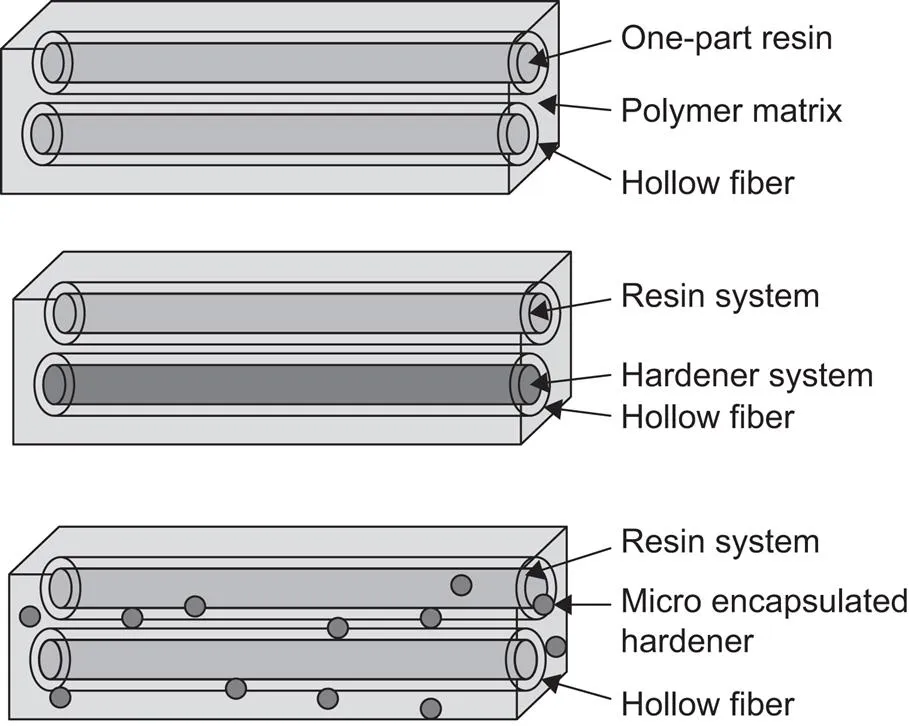
Extrinsic self-healing has been facilitated to polymeric materials for recovering the original properties of the materials at reasonable cost after damage. Extrinsic self-healing implies on three approaches based on micro/nanocapsules embedment, hollow fiber embedment, and microvascular system. In microencapsulation technique, healing agent is embedded or phase separated within the matrix so that healing occurs without external intervention. A catalyst is also incorporated into the matrix. The crack ruptures the micro/nanocapsules causing the release of healing agent into the matrix. The released healing agent traverses in the matrix through the capillary action, which come into contact with the catalyst causing polymerization and further clears the damage. The disadvantage of this technique is that it causes limited healing action due to the small amount of healing agent. Therefore multiple healing actions are not possible with the micro/nanocapsules. Bond and coworkers demonstrated self-healing utilizing the hollow glass fibers which contains healing agent [3–5]. Hollow glass fiber approach encapsulates more healing agent and also could reinforce the matrix and mostly preferred than micro encapsulated self-healing approach. Bond et al. [4] observed apparent restoration of compressive strength in epoxy resin-bonded hollow glass fiber. Fibers with large diameter and increased hollow fraction have incremental effect to the strength determined under axial compressive loading. About 97% of the mechanical strength was restored after investigation of impact properties followed by four-point bend flexural testing [3]. Fig. 1.1 [6] represents the schematic representation of self-healing via hollow fibers. Fig. 1.2 represents the representation of self-healing by micro/nanocapsules. Microvascular system mimics the biological vascular system in plants and animals with a continuous supply of healing agent through a centralized network. The crack-induced delivery of healants to the material furnishes multiple healing abilities and restores the properties [7]. The continuous delivery of healing agent in the three-dimensional microvascular systems opened up new avenues for repeatable healing in structural components. Of the three autonomic healing systems, microvascular healing systems often have highest efficiency.

Self-healing using microvascular interpenetrating networks was fabricated in epoxy resins via dual ink deposition and vertical ink writing [9]. Healing efficiency of 50% was retained even after 30 consecutive healing cycles. Nancy et al. [10] developed two sets of independent vascular networks; one comprising of resin part and other comprising of amine curing agent was embedded in the polymer substrate coating. The healing components got wicked under capillary action in the damage site and close the crack due to the reaction of the resin and curing agent. Coaxial electrospinning techniques were utilized for incorporation of linseed oil, a self-healing agent in graphene oxide (GO)-reinforced polyacrylonitrile (PAN) shells [11]. GO decorated PAN fibers were incorporated into PU coatings. When crack forms, linseed oil will be released and will react with oxygen and gets solidified covering the crack. Moreover, GO had improved the thermal stability of the material.
1.1.2 Intrinsic self-healing in polymeric systems
This is a class of nonautonomic healing system which requires external stimuli for self-healing. This involves healing process via bond rupture and bond reformation and could be operated over multiple times. Chemical reactions and molecular interactions which can be activated by heat, light, electrical energy, and magnetism are examples for such systems. Intrinsic self-healing is based on the presence of particular reversible chemical bonds. Since, intrinsic reversibility of these chemical bonds enables multiple healing responses at the same location.
Thermally reversible Diels–Alder (DA) reactions are most widely used for fabricating thermally reversible self-healing systems. DA reaction represents the class of [4+2] cycloaddition reaction which occurs between a diene and a dienophile. Alkenes and alkynes attached to electron withdrawing groups are mostly used as a dienophile to bring about the reaction with a diene. Furan–maleimide chemistry is mostly widely used in thermally reversible self-healing polymeric systems. Peterson et al. [12] utilized DA click chemistry for developing a reversibly cross-link gel as self-healing site in traditional epoxy-amine reaction. The healing could be repeated for about five cycles and 21% of the composite strength was recovered after the first healing cycle. Bowman et al. [13] observed interconversions of furan and maleimide and observed that reversible conversions occurred at 74% at 85°C to 24% at 155°C, in a cross-linked polymeric system. Park et al. [14] fabricated a novel self-mendable bis-maleimide tetrafuran (2MEP4F), based on DA reaction chemistry. Multiple self-healing after electrical resistive heating and shape memory effects were observed for these functional composites. 2MEP4F polymers restored molecular structure and retained the similar or slightly improved fracture resistance properties by thermally reversible DA and retro-DA chemistry [15].
Anthracene–maleimide DA system were also studied by many researchers for fabricating thermally reversible self-healing systems [16,17]. Poly(ethylene terephthalate) copolymers containing anthracene structural units are modified by DA reactions with maleimides was found to be thermally reversible at 250°C [16]. Syrett et al. [18] reported the synthesis of novel well-defined linear and...
Table of contents
- Cover image
- Title page
- Table of Contents
- Copyright
- List of Contributors
- Chapter 1. Self-healing polymeric systems—fundamentals, state of art, and challenges
- Chapter 2. Types of chemistries involved in self-healing polymeric systems
- Chapter 3. Self-healing polymers: from general basics to mechanistic aspects
- Chapter 4. Shape memory-assisted self-healing polymer systems
- Chapter 5. Characterization of self-healing polymeric materials
- Chapter 6. Role of nanoparticles in self-healing of polymeric systems
- Chapter 7. Self-healing biomaterials based on polymeric systems
- Chapter 8. Self-healing Diels–Alder engineered thermosets
- Chapter 9. Self-healing polymeric coatings containing microcapsules filled with active materials
- Chapter 10. Capsule-based self-healing polymers and composites
- Chapter 11. Ionomers as self-healing materials
- Chapter 12. Self-healing materials utilizing supramolecular interactions
- Chapter 13. Self-healing hydrogels
- Chapter 14. A continuum mechanics approach to the healing efficiency of extrinsic self-healing polymers
- Chapter 15. Self-healing fiber-reinforced polymer composites for their potential structural applications
- Chapter 16. Self-healing polymeric coating for corrosion inhibition and fatigue repair
- Chapter 17. Applications of self-healing polymeric systems
- Index
Trusted by 375,005 students
Access to over 1.5 million titles for a fair monthly price.
Study more efficiently using our study tools.
Frequently asked questions
Yes, you can cancel anytime from the Subscription tab in your account settings on the Perlego website. Your subscription will stay active until the end of your current billing period. Learn how to cancel your subscription
No, books cannot be downloaded as external files, such as PDFs, for use outside of Perlego. However, you can download books within the Perlego app for offline reading on mobile or tablet. Learn how to download books offline
Perlego offers two plans: Essential and Complete
- Essential is ideal for learners and professionals who enjoy exploring a wide range of subjects. Access the Essential Library with 800,000+ trusted titles and best-sellers across business, personal growth, and the humanities. Includes unlimited reading time and Standard Read Aloud voice.
- Complete: Perfect for advanced learners and researchers needing full, unrestricted access. Unlock 1.5M+ books across hundreds of subjects, including academic and specialized titles. The Complete Plan also includes advanced features like Premium Read Aloud and Research Assistant.
We are an online textbook subscription service, where you can get access to an entire online library for less than the price of a single book per month. With over 1.5 million books across 990+ topics, we’ve got you covered! Learn about our mission
Look out for the read-aloud symbol on your next book to see if you can listen to it. The read-aloud tool reads text aloud for you, highlighting the text as it is being read. You can pause it, speed it up and slow it down. Learn more about Read Aloud
Yes! You can use the Perlego app on both iOS and Android devices to read anytime, anywhere — even offline. Perfect for commutes or when you’re on the go.
Please note we cannot support devices running on iOS 13 and Android 7 or earlier. Learn more about using the app
Please note we cannot support devices running on iOS 13 and Android 7 or earlier. Learn more about using the app
Yes, you can access Self-Healing Polymer-Based Systems by Sabu Thomas, Anu Surendran, Sabu Thomas,Anu Surendran in PDF and/or ePUB format, as well as other popular books in Physical Sciences & Physics. We have over 1.5 million books available in our catalogue for you to explore.