- 888 pages
- English
- ePUB (mobile friendly)
- Available on iOS & Android
eBook - ePub
About this book
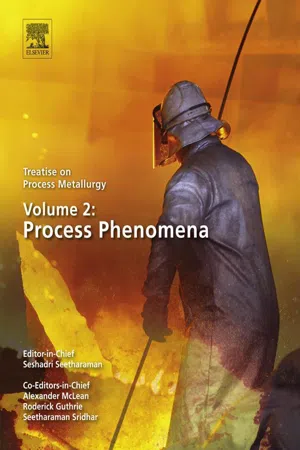
Process metallurgy provides academics with the fundamentals of the manufacturing of metallic materials, from raw materials into finished parts or products.
Coverage is divided into three volumes, entitled Process Fundamentals, encompassing process fundamentals, extractive and refining processes, and metallurgical process phenomena; Processing Phenomena, encompassing ferrous processing; non-ferrous processing; and refractory, reactive and aqueous processing of metals; and Industrial Processes, encompassing process modeling and computational tools, energy optimization, environmental aspects and industrial design.
The work distils 400+ years combined academic experience from the principal editor and multidisciplinary 14-member editorial advisory board, providing the 2,608-page work with a seal of quality.
The volumes will function as the process counterpart to Robert Cahn and Peter Haasen's famous reference family, Physical Metallurgy (1996)--which excluded process metallurgy from consideration and which is currently undergoing a major revision under the editorship of David Laughlin and Kazuhiro Hono (publishing 2014). Nevertheless, process and extractive metallurgy are fields within their own right, and this work will be of interest to libraries supporting courses in the process area.
- Synthesizes the most pertinent contemporary developments within process metallurgy so scientists have authoritative information at their fingertips
- Replaces existing articles and monographs with a single complete solution, saving time for busy scientists
- Helps metallurgists to predict changes and consequences and create or modify whatever process is deployed
Information
Subtopic
Mining EngineeringTable of contents
- Cover image
- Title page
- Table of Contents
- Copyright
- Dedication
- Preface
- Editor in Chief
- Contributors to Volume 2
- Acknowledgement
- Chapter 1. Interfacial Phenomena in High Temperature Metallurgy
- Chapter 1.1. Surfaces and Interfaces
- Chapter 1.2. Surface Tension and Contact Angle
- Chapter 1.3. Experiments
- Chapter 1.4. Surface Tension Models
- Chapter 1.5. Interfacial Free Energy and Wettability
- Chapter 1.6. Some Aspects of Electrochemistry of Interfaces
- Chapter 1.7. Interfacial Convection and Its Effect on Material Processing
- Chapter 1.8. Stability of Interface Between Liquid Steel and Molten Slag
- Chapter 1.9. Applications of Interfacial Phenomena in Process Metallurgy
- Chapter 2. Metallurgical Process Phenomena
- Chapter 2.1. The Importance of Metallurgical Process Phenomena
- Chapter 2.2. Kinetics of Gas–Liquid and Liquid–Liquid Reactions
- Chapter 2.3. Bubbles in Process Metallurgy
- Chapter 2.4. Foams and Foaming
- Chapter 2.5. Applications
- Chapter 3. Some Applications of Fundamental Principles to Metallurgical Operations
- Chapter 3.1. Some Metallurgical Considerations Pertaining to the Development of Steel Quality
- Chapter 3.2. Refractory Corrosion During Steelmaking Operations
- Chapter 3.3. Application of Slag Engineering Fundamentals to Continuous Steelmaking
- Chapter 3.4. Kinetics of Assimilation of Additions in Liquid Metals
- Chapter 4. Metallurgical Process Technology
- Chapter 4.1. Process Kinetics, Fluid Flow, and Heat and Mass Transfer, in Process Metallurgy
- Chapter 4.2. Turbulence Modeling and Implementation
- Chapter 4.3. Computational Fluid Mechanics
- Chapter 4.4. Solidification
- Chapter 4.5. Computational and Physical Modeling of Solidification in CCC and TSC
- Chapter 4.6. Single Phase, Two Phase, and Multiphase Flows, and Methods to Model these Flows
- Chapter 4.7. The Design of a New Casting Process: From Fundamentals to Practice
- Chapter 4.8. Conclusion
- Chapter 5. Computational Thermodynamics, Models, Software and Applications
- Chapter 5.1. Thermodynamics
- Chapter 5.2. Slag Viscosity Model
- Chapter 5.3. Applications
- Chapter 5.4. Process Modeling
- Index
Trusted by 375,005 students
Access to over 1.5 million titles for a fair monthly price.
Study more efficiently using our study tools.
Frequently asked questions
Yes, you can cancel anytime from the Subscription tab in your account settings on the Perlego website. Your subscription will stay active until the end of your current billing period. Learn how to cancel your subscription
No, books cannot be downloaded as external files, such as PDFs, for use outside of Perlego. However, you can download books within the Perlego app for offline reading on mobile or tablet. Learn how to download books offline
Perlego offers two plans: Essential and Complete
- Essential is ideal for learners and professionals who enjoy exploring a wide range of subjects. Access the Essential Library with 800,000+ trusted titles and best-sellers across business, personal growth, and the humanities. Includes unlimited reading time and Standard Read Aloud voice.
- Complete: Perfect for advanced learners and researchers needing full, unrestricted access. Unlock 1.5M+ books across hundreds of subjects, including academic and specialized titles. The Complete Plan also includes advanced features like Premium Read Aloud and Research Assistant.
We are an online textbook subscription service, where you can get access to an entire online library for less than the price of a single book per month. With over 1.5 million books across 990+ topics, we’ve got you covered! Learn about our mission
Look out for the read-aloud symbol on your next book to see if you can listen to it. The read-aloud tool reads text aloud for you, highlighting the text as it is being read. You can pause it, speed it up and slow it down. Learn more about Read Aloud
Yes! You can use the Perlego app on both iOS and Android devices to read anytime, anywhere — even offline. Perfect for commutes or when you’re on the go.
Please note we cannot support devices running on iOS 13 and Android 7 or earlier. Learn more about using the app
Please note we cannot support devices running on iOS 13 and Android 7 or earlier. Learn more about using the app
Yes, you can access Treatise on Process Metallurgy, Volume 2: Process Phenomena by in PDF and/or ePUB format, as well as other popular books in Technology & Engineering & Mining Engineering. We have over 1.5 million books available in our catalogue for you to explore.