eBook - ePub
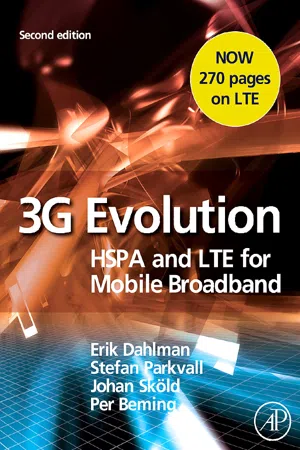
3G Evolution
HSPA and LTE for Mobile Broadband
- 648 pages
- English
- ePUB (mobile friendly)
- Available on iOS & Android
eBook - ePub
About this book
Reflecting the recent completion of LTE's specification, the new edition of this bestseller has been fully updated to provide a complete picture of the LTE system. The latest LTE standards are included on the radio interface architecture, the physical layer, access procedures, MBMS, together with three brand new chapters on LTE Transmission Procedures, Flexible Bandwidth in LTE and LTE evolution into IMT-Advanced.Key technologies presented include multi-carrier transmission, advanced single-carrier transmission, advanced receivers, OFDM, MIMO and adaptive antenna solutions, advanced radio resource management and protocols, and different radio network architectures. Their role and use in the context of mobile broadband access in general is explained. Both a high-level overview and more detailed step-by-step explanations of HSPA and LTE implementation are given. An overview of other related systems such as TD SCDMA, CDMA2000, and WiMAX is also provided.The new edition has up-to-date coverage of the recently published LTE Release 8 radio-access standard, giving the reader insight into the ongoing and future process of LTE and LTE-Advanced standardisation.Coverage on LTE in this edition includes ( total of 270 pages on LTE): Easy-to-access overview of the LTE protocol layersComplete description of LTE physical layer including reference signals, control signalling, multi-antenna transmission schemesCovers both FDD and TDD, their fundamental difference and their impact on the LTE designDetailed description of access procedures including cell search, random access, broadcast of system informationTransmission procedures, including retransmission protocols, scheduling, uplink power controlEvolution towards IMT-Advanced ("4G")"Reading a specification requires some effort. After reading the spec, you would know WHAT to transmit, but not WHY and HOW. This is where our book becomes important. Not only does it provide an easy-to-read description of the signals, procedures, and mechanisms in LTE, it also tells you WHY a certain signal, channel or procedure is present and HOW it is used. After reading the book, you will have a good understanding on how LTE works and why it is designed the way it is." - the authorsThe authors of the book all work at Ericsson Research and are deeply involved in 3G development and standardisation since the early days of 3G research. They are leading experts in the field and are today still actively contributing to the standardisation of both HSPA and LTE within 3GPP. This includes details of the standards and technologies (160 new pages): LTE radio interface architecture, LTE physical layer and LTE access procedures.
- Includes details of the standards and technologies (160 new pages): LTE radio interface architecture, LTE physical layer and LTE access procedures
- Contains three brand new chapters on LTE: Transmission Procedures, Flexible Bandwidth and LTE Evolution and expanded details on the physical layer (total LTE content is 270 pages)
- Examines the latest developments in the evolution of LTE into IMT-Advanced, the next stage of 3G Evolution
- Gives clear explanations of the role of OFDM and MIMO technologies in HSPA and LTE
- Outlines the System Architecture Evolution (SAE) supporting LTE and HSPA evolution
Information
Part I. Introduction
Chapter 1. Background of 3G Evolution
From the first experiments with radio communication by Guglielmo Marconi in the 1890s, the road to truly mobile radio communication has been quite long. To understand the complex 3G mobile-communication systems of today, it is also important to understand where they came from and how cellular systems have evolved from an expensive technology for a few selected individuals to today's global mobile-communication systems used by almost half of the world's population. Developing mobile technologies has also changed, from being a national or regional concern, to becoming a very complex task undertaken by global standards-developing organizations such as the Third Generation Partnership Project (3GPP) and involving thousands of people.
1.1. History and Background of 3G
The cellular technologies specified by 3GPP are the most widely deployed in the world, with more than 2.6 billion users in 2008. The latest step being studied and developed in 3GPP is an evolution of 3G into an evolved radio access referred to as the Long-Term Evolution (LTE) and an evolved packet access core network in the System Architecture Evolution (SAE). By 2009–2010, LTE and SAE are expected to be first deployed.
Looking back to when it all it started, it begun several decades ago with early deployments of analog cellular services.
1.1.1. Before 3G
The US Federal Communications Commission (FCC) approved the first commercial car-borne telephony service in 1946, operated by AT&T. In 1947 AT&T also introduced the cellular concept of reusing radio frequencies, which became fundamental to all subsequent mobile-communication systems. Commercial mobile telephony continued to be car-borne for many years because of bulky and power-hungry equipment. In spite of the limitations of the service, there were systems deployed in many countries during the 1950s and 1960s, but the users counted only in thousands at the most.
These first steps on the road of mobile communication were taken by the monopoly telephone administrations and wire-line operators. The big uptake of subscribers and usage came when mobile communication became an international concern and the industry was invited into the process. The first international mobile communication system was the analog NMT system (Nordic Mobile Telephony) which was introduced in the Nordic countries in 1981, at the same time as analog AMPS (Advanced Mobile Phone Service) was introduced in North America. Other analog cellular technologies deployed worldwide were TACS and J-TACS. They all had in common that equipment was still bulky, mainly car-borne, and voice quality was often inconsistent, with ‘cross-talk’ between users being a common problem.
With an international system such as NMT came the concept of ‘roaming,’ giving a service also for users traveling outside the area of their ‘home’ operator. This also gave a larger market for the mobile phones, attracting more companies into the mobile communication business.
The analog cellular systems supported ‘plain old telephony services,’ that is voice with some related supplementary services. With the advent of digital communication during the 1980s, the opportunity to develop a second generation of mobile-communication standards and systems, based on digital technology, surfaced. With digital technology came an opportunity to increase the capacity of the systems, to give a more consistent quality of the service, and to develop much more attractive truly mobile devices.
In Europe, the telecommunication administrations in CEPT[1] initiated the GSM project to develop a pan-European mobile-telephony system. The GSM activities were in 1989 continued within the newly formed European Telecommunication Standards Institute (ETSI). After evaluations of TDMA, CDMA, and FDMA-based proposals in the mid-1980s, the final GSM standard was built on TDMA. Development of a digital cellular standard was simultaneously done by TIA in the USA resulting in the TDMA-based IS-54 standard, later simply referred to as US-TDMA. A somewhat later development of a CDMA standard called IS-95 was completed by TIA in 1993. In Japan, a second-generation TDMA standard was also developed, usually referred to as PDC.
1 The European Conference of Postal and Telecommunications Administrations (CEPT) consist of the telecom administrations from 48 countries.
All these standards were ‘narrowband’ in the sense that they targeted ‘low-bandwidth’ services such as voice. With the second-generation digital mobile communications came also the opportunity to provide data services over the mobile-communication networks. The primary data services introduced in 2G were text messaging (SMS) and circuit-switched data services enabling e-mail and other data applications. The peak data rates in 2G were initially 9.6 kbps. Higher data rates were introduced later in evolved 2G systems by assigning multiple time slots to a user and by modified coding schemes.
Packet data over cellular systems became a reality during the second half of the 1990s, with General Packet Radio Services (GPRS) introduced in GSM and packet data also added to other cellular technologies such as the Japanese PDC standard. These technologies are often referred to as 2.5G. The success of the wireless data service iMode in Japan gave a very clear indication of the potential for applications over packet data in mobile systems, in spite of the fairly low data rates supported at the time.
With the advent of 3G and the higher-bandwidth radio interface of UTRA (Universal Terrestrial Radio Access) came possibilities for a range of new services that were only hinted at with 2G and 2.5G. The 3G radio access development is today handled in 3GPP. However, the initial steps for 3G were taken in the early 1990s, long before 3GPP was formed.
What also set the stage for 3G was the internationalization of cellular standardization. GSM was a pan-European project, but quickly attracted worldwide interest when the GSM standard was deployed in a number of countries outside Europe. There are today only three countries worldwide where GSM is not deployed. A global standard gains in economy of scale, since the market for products becomes larger. This has driven a much tighter international cooperation around 3G cellular technologies than for the earlier generations.
1.1.2. Early 3G Discussions
Work on a third-generation mobile communication started in ITU (International Telecommunication Union) in the 1980s. The radio communication sector ITU-R issued a first recommendation defining Future Public Land Mobile Telecommunications Systems (FPLMTS) in 1990, later revised in 1997 [48]. The name for 3G within ITU had by then changed from FPLMTS to IMT-2000. The World Administrative Radio Congress WARC-92 identified 230 MHz of spectrum for IMT-2000 on a worldwide basis. Of these 230 MHz, 2 × 60 MHz were identified as paired spectrum for FDD (Frequency Division Duplex) and 35 MHz as unpaired spectrum for TDD (Time Division Duplex), both for terrestrial use. Some spectrum was also set aside for satellite services. With that, the stage was set to specify IMT-2000.
Task Group 8/1 within ITU-R developed a range of recommendations for IMT-2000, defining a framework for services, network architectures, radio interface requirements, spectrum considerations, and evaluation methodology. Both a terrestrial and a satellite component were defined.
Task Group 8/1 defined the process for evaluating IMT-2000 technologies in ITU-R recommendation M.1225 [45]. The evaluation criteria set the target data rates for the 3G circuit-switched and packet-switched data services:
- Up to 2 Mbps in an indoor environment.
- Up to 144 kbps in a pedestrian environment.
- Up to 64 kbps in a vehicular environment.
These numbers became the benchmark that all 3G technologies were compared with. However, already today, data rates well beyond 2 Mbps can be seen in deployed 3G systems.
1.1.3. Research on 3G
In parallel with the widespread deployment and evolution of 2G mobile-communication systems during the 1990s, substantial efforts were put into 3G research activities. In Europe the partially EU-funded project Research into Advanced Communications in Europe (RACE) carried out initial 3G research in its first phase. 3G in Europe was named Universal Mobile Telecommunications Services (UMTS). In the second phase of RACE, the CODIT project (Code Division Test bed) and the ATDMA project (Advanced TDMA Mobile Access) further developed 3G concepts based on Wideband CDMA (WCDMA) and Wideband TDMA technologies. The next phase of related European research was Advanced Communication Technologies and Services (ACTS), which included the UMTS-related project Future Radio Wideband Multiple Access System (FRAMES). The FRAMES project resulted in a multiple access concept that included both Wideband CDMA and Wideband TDMA components.
At the same time parallel 3G activities were going on in other parts of the world. In Japan, the Association of Radio Industries and Businesses (ARIB) was in the process of defining a 3G wireless communication technology based on Wideband CDMA. Also in the US, a Wideband CDMA concept called WIMS was developed within the T1.P1[2] committee. Also Korea started work on Wideband CDMA at this time.
2 The T1.P1 committee was part of T1 which presently has joined the ATIS standardization organization.
The FRAMES concept was submitted to the standardization activities for 3G in ETSI,[3] where other multiple access proposals were also introduced by the industry, including the Wideband CDMA concept from the ARIB standardization in Japan. The ETSI proposals were merged into five concept groups, which also meant that the Wideband CDMA proposals from Europe and Japan were merged.
3 The TDMA part of the FRAMES project was also fed into 2G standardization as the evolution of GSM into EDGE (Enhanced Data rates for GSM Evolution).
1.1.4. 3G Standardization Starts
The outcome of the ETSI process in early 1998 was the selection of Wideband CDMA (WCDMA) as the technology for UMTS in the paired spectrum (FDD) and TD-CDMA (Time Division CDMA) for the unpaired spectrum (TDD). There was also a decision to harmonize the parameters between the FDD and the TDD components.
The standardization of WCDMA went on in parallel in ETSI and ARIB until the end of 1998 when the Third Generation Partnership Project (3GPP) was formed by standards-developing organizations from all regions of the world. This solved the problem of trying to maintain parallel development of aligned specifications...
Table of contents
- Copyright
- Brief Table of Contents
- Table of Contents
- List of Figures
- List of Tables
- Preface
- Acknowledgements
- Part I. Introduction
- Part II. Technologies for 3G Evolution
- Part III. HSPA
- Part IV. LTE and SAE
- Part V. Performance and Concluding Remarks
- Bibliography
- Index
Trusted by 375,005 students
Access to over 1.5 million titles for a fair monthly price.
Study more efficiently using our study tools.
Frequently asked questions
Yes, you can cancel anytime from the Subscription tab in your account settings on the Perlego website. Your subscription will stay active until the end of your current billing period. Learn how to cancel your subscription
No, books cannot be downloaded as external files, such as PDFs, for use outside of Perlego. However, you can download books within the Perlego app for offline reading on mobile or tablet. Learn how to download books offline
Perlego offers two plans: Essential and Complete
- Essential is ideal for learners and professionals who enjoy exploring a wide range of subjects. Access the Essential Library with 800,000+ trusted titles and best-sellers across business, personal growth, and the humanities. Includes unlimited reading time and Standard Read Aloud voice.
- Complete: Perfect for advanced learners and researchers needing full, unrestricted access. Unlock 1.5M+ books across hundreds of subjects, including academic and specialized titles. The Complete Plan also includes advanced features like Premium Read Aloud and Research Assistant.
We are an online textbook subscription service, where you can get access to an entire online library for less than the price of a single book per month. With over 1.5 million books across 990+ topics, we’ve got you covered! Learn about our mission
Look out for the read-aloud symbol on your next book to see if you can listen to it. The read-aloud tool reads text aloud for you, highlighting the text as it is being read. You can pause it, speed it up and slow it down. Learn more about Read Aloud
Yes! You can use the Perlego app on both iOS and Android devices to read anytime, anywhere — even offline. Perfect for commutes or when you’re on the go.
Please note we cannot support devices running on iOS 13 and Android 7 or earlier. Learn more about using the app
Please note we cannot support devices running on iOS 13 and Android 7 or earlier. Learn more about using the app
Yes, you can access 3G Evolution by Erik Dahlman,Stefan Parkvall,Johan Skold,Per Beming in PDF and/or ePUB format, as well as other popular books in Technology & Engineering & Electrical Engineering & Telecommunications. We have over 1.5 million books available in our catalogue for you to explore.