eBook - ePub
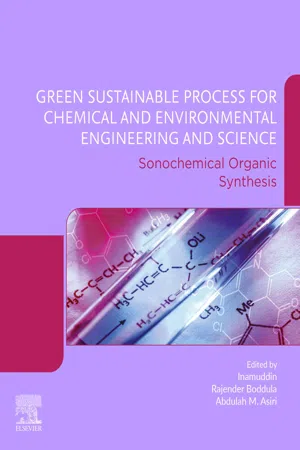
Green Sustainable Process for Chemical and Environmental Engineering and Science
Sonochemical Organic Synthesis
- 382 pages
- English
- ePUB (mobile friendly)
- Available on iOS & Android
eBook - ePub
Green Sustainable Process for Chemical and Environmental Engineering and Science
Sonochemical Organic Synthesis
About this book
Green Sustainable Process for Chemical and Environmental Engineering and Science: Sonochemical Organic Synthesis focuses on purification and extraction of organic, biological, and medicinal compounds using sonochemistry. It provides readers with an understanding of green ultrasound-assisted chemical synthesis for industrial applications. This book systematically explores the application of ultrasound in organic synthesis of all types and includes stereoselectivity, regioselectivity, oxidations, reductions, protection, deprotection, additions, condensation, coupling, C-X bond formation, named reactions, heterocyclics, biological drugs, and fluoroorganics over conventional techniques. A brief introduction to the parameters which influence the process, solvent-effects, supported reagents and catalysis and the pros and cons to the practical use of sonochemical protocols in organic synthesis are also discussed. This book provides overview on the applications of sonochemical technology for the sustainable and environmentally friendly development of synthetic methodologies for organic and pharmaceutical chemistry. Sonochemical Organic Synthesis is an essential resource on green chemistry technologies for academic researchers, R&D professionals, and students working in modern organic chemistry and medicinal chemistry.
- Offers a broad overview of ultrasonics-assisted green organic synthesis
- Discusses sonochemical technology for green organic synthesis and biological medicinal importance
- Gives detailed accounts of numerous industrial applications, including polymers, pharmaceutical, fluoroorganics, biofuel, carbon, and more
- Includes a description of significant factors and challenges in ultrasonics-assisted green organic synthesis
- Lists recent developments in the use of sonochemical technology in organic chemist
Information
Chapter 1
Ultrasound-assisted organic synthesis
Neha N. Gharat; Virendra K. Rathod Department of Chemical Engineering, Institute of Chemical Technology, Mumbai, India
Abstract
Rate of organic reactions can be increased by using a greener approach of high-intensity ultrasound irradiation. Ultrasound sonochemistry is more efficient in terms of cost-effectiveness, high-efficiency, low-waste, low-energy requirements, and gives excellent yield. This chapter briefly discusses the involved mechanism to carry out reactions, operating parameters considered while intensifying the process, reactor design with chemical kinetics for sonochemical reactions along with the scale-up requirement. Lastly, the application of sonochemistry, along with its future aspects in various commercial industries such as food, pharmaceutical, cosmetic, and chemical through multiple types of reactions, is also discussed.
Keywords
Ultrasound irradiation; Organic synthesis; Reactor design; Industrial application; Operating parameters
1 Introduction
Traditional methods to carry out organic synthesis reactions face drawbacks such as long reaction time, non-satisfactory yields, more solvent, toxic/costly reagent requirements and high temperatures and on the other hand, results in uneconomical products. Use of heterogeneous systems gives rise to mass transfer resistance issues depending on the number and type of phases present. It may also lead to agglomeration of particles which lowers surface area and eventually slows down the reaction rate. To overcome all these issues, the use of ultrasound (US) is a cost-effective method to intensify various reactions such as aqueous and nonaqueous homogeneous reactions, heterogeneous reactions, phase-transfer reactions, metal-organic frameworks, bio-enzymatic, among others.
Application of sound waves along with its chemical effects is termed as sonochemistry. The application of ultrasound waves was first tried in the early nineties by Richards and Loomis. This was followed by Schultes and Frenzel who studied the aqueous hydrogen peroxide formation at 540 kHz. Furthermore, in 1936, Schultes and Gohr observed that light could be produced by the high-intensity sonochemical reaction of liquids in the range of 190–750 nm wavelength. This phenomenon was termed as sonoluminescence. This long journey of sonochemistry has been remarkable after the 1980s, where cavitation phenomena was considered.
Ultrasound has been used as a process intensification tool, between 20 kHz and 5 MHz frequency range, for the removal of biologically active compounds nanoscale operations and formation of medicines. Chemical reactivity increases by ultrasound through the formation and collapse of cavitation bubbles in a liquid medium. The propagation of ultrasound waves takes place in a liquid medium in alternate compression as well as rarefaction and cavities are formed. Once the attractive forces of the liquid overcome by rarefaction cycle, the cavities grow to a maximum size and then burst resulting in energy dissipation (Fig. 1) [1–3]. Due to turbulence, corresponding with the liquid circulation associated with the creation and breakdown of the bubbles, mass transfer rates are improved. Whether ultrasound can be applied to accelerate the reaction chemically as well as physically depends on the local hot spots and by enhancing the mass transfer rates, respectively. In addition to improvement in mass transfer rates, it also gives better catalyst effectiveness. Typically, the effects of cavitation in aqueous medium incorporate elevated temperatures (2000–5000 K), pressures up to 1800 atmosphere. Ultrasound is beneficial to accelerate chemical reactions by improving yields, lowering reaction times as well as increasing selectivity. Due to all these reasons, it has been popularized as a novel approach for the production of organic compounds since the past couple of decades [4]. Even though, the use of ultrasound is beneficial for laboratory-scale operations; for its commercial implementation for organic synthesis, there are some engineering concerns such as missing scale-up procedures, efficient designs [5].

2 Extrinsic variables affecting ultrasound irradiation
The intensity of cavitation produced by ultrasound is dependent on various parameters. These parameters not only add in the cost of the process but also decide the scale-up of the reactor. Thus, it is essential to optimize these parameters for the particular system to get maximum yield at minimum cost. While carrying out US-assisted reactions, it is advisable to study the following parameters for the development of new analytical applications.
2.1 Influence of solvent
The change in solvent also changes the physicochemical properties, i.e., density, vapor pressure, surface tension, and viscosity which affects cavitation intensity, but chemical reactivity of the solvent has an intense effect on ultrasonication. The secondary reactions of sonolysis of water vapor between OH• and H• explain aqueous ultrasonication. At elevated temperature, solvent does not show inert behavior. It can be overcome by application of low vapor pressure solvent (except halocarbons) which reduces their concentration in the vapor phase of ultrasonication. In order to lower the viscosity of the medium, the solvent plays an important role by making it uniform and miscible [6]. Therefore, the selection of solvent has great importance in ultrasound irradiation.
The polarity of the solvent, along with denaturation conditions are the parameters that need to be considered while selecting the solvent for US-assisted enzymatic reactions. In a comparison of oil with methanol as a reactant/solvent for the synthesis of biodiesel, the bubble gets collapsed at a higher rate in methanol than that of oil. As the viscosity of methanol is lower than oil, the rate of bubble collapse in more in methanol. Therefore, methanol is preferred as a solvent in case of biodiesel formation due to the advantages of enhanced interfacial area and rate of reaction [7].
2.2 Influence of power
Chemical effects on a reaction can be caused by supplying sufficient acoustic energy so that the cavitation threshold of the medium is overcome. “Cavitational zone” is the region where cavitation occurs around the radiating source. This enhances with increasing intensity of dissipation. Cavitational intensity can be increased by increasing ultrasonic power. Also, with an increase in power, enhancement in the rate of reaction is observed and due to continuous use of power for a long time, rate of reaction decreases [8] which results in t...
Table of contents
- Cover image
- Title page
- Table of Contents
- Copyright
- Contributors
- Chapter 1: Ultrasound-assisted organic synthesis
- Chapter 2: Sonochemical protocol for catalyst-free organic synthesis
- Chapter 3: Sonochemical protocol for stereoselective organic synthesis
- Chapter 4: Sonochemical protocol for alkylation reactions
- Chapter 5: Sonochemical protocol for solvent-free organic synthesis
- Chapter 6: Sonochemical protocol for biocatalysis
- Chapter 7: Sonochemical protocol for coupling reactions
- Chapter 8: Sonochemical protocol for protection and deprotection of functional groups in organic synthesis
- Chapter 9: Sonochemical protocols for Grignard reactions
- Chapter 10: Sonochemical approach for the synthesis of organo-modified layered double hydroxides and their applications
- Chapter 11: Sonochemical protocol for the organo-synthesis of TiO2 and its hybrids: Properties and applications
- Chapter 12: Sonochemical protocol of polymer synthesis
- Chapter 13: Sonochemical methods and their leading properties for chemical synthesis
- Index
Trusted by 375,005 students
Access to over 1.5 million titles for a fair monthly price.
Study more efficiently using our study tools.
Frequently asked questions
Yes, you can cancel anytime from the Subscription tab in your account settings on the Perlego website. Your subscription will stay active until the end of your current billing period. Learn how to cancel your subscription
No, books cannot be downloaded as external files, such as PDFs, for use outside of Perlego. However, you can download books within the Perlego app for offline reading on mobile or tablet. Learn how to download books offline
We are an online textbook subscription service, where you can get access to an entire online library for less than the price of a single book per month. With over 1.5 million books across 990+ topics, we’ve got you covered! Learn about our mission
Look out for the read-aloud symbol on your next book to see if you can listen to it. The read-aloud tool reads text aloud for you, highlighting the text as it is being read. You can pause it, speed it up and slow it down. Learn more about Read Aloud
Yes! You can use the Perlego app on both iOS and Android devices to read anytime, anywhere — even offline. Perfect for commutes or when you’re on the go.
Please note we cannot support devices running on iOS 13 and Android 7 or earlier. Learn more about using the app
Please note we cannot support devices running on iOS 13 and Android 7 or earlier. Learn more about using the app
Yes, you can access Green Sustainable Process for Chemical and Environmental Engineering and Science by Rajender Boddula,Abdullah M. Asiri,Inamuddin,Dr. Inamuddin in PDF and/or ePUB format, as well as other popular books in Tecnologia e ingegneria & Ingegneria chimica e biochimica. We have over 1.5 million books available in our catalogue for you to explore.