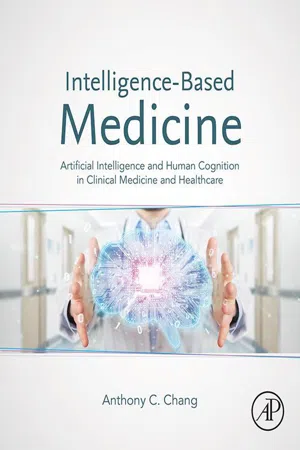
eBook - ePub
Intelligence-Based Medicine
Artificial Intelligence and Human Cognition in Clinical Medicine and Healthcare
- 534 pages
- English
- ePUB (mobile friendly)
- Available on iOS & Android
eBook - ePub
Intelligence-Based Medicine
Artificial Intelligence and Human Cognition in Clinical Medicine and Healthcare
About this book
Intelligence-Based Medicine: Data Science, Artificial Intelligence, and Human Cognition in Clinical Medicine and Healthcare provides a multidisciplinary and comprehensive survey of artificial intelligence concepts and methodologies with real life applications in healthcare and medicine. Authored by a senior physician-data scientist, the book presents an intellectual and academic interface between the medical and the data science domains that is symmetric and balanced.The content consists of basic concepts of artificial intelligence and its real-life applications in a myriad of medical areas as well as medical and surgical subspecialties. It brings section summaries to emphasize key concepts delineated in each section; mini-topics authored by world-renowned experts in the respective key areas for their personal perspective; and a compendium of practical resources, such as glossary, references, best articles, and top companies.The goal of the book is to inspire clinicians to embrace the artificial intelligence methodologies as well as to educate data scientists about the medical ecosystem, in order to create a transformational paradigm for healthcare and medicine by using this emerging new technology.
- Covers a wide range of relevant topics from cloud computing, intelligent agents, to deep reinforcement learning and internet of everything
- Presents the concepts of artificial intelligence and its applications in an easy-to-understand format accessible to clinicians and data scientists
- Discusses how artificial intelligence can be utilized in a myriad of subspecialties and imagined of the future
- Delineates the necessary elements for successful implementation of artificial intelligence in medicine and healthcare
Information
Part I
Introduction to Artificial Intelligence
Outline
Part I
Introduction to Artificial Intelligence
On March 10, 2016, Google DeepMind’s AlphaGo software made the game’s 37th move as it competed against the best human Go champion Lee Sedol: this move was so astonishing in its ingenuity that Sedol felt compelled to leave the room to recover. This moment, in which the computer or machine intelligence may have created an entirely novel Go strategy, heralded the recent dawning of a new era in artificial intelligence (AI).
The recent impressive gains in sophistication of deep learning (DL) technology and utilization especially since 2012 have led to an escalating momentum for AI awareness and adoption. Major universities with AI departments (such as Stanford, MIT, and Carnegie Mellon) and technology giants [such as IBM, Apple, Facebook, and Microsoft in the United States as well as other large companies such as Baidu, Alibaba, and Tencent (BAT) in China] are all fervidly exploring real-life applications of AI. Even though the advent of data science and machine and DL has advanced information and analyses (such as financial interactions and sports performance) and promoted innovations (such as virtual assistants, autonomous cars, drones, and even a work of art completed by DL that has fetched a few hundred thousand dollars at Christie’s), healthcare and medicine remain very much behind these other domains in leveraging this new AI paradigm. The recent major escalation of venture capital into healthcare and AI domain, however, promulgated over 100 companies in AI in healthcare with an expectant $50 billion to be spent on AI in healthcare by 2025 with more than $100 billion in savings. In early 2019 Google has announced its corporate direction in deploying its “AI-first strategy” into healthcare.
Since the first article published in the domain of AI in biomedicine in 1958 [1], there has been a relative paucity of published reports focused on AI in medical journals (perhaps about 100,000 total articles out of close to 50 million articles, or about 0.2%) and a congruent lack of serious interest amongst most clinicians in applications of AI in medicine. Even in 2018 there were only about 6000 reports on AI applications in medicine (under a myriad of AI-related search terms such as “artificial intelligence,” “machine learning,” “deep learning,” “cognitive computing,” and “natural-language processing”) out of a total of close to 1.8 million articles in over 28,000 journals, or a mere 0.35% of total medical publications. Finally, there is publication activity only very recently in the more prestigious journals that have been relatively quiescent in this domain for a lengthy period [2–5].
We all face the imbroglio of healthcare with its complex ecosystem and data in disarray, and this has led to a significant rise in professional burnout amongst its caretakers. We have a once-in-a-generation opportunity to capture this robust AI resource for clinical medicine and healthcare, and potentially make the transformational change that is so direly needed in the coming decades.
From reactive “Sick” care to proactive healthcare: the future of digital health and artificial intelligence (AI)
Daniel Kraft1, 2
1Medicine, Singularity University, Santa Clara, CA, United States 2Exponential Medicine, Singularity University, Santa Clara, CA, United States
As technology continues to advance, accelerate, and converge, massive new sources of data ranging from wearable devices, to personal genomics, to the information contained in our electronic medical records (EMRs) have manifested, including a wide array of “real-world” data increasingly sourced beyond the traditional four walls of the clinic or hospital bed. How and where we obtain, parse, and utilize this data when paired with the increasing capabilities of AI and machine learning have the potential to dramatically shift the practice of medicine—from one that is fundamentally a reactive “sick care” system, based on intermittent data historically only collected in the clinical environment, to one that is continuous, proactive, personalized, information-rich, and increasingly crowd-sourced and truly “healthcare” focused [1].
The first widely adopted consumer wearables only came to market in 2009 with the launch of FitBit, and 23andMe pioneered consumer genomics in 2007, democratizing access to genetic and wearable information and with the launch of Apple App Store in 2008 a rapidly growing app milieu, including 1000s of health-related apps were developed.
We have in the decade since seen an exponential growth of medical and health-related data, from ever higher resolution imaging platforms to emerging personal data sources, ranging from steps/activity and sleep data to consumer genome and microbiome sequencing, to data from Internet of Things, cameras, social media feeds, to now ECGs and blood pressure cuffs embedded in our clothing, smartwatches, and more.
The potential of our soon to be continuous data streams of our digital exhaust (coined the “digitome” (Fig. 1A) is enabling the measure of almost every component of physiology and behavior, brings the potential for a continuous, personalized, precise, and a proactive form of healthcare, moving to precision wellness … to diagnose/detect disease at earlier stages as well as help optimize and personalize therapy via iterative feedback loops.
The Digitome: the summation of digital data gathered to capture an individual’s current state of health, which might include genetic data, physiological parameters, medication status, diet, and lifestyle behaviors [1,2].

The “Quantified Self” movement has emerged, as many individuals track (and sometimes share) their personal data [3]. The opportunity has arrived to move beyond the individual Quantified Self, in which individuals recording, and analyze various aspects of their lives with data usually silo’d in their own possession, to an era “Quantified Health,” in which these various data streams can connect to the clinician and clinical care endeavor to “Quantified Health” enabling (1) improved individualized prevention based on objective measures, (2) earlier diagnosis leveraging algorithms to detect signs of problems at earlier stage, and (3) a more data and feedback-driven therapy utilizing everything from traditional drugs to digital interventions (Fig. 1B).
What is the clinician, already overwhelmed, to do with this wealth of new data (streaming real time, to historical), and ideally how might they leverage it to form actionable information that can be utilized across the healthcare continuum (wellness/prevention, diagnosis, and therapy to public health and clinical trials). Doctors “don’t know what to do with data from wearables,” nor is it often synthesized as meaningful, useful information integrated into the workflow of most medical record systems.
Recently, as application programing interfaces between various devices (both consumer and FDA grade) and massive consumer playe...
Table of contents
- Cover image
- Title page
- Table of Contents
- Copyright
- Dedication
- Quote
- About the author
- Foreword
- Foreword
- Preface
- Acknowledgments
- Part I: Introduction to Artificial Intelligence
- Part II: Data Science and Artificial Intelligence in the Current Era
- Part III: The Current Era of Artificial Intelligence in Medicine
- Part IV: The Future of Artificial Intelligence and Application in Medicine
- Conclusion
- Artificial intelligence in medicine compendium
- Glossary
- Key references
- Index
Trusted by 375,005 students
Access to over 1.5 million titles for a fair monthly price.
Study more efficiently using our study tools.
Frequently asked questions
Yes, you can cancel anytime from the Subscription tab in your account settings on the Perlego website. Your subscription will stay active until the end of your current billing period. Learn how to cancel your subscription
No, books cannot be downloaded as external files, such as PDFs, for use outside of Perlego. However, you can download books within the Perlego app for offline reading on mobile or tablet. Learn how to download books offline
We are an online textbook subscription service, where you can get access to an entire online library for less than the price of a single book per month. With over 1.5 million books across 990+ topics, we’ve got you covered! Learn about our mission
Look out for the read-aloud symbol on your next book to see if you can listen to it. The read-aloud tool reads text aloud for you, highlighting the text as it is being read. You can pause it, speed it up and slow it down. Learn more about Read Aloud
Yes! You can use the Perlego app on both iOS and Android devices to read anytime, anywhere — even offline. Perfect for commutes or when you’re on the go.
Please note we cannot support devices running on iOS 13 and Android 7 or earlier. Learn more about using the app
Please note we cannot support devices running on iOS 13 and Android 7 or earlier. Learn more about using the app
Yes, you can access Intelligence-Based Medicine by Anthony C. Chang in PDF and/or ePUB format, as well as other popular books in Biological Sciences & Biotechnology. We have over 1.5 million books available in our catalogue for you to explore.