
- 496 pages
- English
- ePUB (mobile friendly)
- Available on iOS & Android
eBook - ePub
RF Front-End: World Class Designs
About this book
All the design and development inspiration and direction a harware engineer needs in one blockbuster book! Janine Love site editor for RF Design Line,columnist, and author has selected the very best RF design material from the Newnes portfolio and has compiled it into this volume. The result is a book covering the gamut of RF front end design from antenna and filter design fundamentals to optimized layout techniques with a strong pragmatic emphasis. In addition to specific design techniques and practices, this book also discusses various approaches to solving RF front end design problems and how to successfully apply theory to actual design tasks. The material has been selected for its timelessness as well as for its relevance to contemporary RF front end design issues.Contents:Chapter 1 Radio waves and propagationChapter 2 RF Front End DesignChapter 3 Radio Transmission FundamentalsChapter 4 Advanced ArchitecturesChapter 5 RF Power AmplifiersChapter 6 RF AmplifiersCHAPTER 7 Basics of PA DesignChapter 8 Power AmplifiersChapter 9 RF/IF CircuitsChapter 10 FiltersChapter 11 Transmission Lines and PCBs as FiltersChapter 12 Tuning and MatchingChapter 13 Impedance MatchingChapter 14 RF Power Linearization Techniques
- Hand-picked content selected by Janine Love, RF DesignLine site editor and author
- Proven best design practices for antennas, filters, and layout
- Case histories and design examples get you off and running on your current project
Information
Chapter 1. Radio Waves and Propagation
So, let’s begin at the beginning. This chapter provides a basic understanding of radio waves, electric fields, and propagation. It also covers the basic formula for the relationship between frequency and wavelength. The bulk of this chapter is a great primer on how radio waves travel in real-world applications, including reflection and multipath, as well as containing quite a number of engaging sections on atmospheric effects.—Janine Sullivan Love
The properties of radio waves and the way in which they travel or propagate are of prime importance in the study of radio technology. These waves can travel over vast distances enabling communication to be made where no other means is possible. Using them, communication can be established over distances ranging from a few meters to many thousands of miles. This enables telephone conversations and many other forms of communication to be made with people on the other side of the world using shortwave propagation or satellites. Radio waves can be received over even greater distances. Radio telescopes pick up minute signals from sources many light years away.
Radio waves are a form of radiation known as electromagnetic waves. As they contain both electric and magnetic elements it is first necessary to take a look at these fields before looking at the electromagnetic wave itself.
1.1. Electric Fields
Any electrically charged object, whether it has a static charge or is carrying a current, has an electric field associated with it. It is a commonly known fact that like charges repel one another and opposite charges attract. This can be demonstrated in a number of ways. Hair often tends to stand up after it has been brushed or combed. The brushing action generates an electrostatic charge on the hairs, and as they all have the same type of charge they tend to repel one another and stand up. In this way it can be seen that a force is exerted between them. Examples like these are quite dramatic and result because the voltages that are involved are very high and can typically be many kilovolts. However, even the comparatively low voltages that are found in electronic circuits exhibit the same effects, although to a much smaller degree.
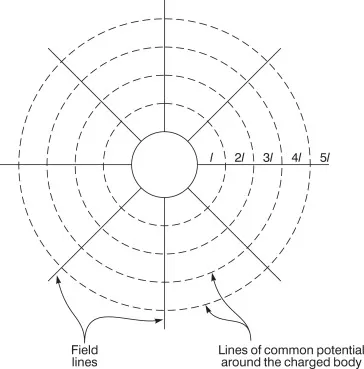
The electric field radiates out from any item with an electric potential as shown in Figure 1.1. The electrostatic potential falls away as the distance from the object is increased. Take the example of a charged sphere with a potential of 10 volts. At the surface of the sphere the electrostatic potential is 10 volts. However, as the distance from the sphere is increased, this potential starts to fall. It can be seen that it is possible to draw lines of equal potential around the sphere as shown in Figure 1.1.
Figure 1.1. Field lines and potential lines around a charged sphere
The potential falls away as the distance is increased from the sphere. It can be shown that the potential falls away as the inverse of the distance, i.e., doubling the distance halves the potential. The variation of potential with the distance from the sphere is shown in Figure 1.2.
Figure 1.2. Variation of potential with distance from the charged sphere
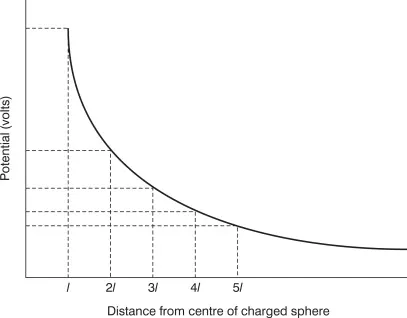
The electric field gives the direction and magnitude of the force on a charged object. The field intensity is the negative value of the slope in Figure 1.2. The slope of a curve plotted on a graph is the rate of change of a variable. In this case it represents the rate of change of the potential with distance at a particular point. This is known as the potential gradient. It is found that the potential gradient varies as the inverse square of the distance. In other words doubling the distance reduces the potential gradient by a factor of four.
1.2. Magnetic Fields
Magnetic fields are also important. Like electric charges, magnets attract and repel one another. Analogous to the positive and negative charges, magnets have two types of pole, namely a north and a south pole. Like poles repel and dissimilar ones attract. In the case of magnets it is also found that the magnetic field strength falls away as the inverse square of the distance.
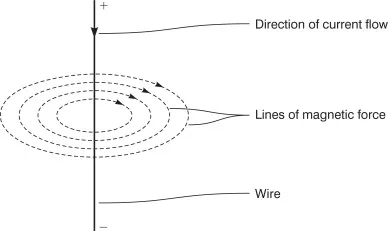
While the first magnets to be used were permanent magnets, much later it was found that an electric current flowing in a conductor generated a magnetic field (Figure 1.3). This could be detected by the fact that a compass needle placed close to the conductor would deflect. The lines of force are in a particular direction around the wire as shown. An easy method of determining which way they go around the conductor is to use the corkscrew rule. Imagine a right-handed corkscrew being driven into a cork on the direction of the current flow. The lines of force will be in the direction of rotation of the corkscrew.
Figure 1.3. Lines of magnetic force around a current-carrying conductor
1.3. Radio Waves
As already mentioned radio signals are a form of electromagnetic wave. They consist of the same basic type of radiation as light, ultraviolet and infrared rays, differing from them in their wavelength and frequency. These waves are quite complicated in their make-up, having both electric and magnetic components that are inseparable. The planes of these fields are at right angles to one another and to the direction of motion of the wave. These waves can be visualized as shown in Figure 1.4.
Figure 1.4. An electromagnetic wave
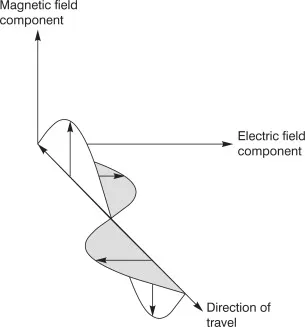
The electric field results from the voltage changes occurring in the antenna which is radiating the signal, and the magnetic field changes result from the current flow. It is also found that the lines of force in the electric field run along the same axis as the antenna, but spreading out as they move away from it. This electric field is measured in terms of the change of potential over a given distance, e.g., volts per meter, and this is known as the field strength.
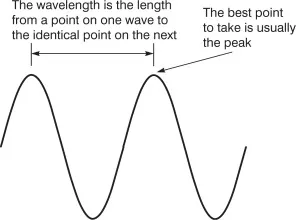
There are a number of properties of a wave. The first is its wavelength. This is the distance between a point on one wave to the identical point on the next, as shown in Figure 1.5. One of the most obvious points to choose is the peak, as this can be easily identified, although any point is acceptable.
Figure 1.5. The wavelength of an electromagnetic wave
The second property of the electromagnetic wave is its frequency. This is the number of times a particular point on the wave moves up and down in a given time (normally a second). The unit of frequency is the hertz and it is equal to one cycle per second. This unit is named after the German scientist who discovered radio waves. The frequencies used in radio are usually very high. Accordingly the prefixes kilo-, mega-, and giga- are often seen; 1 kHz is 1000 hertz, 1 MHz is a million hertz, and 1 GHz is a thousand million hertz, i.e., 1000 MHz. Originally the unit of frequency was not given a name and cycles per second (c/s) were used. Some older books may show these units together with their prefixeskc/s, Mc/s, etc. for higher frequencies.
The third major property of the wave is its velocity. Radio waves travel at the same speed as light. For most practical purposes the speed is taken to be 300,000,000 meters per second, although a more exact value is 299,792,500 meters per second.
1.4. Frequency to Wavelength Conversion
Many years ago the position of stations on the radio dial was given in terms of wavelengths. A station might have had a wavelength of 1500 meters. Today stations give out their frequency because nowadays this is far easier to measure. A frequency counter can be used to measure this very accurately, and with today’s technology their cost is relatively low. It is very easy to relate the frequency and wavelength as they are linked by the speed of light as shown:

where λ = the wavelength in meters
f = frequency in hertz
c = speed of radio waves (light) taken as 300,000,000 meters per second for all practical purposes
Taking the previous example the wavelength of 1500 meters corresponds to a frequency of 300,000,000/1500 or 200 thousand hertz (200 kHz).
1.5. Radio Spectrum
Electromagnetic waves have a wide variety of frequencies. Radio signals have the lowest frequency, and hence the longest wavelengths. Above the radio spectrum, other forms of radiation can be found. These include infrared radia...
Table of contents
- Brief Table of Contents
- Table of Contents
- Copyright Page
- Preface
- About the Editor
- About the Contributors
- Chapter 1. Radio Waves and Propagation
- Chapter 2. RF Front-End Design
- Chapter 3. Radio Transmission Fundamentals for WLANs
- Chapter 4. Advanced Architectures
- BibliographyReferences
- Chapter 5. RF Power Amplifiers
- BibliographyReferences
- Chapter 6. RF Amplifiers
- Chapter 7. Basics of PA Design
- BibliographyReferences
- Chapter 8. Power Amplifiers
- BibliographyReferences
- Chapter 9. RF/IF Circuits
- Chapter 10. Filters
- BibliographyReferences
- Chapter 11. Transmission Lines and PCBs as Filters
- BibliographyReferences
- Chapter 12. Tuning and Matching
- Chapter 13. Impedance Matching
- Chapter 14. RF Power Amplifier Linearization Techniques
- BibliographyReferences
- Index
Trusted by 375,005 students
Access to over 1.5 million titles for a fair monthly price.
Study more efficiently using our study tools.
Frequently asked questions
Yes, you can cancel anytime from the Subscription tab in your account settings on the Perlego website. Your subscription will stay active until the end of your current billing period. Learn how to cancel your subscription
No, books cannot be downloaded as external files, such as PDFs, for use outside of Perlego. However, you can download books within the Perlego app for offline reading on mobile or tablet. Learn how to download books offline
Perlego offers two plans: Essential and Complete
- Essential is ideal for learners and professionals who enjoy exploring a wide range of subjects. Access the Essential Library with 800,000+ trusted titles and best-sellers across business, personal growth, and the humanities. Includes unlimited reading time and Standard Read Aloud voice.
- Complete: Perfect for advanced learners and researchers needing full, unrestricted access. Unlock 1.5M+ books across hundreds of subjects, including academic and specialized titles. The Complete Plan also includes advanced features like Premium Read Aloud and Research Assistant.
We are an online textbook subscription service, where you can get access to an entire online library for less than the price of a single book per month. With over 1.5 million books across 990+ topics, we’ve got you covered! Learn about our mission
Look out for the read-aloud symbol on your next book to see if you can listen to it. The read-aloud tool reads text aloud for you, highlighting the text as it is being read. You can pause it, speed it up and slow it down. Learn more about Read Aloud
Yes! You can use the Perlego app on both iOS and Android devices to read anytime, anywhere — even offline. Perfect for commutes or when you’re on the go.
Please note we cannot support devices running on iOS 13 and Android 7 or earlier. Learn more about using the app
Please note we cannot support devices running on iOS 13 and Android 7 or earlier. Learn more about using the app
Yes, you can access RF Front-End: World Class Designs by Janine Love in PDF and/or ePUB format, as well as other popular books in Technology & Engineering & Industrial Design. We have over 1.5 million books available in our catalogue for you to explore.