- 302 pages
- English
- ePUB (mobile friendly)
- Available on iOS & Android
eBook - ePub
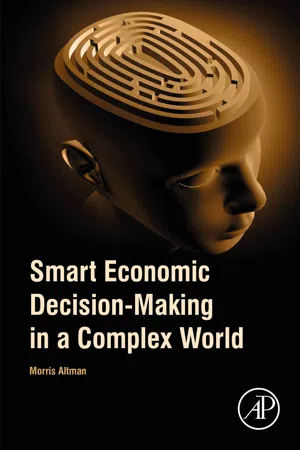
Smart Economic Decision-Making in a Complex World
About this book
Smart Economic Decision-Making in a Complex World is a fresh and reality-based perspective on decision-making with significant implications for analysis, self-understanding and policy. The book examines the conditions under which smart people generate outcomes that improve their place of work, their household and society. Within this work, the curious reader will find interesting open questions on many fascinating areas of current economic debate, including, the role of realistic assumptions robust model building, understanding how and when non-neoclassical behavior is best practice, why the assumption of smart decision-makers is best to understand and explain our economies and societies, and under what conditions individuals can make the best possible choices for themselves and society at large.
Additional sections cover when and how efficiency is achieved, why inefficiencies can persist, when and how consumer welfare is maximized, and what benchmarks should be used to determine efficiency and rationality.
- Makes the case for 'smart and rational' decision-making as a context-dependent rational process that is framed by socio-cultural environment and conditioned by institutional capacities
- Explains how incorporation of the 'smart' decision-maker concept into economic thought improves our understanding of how, why and when people generate certain outcomes
- Explores how economic efficiency can be achieved, individual preferences realized, and social welfare maximized through the use of 'smart and rational' approaches
Information
Chapter 1
Introduction: Smart thinking in the real world of complexity
Abstract
A central theme of this chapter and of this book is that individuals are smart and this sense rational and can be expected to make smart choices. But these choices typically do not conform the behavioural norms specified by conventional economics for rational behaviour and, therefore, for rational choices. Smart thinking encompasses behaviour that is based on what the individuals deem to be the best path towards achieving their objectives. This behaviour is heavily affected by their decision-making environment as well as their decision-making capabilities, neither of which need be ideal nor fit for purpose. Smart thinking and smart decision-making therefore overlap with the concepts of bounded rationality and satisficing developed by Simon. But smart thinking or broadly rational behaviour might very well appear to be irrational from the prism of conventional economics because they typically don’t conform to conventional behavioural norms for rationality. I also argue, flowing upon Gigerenzer’s fast and frugal heuristics narrative, that adhering to these conventional behavioural norms can result in sub-optimal outcomes from the point of view of the individual decision-maker. Indeed, adopting different behavioural norms and making different choices often yield better outcomes. Being neoclassically rational can actually yield sub-optimal or inefficient outcomes. Ultimately, optimal decision-making norms is context dependent—one size does not fit all. These norms can involve either slow or fast thinking (Kahneman), dependent on circumstance. Also, in the smart thinking narrative errors and biases in decision-making can still take place, but they are correctable through experience and appropriate changes in decision-making capabilities and the decision-making environment. The latter can also correct for any externalities that are often part and parcel of smart or rational decision-making. This chapter also provides a chapter-by-chapter summary of this book.
Keywords
Smart thinking; Bounded rationality; Satisficing; Rationality; Decision-making environment; Capabilities; Heuristics; Errors and biases; Optimality; Externalities
A fundamental point that I make in this book is that individuals tend to be smart and are capable of making decisions that are in their own best interest.a But their decisions are impacted by their decision-making environment and their decision-making capabilities (which include bargaining power and human and gender rights). Gaps in this environment and their capabilities, which should be expected in the real world of complexity and differential power relationships, can result in decisions that are not best or ‘optimal’ from the point of view of the individual. But this has more to do with circumstances that are exogenous; largely beyond the control of the individual. Ultimately, people end up making smart decisions, doing the best they can (or satisficing) given their particular circumstances.b But these smart individuals can make poor or error-prone decisions given the constraints and opportunities (or lack thereof) which they face. And, these sub-optimal decisions can be improved upon by changing their decision-making environment and their decision-making capabilities (Altman, 2017a, 2017b).
This does not mean that smart decision-makers (concerned with their own wellbeing or even that of their families or close friends) will be intent on doing the best for their communities, firms, or even households. Their smart, intelligent, or rational behaviour can be harmful to others. As economists would put it, individual behaviour can have negative externalities. This problem can be fixed by repairing the decision-making environment so that individuals bear the cost of their socially pernicious behaviour (Thaler & Sunstein, 2008).
Overall, I argue, one should respect the preferences of individuals. Individuals, however, require the environment and capabilities to construct informed preferences and make choices that improve their wellbeing without causing harm to others. One should not be bent on forcing and manipulating individuals to make choices that experts prefer, unless free choice causes harm to others.
This book builds upon the research of Herbert Simon and, more generally, the Carnegie-Mellon school of behavioural economics. I refer to this approach to behavioural economics as the bounded rationality methodological approach to behavioural economics (Altman, 1999, 2005, 2015, 2017a, 2017b).c In this perspective, the prior assumption is that decision-makers are relatively rational, intelligent and smart (satisficing, boundedly rational and evolutionarily rational). As one of the intellectual leaders of the Carnegie-Mellon school, James March (1978, p. 589) stated, it is of primary importance to determine if we can explain human behaviour in terms of rationality, broadly defined, even if at first glance such behaviour does not appear rational and might even appear to be error-prone or ‘biased’. More generally, I refer to this methodological approach as smart decision-making (Altman, 2017a, 2017b), which encompasses bounded rationality, procedural rationality, fast and frugal heuristics, slow and fast thinking, the brain as a scarce resource (following the insights of Freidrich Hayek) and the institutional, sociological and psychological-neurological determinants of decision-making. This is counter-posed to the world view of conventional or neoclassical rationality as well as the heuristics and biases perspective on behavioural economics, pioneered by Kahneman and Tversky (Kahneman, 2003, 2011), that now dominates contemporary behavioural economics. This perspective is closely tied to the nudging approach to public policy wherein one serious point of focus is assuming that experts can drive welfare enhancing decisions on behalf of highly biased and, moreover, persistently biased individuals.
Smart decision-making encompasses intelligent or smart decision-makers or agents, who develop or adopt decision-making processes and make decisions given their cognitive limitations, the decision-making mechanism of the brain, individuals (or economic agents) decision-making capabilities, decision-making experience, environmental factors, which include institutional and legal parameters, culture and norms, relative power in the decision-making process and related sociological factors. It is also recognized that cognitive limitations are affected by technology (computers and calculators, for example), the capabilities to effectively use new or improved technologies and the learning processes that affect how the brain is hardwired (neuroplasticity). Smart decision-makers or agents do the best they can, given the pertinent circumstances that affect the decision-making process and related outcomes. Herbert Simon refers to the act of doing the best we can as satisficing behaviour. Satisficing, however, need not result in the best possible or optimal outcomes for the firm, household, society or individual; but it can, depending on circumstances.
Deviations from optimality do not imply that decision-makers are not smart and in this sense irrational. Nor does establishing that decision-makers are smart imply that decision-making outcomes are optimal. Here rationality, broadly defined, relates to the choices people make and the decision-making processes adopted by individuals given their various constraints and opportunities as well as their decision-making environment. Optimality in production and consumption at an individual, firm, household or social level need not necessarily flow from smart decision-making. Smart decision-making, however, would often be a necessary but not a sufficient condition for optimality to be obtained. What these sufficient conditions might be are critically important to research that stems from the smart agent or smart decision-making perspective.
Inadequate decision-making environments, for example, would preclude smart agents from achieving optimal results from their own and from society’s perspective (where externalities exist). For example, you might wish to increase your savings for retirement, but you invest in high-risk high-return financial paper because of the false or misleading financial information provided to you, resulting in you losing much of your savings. You might employ a low wage strategy for your firm because you are adopting (with good intent) a false mental model (theoretical framework) on the impact of higher wages of firm competitiveness. Women might want to have one child, but they end up giving birth to four or five, because they are not empowered to realize their preferences. A firm’s productivity might not be maximized because decision-makers are maximizing a complex utility function that includes managerial slack and short-term returns. None of the above is a product of irrationality. They are a product of preferences, misleading information, false mental models, decision-making capabilities, experience and the overarching decision-making environment.
Conventional theory’s point of focus is on very generalized concepts related to how humans should behave and are expected to behave to generate optimal outcomes. As long as the analytical prediction is correct, all is well. This is effectively the correlation-based analysis promoted by Friedman (1953). If you get the prediction correct, you can assume for reasons of simplicity that humans behave as if they are maximizing profits, minimizing costs and maximizing utility (which is often assumed to be identical wealth maximization, controlling for risk). The realism of the simplifying assumptions we make about decision-makers, the decision-making processes and the decision-making environment are not of importance from this perspective. We can simply assume that individuals behave as if they are maximizing profits or utility, as long as the analytical prediction is the correct prediction (Berg & Gigerenzer, 2010). The assumption here is that individuals ideally should behave ‘neoclassically’, if they are rational, which they are assumed to be. Rationality is defined in terms of neoclassical rationality. Apart from this, what transpires in the decision-making process is not of substantive interest. We simply abide methodologically with neoclassical simplifying assumptions of how individuals behave within the firm and in the household. Moreover, it is further assumed that the decision-making environment allows for the realization of optimal outcomes, given neoclassical rationality, for the individual, the household and the firm.
The analytical focus, therefore, is on correlation as opposed to true causation, where the latter relates to determining what particular behaviours and decision-making environments generate particular outcomes. Modelling true causation would address issues of spurious correlation, omitted variables and the possibility of alternative behaviours, yielding similar sustainable outcomes. What is key is the determination of what specific behaviours, decision-making processes and institutional and sociological variables yield specific outcomes. This deeper modelling agenda is part of the bounded rationality approach to behavioural economics.
The bounded rationality tradition in behavioural economics plays particular attention to identifying the actual decision-making process that generates particular outcomes. It ventures into the black box of the firm, the household and the individual. Only by understanding how individuals actually behave, how they make decisions, can we determine if these decisions are smart and in this broad sense rational. Hence, rationality here is contextualized. Benchmarks for what is rational are, therefore, not constructed by some imagined ideal unrelated to the decision-making capabilities and environments of the individual, household or firm.
For this reason, a core attribute of the approach taken in this book is, following from Simon, the overall importance of reasonable, reality-based, simplifying modelling assumptions for robust economic analysis. Related to this is the significance of situating our definition of rationality and smart decision-making in context. Simon writes (1986, p. s209):
The judgment that certain behavior is ‘rational’ or ‘reasonable’ can be reached only by viewing the behavior in the context of a set of premises or ‘givens.’ These givens include the situation in which the behavior takes place, the goals it is aimed at realizing, and the computational means available for determining how the goals can be attained. In the course of this conference, many participants referred to the context of behavior as its ‘frame,’ a label that I will also use from time to time. Notice that the frame must be comprehensive enough to encompass goals, the definition of the situation, and computational resources.
The smart agent, smart decision-making approach to decision-making and behavioural economics not only stands in contrast to what we find in much of conventional economics, it also stands in contrast, as mentioned above, to a theme running through much of contemporary behavioural economics where much of the typical individual’s behaviour is deemed irrational and error-prone (Altman, 2017a, 2017b). This is the heuristics and biases approach pioneered by Kahneman and Tversky (Kahneman, 2003, 2011). A common thread running through this approach and conventional economics is adopting neoclassical benchmarks for rationality and, flowing from this, benchmarks for optimal outcomes in the domain of consumption and product...
Table of contents
- Cover image
- Title page
- Table of Contents
- Copyright
- Dedication
- Endorsements
- Acknowledgements
- Chapter 1: Introduction: Smart thinking in the real world of complexity
- Chapter 2: The evolution of decision-making: Why institutions and capabilities matters
- Chapter 3: How complexity affects decision-making
- Chapter 4: Freedom of choice in a complex world
- Chapter 5: Understanding rational inefficiency: A scientific basis for economic failure and success
- Chapter 6: How consumers can achieve freedom of choice: When consumers are truly sovereign
- Chapter 7: Inside the black box of the firm: Why choice, power and preferences matter for productivity and efficiency
- Chapter 8: How smart people can be involuntarily employment when misguided policy dominates decision-making
- Chapter 9: Why financial literacy matters for socio-economic wellbeing
- Chapter 10: How labour markets really work
- Index
Trusted by 375,005 students
Access to over 1.5 million titles for a fair monthly price.
Study more efficiently using our study tools.
Frequently asked questions
Yes, you can cancel anytime from the Subscription tab in your account settings on the Perlego website. Your subscription will stay active until the end of your current billing period. Learn how to cancel your subscription
No, books cannot be downloaded as external files, such as PDFs, for use outside of Perlego. However, you can download books within the Perlego app for offline reading on mobile or tablet. Learn how to download books offline
Perlego offers two plans: Essential and Complete
- Essential is ideal for learners and professionals who enjoy exploring a wide range of subjects. Access the Essential Library with 800,000+ trusted titles and best-sellers across business, personal growth, and the humanities. Includes unlimited reading time and Standard Read Aloud voice.
- Complete: Perfect for advanced learners and researchers needing full, unrestricted access. Unlock 1.5M+ books across hundreds of subjects, including academic and specialized titles. The Complete Plan also includes advanced features like Premium Read Aloud and Research Assistant.
We are an online textbook subscription service, where you can get access to an entire online library for less than the price of a single book per month. With over 1.5 million books across 990+ topics, we’ve got you covered! Learn about our mission
Look out for the read-aloud symbol on your next book to see if you can listen to it. The read-aloud tool reads text aloud for you, highlighting the text as it is being read. You can pause it, speed it up and slow it down. Learn more about Read Aloud
Yes! You can use the Perlego app on both iOS and Android devices to read anytime, anywhere — even offline. Perfect for commutes or when you’re on the go.
Please note we cannot support devices running on iOS 13 and Android 7 or earlier. Learn more about using the app
Please note we cannot support devices running on iOS 13 and Android 7 or earlier. Learn more about using the app
Yes, you can access Smart Economic Decision-Making in a Complex World by Morris Altman in PDF and/or ePUB format, as well as other popular books in Economics & Economic Theory. We have over 1.5 million books available in our catalogue for you to explore.