eBook - ePub
Solid/Liquid Separation
Scale-up of Industrial Equipment
- 454 pages
- English
- ePUB (mobile friendly)
- Available on iOS & Android
eBook - ePub
About this book
This book identifies test procedures used within sectors of the solid/liquid separation equipment industry, providing practical explanations for test data and their uses when faced with a new application to assess. With a strong practical emphasis, this book is ideal for use as a reference text for engineers concerned with applications evaluation of equipment or its scale-up. This book forms part of a five-volume set on all aspects of filtration and separation processes. One other volume is currently available from the set: Wakeman & Tarleton: Solid/Liquid Separation: Principles of Industrial Filtration.This book...•Provides guidance on how to tackle practical solid/liquid separation problems in an industrial setting•Shows how to plan, conduct and interpret experiments•Details test procedures, types of tests and how to interpret results when assessing a new application•Strong emphasis on current industrial practice•Provides a practical account which will help lead to the best use of appropriate equipment yielding optimal results·Provides guidance on how to tackle practical solid/liquid separation problems in an industrial setting·Shows how to plan, conduct and interpret experiments·Details test procedures, types of tests and how to interpret results when assessing a new application·Strong emphasis on current industrial practice·Provides a practical account which will help lead to the best use of appropriate equipment yielding optimal results
Information
Topic
Physical SciencesSubtopic
Fluid Mechanics1
Solid/liquid separation equipment selection
Richard Wakeman and Steve Tarleton, Department of Chemical Engineering, Loughborough University, Loughborough, Leics., LE11 3TU, UK
There are many solid/liquid separation techniques that have established general application within the process industries, and there are a few which are currently in their early stages of commercial exploitation. The dividing line between the two categories is open to dispute, and difficult to identify in a field which is noted for innovation and rapid development. The enormous choice of solid/liquid separation equipment is bewildering to the non-expert and selection of appropriate equipment is thus problematic to the design engineer. It is often difficult to identify the most appropriate separator without extensive previous knowledge of a similar separation problem.
The purpose of this chapter is to provide guidance on what form of small scale tests and results analysis are appropriate for the initial selection of equipment. The basis for the selection and ranking of potentially suitable equipment for a particular separation is described through knowledge of experimental data, selection charts and an expert system approach. Additional tables indicate how ranked equipment can be further short-listed for further investigation.
1.1 Methods of equipment selection
Although a number of different approaches to equipment selection have been proposed, the overall procedure can be summarised by the flowchart shown in Figure 1.1. The basic principle is to use a limited amount of data about the process and some preliminary knowledge of the separability of the feed together with a form of inference mechanism such as a selection chart or table. This combination allows the identification of a range of equipment that could be expected to carry out the required duty. If necessary, the equipment list can be shortened by performing further small scale test work more germane to the identified equipment. The final shortlist of equipment contains those items of equipment that are worth further evaluation through pilot testing and/or computer simulation.
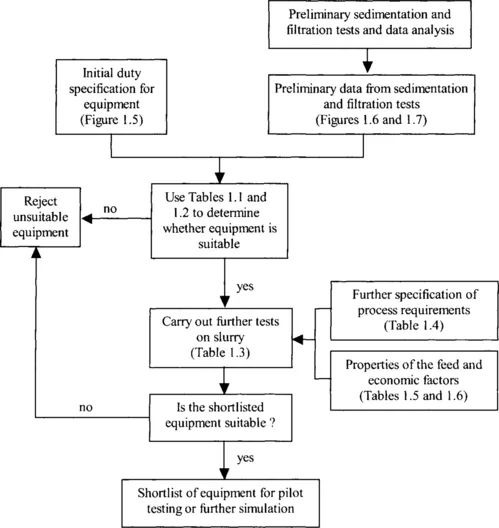
Figure 1.1 Flowchart for the selection of solid/liquid separation equipment
To carry out the steps shown in Figure 1.1, a number of different equipment selection schemes have been proposed. The information available may be categorised into five groups (Wakeman and Tarleton, 1999):
(a) General information (Hicks and Hillgard, 1970; Maloney, 1972; Alt, 1975).
(b) Non-ranked table: Equipment is placed in a list relative to some characterising parameter or performance indicator such as feed concentration, particle size in the feed or standard cake formation time (Flood et al, 1966; Davies, 1970; Purchas, 1970, 1972a, 1978, 1981; Hawkes, 1970; Emmett and Silverblatt, 1974, 1975; Day, 1974; Dahlstrom, 1978; Gaudfrin and Sabatier, 1978; Trawinski, 1980; Purchas and Wakeman, 1986; Pierson, 1990).
(c) Ranked table: Equipment performance is rated by one or more indices to produce ranked lists (Davies, 1965; Purchas, 1972b; Fitch, 1974, 1977; Moos and Dugger, 1979; Komline, 1980; Ernst et al, 1987, 1991). Indices are typically related to operational parameters such as solid product dryness, crystal breakage, cost etc.
(d) Logic diagram: A decision tree guides a user through a series of yes/no choices towards a potentially suitable generic class of separation equipment (Davies, 1965; Tiller, 1974; Pierson, 1990).
(e) Expert system: Rule-based computer programs select and rank potentially suitable separation equipment (Korhonen et al, 1989; Ernst et al, 1987, 1991; Garg et al, 1991; Tarleton and Wakeman, 1991, 2005) – only the latter has become commercially available (in the Filter Design Software (2005) package (FDS)).
The charts, tables and general information contained in categories (a)–(d) can be used as guides toward an initial selection of solid/liquid separation equipment. The better contributions consider a wider variety of possible eventualities, and indicate clearly where decisions must be made. The charts and tables have generally been devised by experts to be fairly comprehensive, and are of greatest value to the solid/liquid separation expert. They also illustrate the near impossibility of combining comprehensive descriptions with usability. Without ‘expert’ guidance it is extremely difficult for an end-user to correlate information and decide which equipment is more suitable for any particular application. Subsequent chapters in this book describe approaches to testing solid/liquid separation equipment and serve as a guide to the tests that need to be undertaken.
With the widespread availability of personal computers, it is obvious that the development of computer software is an ideal way to handle the complexities involved in equipment selection. Whilst rule-based expert systems appeared to provide the optimum solution at first, it later became apparent that inherent restrictions would prevent their widespread application. Thus, interactive personal computer software has been developed to commercial standards and this led to the release of FDS. The underlying philosophies used within the selection module of FDS are described in this chapter.
1.2 Test procedures
The general procedure developed by Purchas provides a valuable, non-specialist, guide through the complex and confusing area of equipment selection (Purchas and Wakeman, 1986). The basis of that procedure has been adopted here, and extended to include a wider range of separation methods as well as a method for the ranking of potentially suitable equipment.
The method requires some limited information about the separability of the suspension, which is provided by filter leaf tests and/or jar sedimentation tests. Similar alternative tests are described in later chapters of this book.
1.2.1 Jar sedimentation tests
The ability of the suspension to settle and the settling rate can be easily determined from a jar test. The settling rate depends on a number of factors – effective particle size, the specific gravity difference between the solid and liquid phases, the flocculated o...
Table of contents
- Cover image
- Title page
- Table of Contents
- Copyright
- Preface
- List of Contributors
- Chapter 1: Solid/liquid separation equipment selection
- Chapter 2: Chemical pre-treatment
- Chapter 3: Deep bed filters
- Chapter 4: Membrane filters – microfiltration and ultrafiltration
- Chapter 5: Pressure filters
- Chapter 6: Vacuum filters
- Chapter 7: Filtering centrifuges
- Chapter 8: Sedimenting centrifuges
- Index
Trusted by 375,005 students
Access to over 1.5 million titles for a fair monthly price.
Study more efficiently using our study tools.
Frequently asked questions
Yes, you can cancel anytime from the Subscription tab in your account settings on the Perlego website. Your subscription will stay active until the end of your current billing period. Learn how to cancel your subscription
No, books cannot be downloaded as external files, such as PDFs, for use outside of Perlego. However, you can download books within the Perlego app for offline reading on mobile or tablet. Learn how to download books offline
Perlego offers two plans: Essential and Complete
- Essential is ideal for learners and professionals who enjoy exploring a wide range of subjects. Access the Essential Library with 800,000+ trusted titles and best-sellers across business, personal growth, and the humanities. Includes unlimited reading time and Standard Read Aloud voice.
- Complete: Perfect for advanced learners and researchers needing full, unrestricted access. Unlock 1.5M+ books across hundreds of subjects, including academic and specialized titles. The Complete Plan also includes advanced features like Premium Read Aloud and Research Assistant.
We are an online textbook subscription service, where you can get access to an entire online library for less than the price of a single book per month. With over 1.5 million books across 990+ topics, we’ve got you covered! Learn about our mission
Look out for the read-aloud symbol on your next book to see if you can listen to it. The read-aloud tool reads text aloud for you, highlighting the text as it is being read. You can pause it, speed it up and slow it down. Learn more about Read Aloud
Yes! You can use the Perlego app on both iOS and Android devices to read anytime, anywhere — even offline. Perfect for commutes or when you’re on the go.
Please note we cannot support devices running on iOS 13 and Android 7 or earlier. Learn more about using the app
Please note we cannot support devices running on iOS 13 and Android 7 or earlier. Learn more about using the app
Yes, you can access Solid/Liquid Separation by Stephen Tarleton,Richard Wakeman in PDF and/or ePUB format, as well as other popular books in Physical Sciences & Fluid Mechanics. We have over 1.5 million books available in our catalogue for you to explore.