- 180 pages
- English
- ePUB (mobile friendly)
- Available on iOS & Android
eBook - ePub
About this book
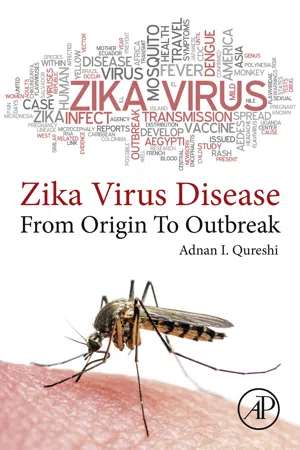
Zika Virus provides an authoritative account of one of most fascinating viruses of the 21st century, covering all the main points. It includes coverage of clinical manifestations, such as fever and fatigue, but also delves into neurological manifestations like acute demyelinating neuropathy. In addition, the book discusses new evidence that suggests that Zika fever in pregnant women can cause abnormal brain development in fetuses by mother-to-child transmission. The Zika virus infection has become one of the first where women are actively discouraged from getting pregnant. Readers will find this book to be a comprehensive resource on the topic.
- Covers every important aspect of the Zika virus disease, from biological, to social and economic impacts
- Focuses on women's health issues that have surfaced, including birth defects in newborns
- Written in an easy to comprehend manner, with technical terms clearly defined in chapters that highlight genetics
Information
Chapter 1
Origin of Zika Virus Disease
Abstract
It has long been agreed upon that mankind will always fear what it is unable to understand. Many of these fears stem from the thought of bodily harm that might lead to death or harm to future offspring. Most recently, the growing fear of an old infection long thought to be dormant has caused havoc and mayhem in a new subset community, most notably the pregnant women.
Keywords
Zika virus disease; Aedes africanus; Pacific Islands; WHO; CDC; Yap island; Outbreak
The rapidly evolving outbreak of Zika warns us that an old disease that slumbered for 6 decades in Africa and Asia can suddenly wake up on a new continent to cause a global health emergency.
WHO Director-General, Dr. Margaret Chan, May 23, 2016.
It has long been agreed upon that mankind will always fear what it is unable to understand. Many of these fears stem from the thought of bodily harm that might lead to death or harm to future offspring. Most recently, the growing fear of an old infection long thought to be dormant has caused havoc and mayhem in a new subset community, most notably the pregnant women.
Zika virus disease has been present for decades and was first discovered more than half a century ago. But where did it come from and how did it first manifest in those affected? These are the questions we will try to answer as we try to understand the origins of the Zika virus disease.
Zika virus is a type of virus that belongs to the Flavivirus family, which also includes viruses such as the West Nile virus, Dengue virus, tick-borne encephalitis virus, and Yellow Fever virus. Zika virus disease is a mosquito-borne disease, meaning it spreads most notably by the bite of an infected mosquito. These mosquitos can bite at anytime during the day or night. Currently, there are no vaccines available for the disease.1 The presence of this disease outside of the United States has been documented for decades. But panic spread when potentially infected cases inside the US territory were identified, especially in the southernmost states. This disease has had numerous outbreaks spanning from 1947 to the most recent outbreak in 2015, which began in Brazil and has spread to the US state of Florida and others.2
An Accidental or Incidental finding?
First Encounter
During the early 1940, there were many viruses being discovered in the mosquito population. Scientists from the National Institute for Medical Research in London, George W. A. Dick, and from the Division of Medicine and Public Health and the Rockefeller Foundation in New York, S. F. Kitchen and Alexander Haddow are considered to be the discoverers of the Zika virus disease.3 It can be argued that it may have been an accidental finding rather than a specific attempt at isolating the virus itself. Admittedly, many major discoveries throughout the centuries have been accidental, like Viagra or penicillin. The scientists were originally in Uganda to study and isolate Yellow Fever virus samples. According to existing sources, these two scientists isolated the Zika virus on two separate occasions approximately 9 months apart by two different methods.
Zika Forest is an isolated tropical forest approximately 4 miles from a centrally located town in Uganda called Entebbe. The forest is considered a property of Uganda Virus Research Institute, Entebbe (UVRIE), and is thus restricted from use by any foreign scientists. The forest is about 62 acres and is bordered by a swamp that is part of Lake Victoria—the lake itself is roughly 500 yards wide and 1 mile in length (Fig. 1.1).3,4 Due to the high levels of immunity to Yellow Fever in monkeys of the Entebbe peninsula, the scientists had chosen Zika Forest as a study location. Alexander Haddow, a virologist, had set up the sentinel rhesus monkey program where rhesus monkey were caged high in the canopy.5 Supposedly these treetop locations, coupled with the temperate environment, were an ideal environment for virus isolation or transmission by mosquitos.

The scientists took temperature of six sentinel platform locations during April 1947. On April 18, 1947, one of the Rhesus monkeys, specifically Rhesus 766, exhibited a temperature of 39.7°C on the subsequent day, April 19, a second reading of the same Rhesus monkey (Rhesus 766) was 40°C.3 Although the Rhesus 766 failed to show any further signs of the disease besides the elevated temperature, blood samples were taken and serum was injected into other mice (intraperitoneally and intracerebrally) and Rhesus 771 (subcutaneously) for further investigation. Those mice who were inoculated intracerebrally showed signs of sickness, but the Rhesus 771 and intraperitoneally inoculated monkey and mice did not manifest any symptoms.3 This was to be later documented as potentially the first ever Zika virus disease manifestation in an animal.
Second Encounter
The second specimen of Zika virus was to be isolated from the actual mosquito itself. In January 1948, about 10 months after the first possible detection of this new type of virus, the same treetop platform technique was used to catch mosquitos. These mosquitos were then brought to the laboratory in Entebbe where they underwent further testing for species or genera identification. The most prominent of the mosquito species Aedes africanus (Fig. 1.2) was isolated separately due to its previous implication in Yellow Fever transmission. The methods by which they were prepared for further testing have been outlined by Dick et al.3 Two different types of inoculates were produced and one of them, called E/1/48 lot made by using 86 A. africanus species of mosquito, was an actual strain of virus responsible for Zika virus disease. These supernates would later be injected into mice and other rhesus monkeys although only mice demonstrated signs of sickness with elevated temperatures. Interestingly, when serum taken on the 8th day from infected monkeys (who did not show signs of disease) was injected into mice, the mice ended up dying, but when serum taken on the 10th day was injected, all the mice remained alive.3 It was later found that these Rhesus monkeys were infected with Zika virus by the mosquito’s inoculants and thus became the second isolation of this previously unknown virus.

All these findings were later cross-tested with other potential viruses for serological specificity. To make sure that this strain of virus was indeed something new, scientists in Uganda ran cross neutralization tests with Yellow Fever, Dengue virus, Theiler’s encephalomyelitis virus, Mango encepholmyleitis, and Uganda S virus. Additionally neutralization tests for Easter equine, Western equine, and St. Louis and Japanese B encephalitis viruses were performed in New York, but none demonstrated any neutralizing effect. This was the first ever discovery of what is now known as the Zika virus.3 The findings in mosquitos affirmed the notio...
Table of contents
- Cover image
- Title page
- Table of Contents
- Copyright
- Contributors
- Author Biographies
- Preface
- Introduction
- Chapter 1: Origin of Zika Virus Disease
- Chapter 2: Mosquito-Borne Diseases
- Chapter 3: Flaviviruses
- Chapter 4: Global Healthcare Perspective
- Chapter 5: United States Health Care Perspective
- Chapter 6: Comparing the Zika Virus Disease Pandemic to Other Disease Pandemics
- Chapter 7: Viral Structure and Genetics
- Chapter 8: Clinical Manifestations and Laboratory Diagnosis of Zika Virus Disease
- Chapter 9: Post-Zika Virus Infection Survival
- Chapter 10: Zika Virus Infection: Therapeutics
- Chapter 11: Economic Impact of Zika Virus
- Chapter 12: Psychological and Social Aspects of Zika Virus Disease
- Index
Trusted by 375,005 students
Access to over 1.5 million titles for a fair monthly price.
Study more efficiently using our study tools.
Frequently asked questions
Yes, you can cancel anytime from the Subscription tab in your account settings on the Perlego website. Your subscription will stay active until the end of your current billing period. Learn how to cancel your subscription
No, books cannot be downloaded as external files, such as PDFs, for use outside of Perlego. However, you can download books within the Perlego app for offline reading on mobile or tablet. Learn how to download books offline
Perlego offers two plans: Essential and Complete
- Essential is ideal for learners and professionals who enjoy exploring a wide range of subjects. Access the Essential Library with 800,000+ trusted titles and best-sellers across business, personal growth, and the humanities. Includes unlimited reading time and Standard Read Aloud voice.
- Complete: Perfect for advanced learners and researchers needing full, unrestricted access. Unlock 1.5M+ books across hundreds of subjects, including academic and specialized titles. The Complete Plan also includes advanced features like Premium Read Aloud and Research Assistant.
We are an online textbook subscription service, where you can get access to an entire online library for less than the price of a single book per month. With over 1.5 million books across 990+ topics, we’ve got you covered! Learn about our mission
Look out for the read-aloud symbol on your next book to see if you can listen to it. The read-aloud tool reads text aloud for you, highlighting the text as it is being read. You can pause it, speed it up and slow it down. Learn more about Read Aloud
Yes! You can use the Perlego app on both iOS and Android devices to read anytime, anywhere — even offline. Perfect for commutes or when you’re on the go.
Please note we cannot support devices running on iOS 13 and Android 7 or earlier. Learn more about using the app
Please note we cannot support devices running on iOS 13 and Android 7 or earlier. Learn more about using the app
Yes, you can access zika virus disease by Adnan I. Qureshi in PDF and/or ePUB format, as well as other popular books in Biological Sciences & Microbiology. We have over 1.5 million books available in our catalogue for you to explore.