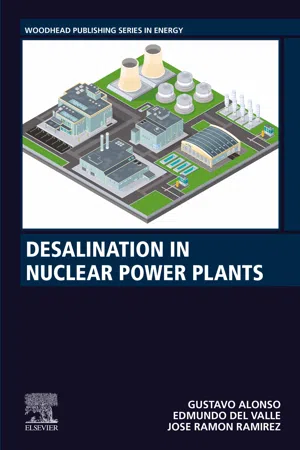
eBook - ePub
Desalination in Nuclear Power Plants
- 258 pages
- English
- ePUB (mobile friendly)
- Available on iOS & Android
eBook - ePub
Desalination in Nuclear Power Plants
About this book
Desalination in Nuclear Power Plants presents the latest research on a variety of nuclear desalination techniques for different nuclear reactor systems; it includes also several aspects regarding competitiveness, sustainability, safety, and licensing process. Authors Alonso, del Valle, and Ramirez explore the possibilities of the cogeneration of water and electricity using a nuclear reactor. This book consolidates the latest research to provide readers with a clear understanding of the advantages and disadvantages of the thermal, membrane, and hybrid desalination processes, along with a comprehensive methodology to guide the reader on how to perform levelized cost analyses for water and electricity. The conditions for the coupling of nuclear reactors and desalination plants are presented, and techniques to maximize water and energy production and to reduce their corresponding costs are provided. Mathematical modeling techniques for different components of the power plant are also included based on mass and energy state equations, as well as different steam currents alternatives for coupling along with a proposed method for their evaluation.
- Explains nuclear cogeneration in the context of multiobjective optimized methods and their application in the design of a cogeneration system of water and electricity
- Explores principles to optimize the cogeneration process from an economic and thermal perspective (exergoeconomic analysis)
- Includes competitiveness, sustainability, safety, and licensing of the nuclear desalination system
Information
1
Introduction
Abstract
Water is a critical renewable resource that is not evenly distributed around the world, and over-exploitation has altered the water cycle, not allowing to be restored. Since several previous decades, the need for drinking water per year has been increased at a staggering rate. This need has been palliated through desalination processes to obtain potable water from seawater and brackish water, desalination has been based on thermal methods like MED and MSF and the use of membrane processes like the reverse osmosis. These methods require the use of energy that has been provided mostly by fossil plants. Unfortunately, the gases emitted freely to the atmosphere are favoring pollution all over the world, despite international agreements to avoid it. Nowadays, it is necessary to include clean technologies, like nuclear, gathering attractive characteristics as being: (a) base load, (b) competitive costs, (c) friendly with the environment, and (d) producing as much drinkable water as an integrated water desalination power plant (IWPP) may produce. It is necessary to understand the pros and cons of nuclear desalination as an alternative to be considered by a country where potable water and electricity are needed. The integrated process of desalination and electricity generation offers a better energy use and in this regard exergoeconomic analysis provides a multiobjective tool to improve energy efficiency keeping the integrated process being economical competitive. In particular, the coupling of nuclear and desalination plants are modeled and analyzed through this book along with their competitiveness, sustainability, and the description of the licensing process that must be fulfilled to be able to have a nuclear desalination plant in operation.
Keywords
Desalination; Desalination plant; Electrodialysis; Reverse osmosis; Seawater; Thermal distillation; Nuclear desalination
It is undeniable that the demand for drinking water is continually increasing throughout the world and may eventually exceed the existing supply today if adequate measures are not taken with direct consequences on economic activities and on health and well-being.
Based on this not so imaginary scenario, many countries have focused their efforts on the desalination of seawater to obtain irrigation water or even drinking water that could cover the corresponding region water needs. However, one of the main barriers to exploit this technology entirely is the associated desalted water cost and several environmental concerns.
Water desalination technology has been developed through thermal distillation and membrane processes; use of thermal distillation at commercial scale started in the 1930s and has been evolving since then, and at the late 1950s and early 1960s membrane processes started its application based mainly on the reverse osmosis technology.
The current desalination capacity worldwide amounts to 95.37 million m3/d from 15,906 desalination plants. Mostly the first desalination plants were using the thermal processes, multieffect distillation, and multistage flash distillation, and by 1980 its share was 84% of the potable water produced. In 2000 the amount of water coming from reverse osmosis technology and thermal processes (MED and MSF) was practically equal.
However, the reverse osmosis process has been optimizing and reducing its cost, such as in 2018; this process represents 69% of the potable water produced. The cause of the increase in the use of the reverse osmosis process is because this one is not such an expensive process as the thermal processes. In the latter, it requires thermal energy and electricity, and for the RO process, it requires electricity, and in both cases the energy source is in most of the cases fossil power plants.
Countries that use desalination technologies have palliated the demand for drinking water at least temporarily but polluting the environment by producing greenhouse gases as a result of desalination plants powered by fossil sources. The pollution currently amounts around 76 million tons of CO2 per year, and that is increasing year after year with the incorporation of more desalination plants powered by fossil sources.
Several alternatives have been pursued to reduce desalination cost; among them are improvements in membrane technologies, energy recovery systems, and coupling desalination plants to use the rejected heat of the power plant in the thermal processes. The coupling of a desalination plant to nuclear power plants or renewable energy sources helps to reduce the economic costs of desalination and provide an energy source that is not emitting greenhouses gases.
The use of desalination coupled systems using nuclear reactors and thermal processes started in the 1960s with successful results. However, the associated desalination plant has been rather small producing water in quantities below 3000 m3/d. Membrane processes also have been associated not only with a nuclear reactor but also with the same purpose. One exceptional case was the Kazakhstan BN-350 nuclear reactor coupled to MED and MSF processes with a 120,000 m3/d total capacity, and it operated for more than 20 years.
However, in this effort, it is essential to point out that the current participation of nuclear power plants represents a negligible amount, only 15 of the 15,906 operational desalination plants are powered by nuclear energy, and fossil fuels power the others. Nonetheless, it is well known that nuclear reactors do not produce greenhouse gases. It is highly probable that, for the coming years, their participation will overgrow.
In addition to the existing nuclear reactors, there is a new design fleet of nuclear reactors called small modular reactors that are designed to accommodate specific needs. Among the design characteristics of these reactor are the production of drinking water and the generation of heat and/or electricity. By the size of this reactors, they can be allocated in remote regions of large cities, in isolated places, and in the rural sector. These types of reactors can be suitable candidates for the coupling of desalination plants.
This book attempts to provide a solid bridge of knowledge formed by diverse concepts and ideas based on nuclear reactor designs currently in operation and others of recent design that could be used to desalinate seawater while simultaneously producing electricity and heat. It is not a book that seeks to replace classic books of physics and nuclear engineering but rather a guide that of the minimum support necessary to understand nuclear desalination, its uses, scope, limitations, and its advantages and disadvantages.
In Chapter 2 a very basic description of nuclear energy is provided along with the description of the leading designs of nuclear power reactors existing today in different countries. How reactor technology has evolved and the future technological prospective of nuclear reactors is also given; the way that these nuclear reactors have been disseminated around the world includes the experience that has been achieved in the field of desalination through the use of nuclear reactors ending some other experience in nuclear reactor applications such as the supply of process heat for the industry and commercial and residential district heating.
Chapter 3 describes the main industrial processes for the desalination of seawater, starting with those based on membranes such as reverse osmosis and electrodialysis. Thermal desalination is also described, and three forms of this type of distillation are described, namely, multistage flash distillation, multieffect distillation, and steam compression (VC)—thermal (TVC) and mechanical (MVC). Finally, some hybrid processes are described.
Once the different nuclear reactors and distillation processes have been introduced, Chapter 4 provides several elements related to the coupling of the former to seawater desalination plants. This chapter also illustrates the case of cogeneration of water and electricity, mentioning aspects of nuclear safety, environment, and performance. Then, Chapter 5 is focused on optimization methods introducing firstly the concept of optimization followed by the multiobjective optimization problem and the description of two of the most applied optimization methods, namely, the so-called genetic algorithm and tabu search.
The thermoeconomic analysis is covered in Chapter 6, where several methods are considered according to their focus: energy levelized cost and thermodynamic, thermoeconomic, where objective functions are defined, and steady-state analysis.
Chapter 7 is devoted to competitiveness and sustainability issues to provide the reader with a broad idea about the pros and cons of desalination by nuclear means. To do so, here, it is treated economic and environmental aspects followed by what are nowadays projects in the field and giving some cases of studies. The chapter is closed, including comparisons with fossil, solar, and wind power technologies.
Finally, Chapter 8 is based on safety and licensing aspects related to nuclear reactors starting with their safety, regulations, and licensing. Particularly, regulations and licensing applicable to cogeneration nuclear power plants are also described.
2
Nuclear reactors
Abstract
A brief description of nuclear energy, the types of fission energy, and the current operating reactors is given. The status of current small modular reactors is included along with the experience of nuclear desalination and generation of process heat for industrial applications and district heat for commercial and residential use.
Keywords
Nuclear reactors; Nuclear desalination
Utilization of the energy released in a controlled nuclear reaction is the principle of nuclear reactors. Fusion and fission are two nuclear reactions releasing energy; they are the base of what is called nuclear energy.
A fusion reaction is given by the fuse of two light nuclei (e.g., deuterium (D) and tritium (T)) to form a heavier nucleus (helium); each fusion reaction releases about 17.6 MeV. Mark Oliphant discovered fusion in 1932. Since this year, many efforts have been devoted to having a c...
Table of contents
- Cover image
- Title page
- Table of Contents
- Copyright
- Authors’ biography
- Preface
- Overview
- 1: Introduction
- 2: Nuclear reactors
- 3: Desalination plants
- 4: Coupling of nuclear reactors and desalination plants
- 5: Optimization methods
- 6: Thermoeconomic analysis
- 7: Competitiveness and sustainability
- 8: Safety and licensing
- Abbreviations
- Bibliographies
- Index
Trusted by 375,005 students
Access to over 1.5 million titles for a fair monthly price.
Study more efficiently using our study tools.
Frequently asked questions
Yes, you can cancel anytime from the Subscription tab in your account settings on the Perlego website. Your subscription will stay active until the end of your current billing period. Learn how to cancel your subscription
No, books cannot be downloaded as external files, such as PDFs, for use outside of Perlego. However, you can download books within the Perlego app for offline reading on mobile or tablet. Learn how to download books offline
Perlego offers two plans: Essential and Complete
- Essential is ideal for learners and professionals who enjoy exploring a wide range of subjects. Access the Essential Library with 800,000+ trusted titles and best-sellers across business, personal growth, and the humanities. Includes unlimited reading time and Standard Read Aloud voice.
- Complete: Perfect for advanced learners and researchers needing full, unrestricted access. Unlock 1.5M+ books across hundreds of subjects, including academic and specialized titles. The Complete Plan also includes advanced features like Premium Read Aloud and Research Assistant.
We are an online textbook subscription service, where you can get access to an entire online library for less than the price of a single book per month. With over 1.5 million books across 990+ topics, we’ve got you covered! Learn about our mission
Look out for the read-aloud symbol on your next book to see if you can listen to it. The read-aloud tool reads text aloud for you, highlighting the text as it is being read. You can pause it, speed it up and slow it down. Learn more about Read Aloud
Yes! You can use the Perlego app on both iOS and Android devices to read anytime, anywhere — even offline. Perfect for commutes or when you’re on the go.
Please note we cannot support devices running on iOS 13 and Android 7 or earlier. Learn more about using the app
Please note we cannot support devices running on iOS 13 and Android 7 or earlier. Learn more about using the app
Yes, you can access Desalination in Nuclear Power Plants by Gustavo Alonso,Edmundo Del Valle,Jose Ramon Ramirez in PDF and/or ePUB format, as well as other popular books in Technology & Engineering & Mechanical Engineering. We have over 1.5 million books available in our catalogue for you to explore.