
- 444 pages
- English
- ePUB (mobile friendly)
- Available on iOS & Android
eBook - ePub
About this book
Printing on Polymers: Fundamentals and Applications is the first authoritative reference covering the most important developments in the field of printing on polymers, their composites, nanocomposites, and gels.
The book examines the current state-of-the-art and new challenges in the formulation of inks, surface activation of polymer surfaces, and various methods of printing. The book equips engineers and materials scientists with the tools required to select the correct method, assess the quality of the result, reduce costs, and keep up-to-date with regulations and environmental concerns.
Choosing the correct way of decorating a particular polymer is an important part of the production process. Although printing on polymeric substrates can have desired positive effects, there can be problems associated with various decorating techniques. Physical, chemical, and thermal interactions can cause problems, such as cracking, peeling, or dulling. Safety, environmental sustainability, and cost are also significant factors which need to be considered.
With contributions from leading researchers from industry, academia, and private research institutions, this book serves as a one-stop reference for this field—from print ink manufacture to polymer surface modification and characterization; and from printing methods to applications and end-of-life issues.
- Enables engineers to select the correct decoration method for each material and application, assess print quality, and reduce costs
- Increases familiarity with the terminology, tests, processes, techniques, and regulations of printing on plastic, which reduces the risk of adverse reactions, such as cracking, peeling, or dulling of the print
- Addresses the issues of environmental impact and cost when printing on polymeric substrates
- Features contributions from leading researchers from industry, academia, and private research institutions
Information
1
Printing on Polymers
Theory and Practice
Joanna Izdebska Department of Printing Technology, Faculty of Production Engineering, Mechanics and Printing Institute, Warsaw University of Technology, Warsaw, Poland
Abstract
In this chapter, a short history of printing and its meaning are given. All printing techniques used for polymer printing as well as some decorative methods are briefly presented. The suitability of various printing techniques to print selected polymeric materials and packaging materials is discussed. Because substrate properties are the primary factors that determine the printability of polymers bases such as films, multilayer films, semirigid and rigid plastic sheets, molded products, synthetic papers, and polymer-coated boards are described. In the case of these nonabsorbent materials, the key factor that determines printability is their surface free energy, which has an impact on material wettability and adhesion of ink to the substrate. All these problems, as well as the most important points related to print quality, are presented in this chapter. At the end, some facts about the plastic printing industry are included.
Keywords
Plastic substrates; Print quality; Printability; Printed polymers; Printing techniques; Surface-free energy; Surface wetting1.1. Introduction—The Impact of Printing
The history of European printing is relatively short, as it dates back to the fifteenth century. At that time, Gutenberg began with printing using a press and movable types. However, attempts to record important information and events or attempts to decorate materials including ceramics have taken place since the dawn of the human history. Fired clay tablets or wooden stamps were used for this purpose. However, it was Gutenberg's invention that was considered the beginning of the development of printing techniques, multiple duplication of the same picture from the form on the printing substrate using ink (Gregory, 1996; Kipphan, 2001).
The first printing substrate was paper, and it is still a dominant one. However, very diverse properties of plastics led to the situation in which they started to play an important role in various areas, including as printed materials. In 1912, when cellophane film (made of regenerated cellulose) started to be produced on a mass scale, its transparency and barrier properties were first used. It was not until the 1930s that cellophane began to be used as a printing substrate for multicolor printing (Gurwick, 1932). Another stage in printing of plastics was the emergence of the first plastic films in the 1950s, which were petroleum derivatives. This event has revolutionized the packaging industry as well. Packaging is a major group of plastic materials. Further application areas are shown in Figure 1.1. Transparency of materials, which gives a whole range of promotion opportunities of a packaged product and various barrier properties, resulted in the fact that plastics and, in particular, films are commonly used for packaging manufacturing, both in the form of monofilms, and as multilayer compositions combined with paper and aluminum films.
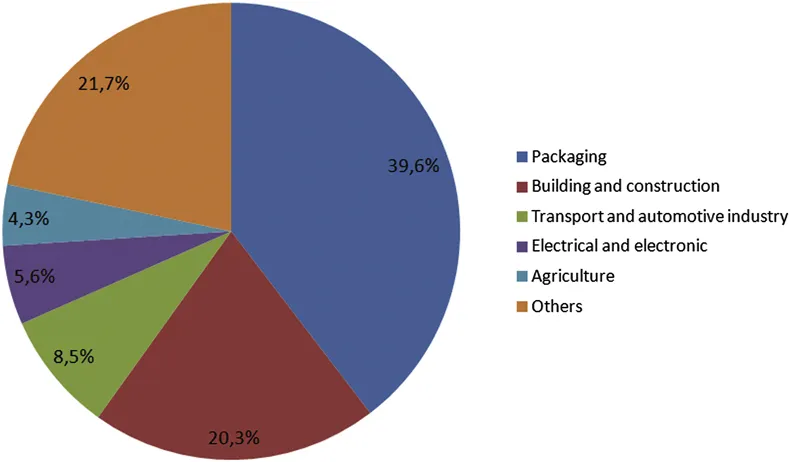
Figure 1.1 Areas of plastics application in 2013. Source: Own elaboration on the basis of the data (Plastics Europe, 2015).
The largest group of packaging is food packaging, and among these, the most important group is flexible packaging with paper as a forerunner. The advantage of flexible packaging manufactured from plastic over paper packaging, inter alia, depends on better protection against moisture, higher tear strength, a relatively lower price, and the possibility to use modern packaging systems as well as a better product presentation.
Modern packaging is designed to protect the packaged product, promote it, and facilitate its use. Therefore, almost every package requires minimum printing information, although much higher requirements are imposed on the majority of them. Nowadays, when shelves are overfilled with products, packaging plays an important role while shopping. Performance esthetics, unique shape, color schemes, or other visual elements can tempt a hesitant customer to buy a given product. The marketing function of packaging is closely connected with the printing process and print quality. However, printing on plastics means not only printing on food, cosmetic, or industrial packaging, but also printing on everyday objects, electronics, medical devices, sports equipment, advertising gadgets, polyester fabrics, etc.
Multicolored, high-quality printing on plastic material can be made only by appropriate selection of printing techniques and their parameters as well as the type of ink used for a given substrate. Due to the variety of materials available on the market, it is estimated that there are currently >700 types, which are divided into several groups (Plastics Europe, 2014). A knowledge of printing techniques and process requirements concerning the substrate or quality control is thus necessary. The subsequent chapters of this book discuss all these issues.
1.2. Printing Techniques
According to the encyclopedic definition (Rosato, 2000), printing is a method used for decoration and execution of marketing objec...
Table of contents
- Cover image
- Title page
- Table of Contents
- Series Page
- Copyright
- Contributors
- Preface
- 1. Printing on Polymers: Theory and Practice
- 2. Polymeric Materials—Structure, Properties, and Applications
- 3. Printing Ink Formulations
- 4. Additives for Ink Manufacture
- 5. Advanced Nanoscale Materials for Ink Manufacture
- 6. Rheology of Printing Inks
- 7. Low-Pressure Plasma-Assisted Polymer Surface Modifications
- 8. Corona Treatment
- 9. Polymer Surface Modifications by Coating
- 10. Other Methods of Polymer Surface Modifications
- 11. Flexographic Printing
- 12. Gravure Printing
- 13. Offset Printing
- 14. Inkjet Printing
- 15. Screen Printing
- 16. Pad Printing
- 17. Embossing Process
- 18. 3-D Printing
- 19. Theory, Modeling, and Simulation of Printing
- 20. Characterization of Print Quality in Terms of Colorimetric Aspects
- 21. Characterization of Mechanical Properties of Prints
- 22. Aging and Degradation of Printed Materials
- 23. Applications of Printed Materials
- 24. Microcapsules in Printing
- 25. Environmental and Safety Issues of Polymers and Polymeric Material in the Printing Industry
- Index
Trusted by 375,005 students
Access to over 1.5 million titles for a fair monthly price.
Study more efficiently using our study tools.
Frequently asked questions
Yes, you can cancel anytime from the Subscription tab in your account settings on the Perlego website. Your subscription will stay active until the end of your current billing period. Learn how to cancel your subscription
No, books cannot be downloaded as external files, such as PDFs, for use outside of Perlego. However, you can download books within the Perlego app for offline reading on mobile or tablet. Learn how to download books offline
Perlego offers two plans: Essential and Complete
- Essential is ideal for learners and professionals who enjoy exploring a wide range of subjects. Access the Essential Library with 800,000+ trusted titles and best-sellers across business, personal growth, and the humanities. Includes unlimited reading time and Standard Read Aloud voice.
- Complete: Perfect for advanced learners and researchers needing full, unrestricted access. Unlock 1.5M+ books across hundreds of subjects, including academic and specialized titles. The Complete Plan also includes advanced features like Premium Read Aloud and Research Assistant.
We are an online textbook subscription service, where you can get access to an entire online library for less than the price of a single book per month. With over 1.5 million books across 990+ topics, we’ve got you covered! Learn about our mission
Look out for the read-aloud symbol on your next book to see if you can listen to it. The read-aloud tool reads text aloud for you, highlighting the text as it is being read. You can pause it, speed it up and slow it down. Learn more about Read Aloud
Yes! You can use the Perlego app on both iOS and Android devices to read anytime, anywhere — even offline. Perfect for commutes or when you’re on the go.
Please note we cannot support devices running on iOS 13 and Android 7 or earlier. Learn more about using the app
Please note we cannot support devices running on iOS 13 and Android 7 or earlier. Learn more about using the app
Yes, you can access Printing on Polymers by Sabu Thomas,Joanna Izdebska-Podsiadły in PDF and/or ePUB format, as well as other popular books in Technology & Engineering & Materials Science. We have over 1.5 million books available in our catalogue for you to explore.