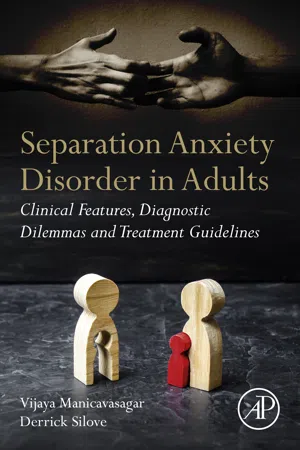
eBook - ePub
Separation Anxiety Disorder in Adults
Clinical Features, Diagnostic Dilemmas and Treatment Guidelines
- 236 pages
- English
- ePUB (mobile friendly)
- Available on iOS & Android
eBook - ePub
Separation Anxiety Disorder in Adults
Clinical Features, Diagnostic Dilemmas and Treatment Guidelines
About this book
Separation Anxiety Disorder in Adults provides a comprehensive foundation for understanding the development, manifestation, and treatment of adult separation anxiety. The book explores precursors and triggers to both childhood and adult separation anxiety disorder, comorbidity with other disorders and conditions, and characteristics of populations and individuals with separation anxiety. Assessment and treatment are comprehensively covered, discussing how treatment for adults difers from that for children. Clinical review questionnaires are included for immediate use in practice.
- Reviews the diagnosis, assessment, management, and treatment of adult separation anxiety
- Covers how treatment for adults differs from that for children
- Identifies precursors and triggers to separation anxiety
- Discusses comorbidity with other disorders and conditions
- Includes clinical review questionnaire measures
Information
Chapter 1
A journey of discovery
separation anxiety disorder in adults
Abstract
The drive to maintain physical proximity to caregivers and protectors is deeply entrenched in the human species as it is in many others. In a primordial state, members of the early home species who accidentally became separated from others were at high risk of being killed by predators or other tribes. Fear of being separated, or separation anxiety, therefore is one of the most primitive of all fear responses, a legacy of our early evolutionary history in which our species, like all others, struggled for survival in situations of great danger.
Keywords
Anxiety disorder; Attachment Theory; Childhood SEPAD; Cognitive behaviour; Mixture analysis; Separation anxiety
The drive to maintain physical proximity to caregivers and protectors is deeply entrenched in the human species as it is in many others. In the primordial state, members of early hominid species who accidentally became separated from others were at high risk of being killed by predators or other tribes. Fear of being separated, or separation anxiety (SA), therefore is one of the most primitive of all fear responses, a legacy of our early evolutionary history in which our species, like all others, struggled for survival in situations of great danger.
When unexpectedly separated, the synchronized response of cognitive awareness of the danger, subjective emotion of fear and physiological arousal act in unison as a potent motivator of action to reestablish contact with close others. Although a small minority of persons live as hermits, loners or social isolates, they are by far the exception. In general, Homo Sapiens is a collective species in which individuals are highly reliant on their primary bonds with other family members and depending on the culture and context, the wider kinship group and society as a whole. This allegiance to the group does not occur simply out of preference or obligation, but because the tendency to affiliate, form and maintain bonds is deeply ingrained in our biological makeup, which, in turn, has been shaped by the drive to survive by seeking and maintaining protection against external dangers. To ensure the effectiveness of the SA system, it is as important for individuals to be concerned for the safety, health and well-being of close others (the protectors) as they are for themselves.
In some people, SA – reflected in fears that danger will befall the self or close others when separated – is excessive and persists in a way that causes the individual great distress and social dysfunction. Should such individuals consult a mental health professional, then it is likely that they will be given a diagnosis of separation anxiety disorder (SEPAD), a category included in the major international classification systems of mental disorders, such as the Diagnostic and Statistical Manual edition 5 (DSM-5, American Psychiatric Association, 2013) and the International Classification of Diseases (ICD-11, World Health Organisation, 2018) used by psychiatrists, psychologists and others working in the field.
Traditionally, SEPAD has been regarded as a disorder of childhood. We have all observed children clinging to their mothers to prevent her from leaving home, or desperately insisting that a parent remain close to them when going to sleep, or becoming tearful and protesting when being left for the first time at school. Even if excessive at the time, these short-term reactions to separation amongst children usually fall within the bounds of age-appropriate response patterns. There is an expectation by adults (parents and teachers) that, with appropriate reassurance and encouragement, the child will grow out of this tendency towards excessive SA. Nevertheless, in some children, the SA reaction becomes a source of overwhelming and persisting distress and symptoms elaborate into a wide range of dysfunctional behaviours that disrupt the lives of the individual, creating major concerns for parents, teachers and the school. Although many children grow out of a period of SEPAD, in some, the problem may persist, leading to major difficulties in the family and potentially impacting adversely on the child's education, psychosocial development and future employment possibilities. In settings of severe and persisting SA, mental health care is warranted and it is likely that a diagnosis of SEPAD will be made and a set of psychological and, in some instances, medical treatments will be instituted.
Over the past two decades, there has been a major transformation in the notion of SA as a normative or, in the case of SEPAD, a pathological reaction confined to infancy and childhood. Although fragmented accounts have been recorded in earlier literature regarding the symptoms of SA in adulthood, it is only in this relatively short timeframe that a systematic approach has been applied to identifying, describing and characterizing the SA reaction in adults. The main focus of this book is to describe this major transformation in the conceptualization of SA and SEPAD as reaction patterns that can occur – and indeed have their onset – at any time in the life course, a shift in thinking that has only gradually become accepted by professionals in the mental health disciplines.
Recognition of SA and SEPAD as reactions that can occur throughout the life course commenced with the discovery, almost a quarter of a century ago, that adults attending anxiety clinics commonly experienced severe SA symptoms and that these experiences had not been attended to or given adequate importance by clinicians in the past. In essence, these observations meant that persons of all ages could experience the defining characteristic of SA and, in its extreme form, SEPAD, which is a persisting state of excessive and inappropriate anxiety relating to the safety and health of close others when physically separated. Importantly, when these fears are persisting and disabling, then it is warranted to make a diagnosis of SEPAD irrespective of the person's age or stage of maturation.
Although the core fear structure is common to all persons with SEPAD, age and level of maturation greatly influence the way these symptoms are expressed, one of the reasons that SA has been overlooked in adults. For example, unlike children, adults do not cling to their mothers but instead use more subtle methods to check on the safety of people that they are close to, for example, by contacting them repeatedly by phone throughout the day – hearing the voice of their close attachment seems to be most reassuring. Importantly, however, once these age-related differences in the surface features of symptoms and related behaviours are taken into account, it is possible to recognize a common suite of SA-related fears, allowing a diagnosis of SEPAD to be applied equally to persons of all ages, gender and backgrounds. As will be seen, to make the diagnosis of SEPAD, a minimum number of defined symptoms must occur concurrently for a specified period of time and the fears and associated behaviours must lead to significant personal suffering and/or negative effects on the person's day-to-day functioning. The details of the clinical presentations and diagnostic symptoms of SEPAD will be provided in Chapter 2.
It may not come as a surprise to the general reader that SEPAD can occur in adulthood. As indicated, the SA response occurs in an interpersonal sphere and must be reciprocated to achieve its survival function. One of the key reasons that individuals live in families and wider social groupings is that these structures confer safety and protection on the individual whatever the person's age, even though childhood may be a period of heightened vulnerability, given that this phase of high reliance on adult caregivers is unusually long in Homo Sapiens.
Within the mental health professions, however, the notion that SEPAD is a disorder confined largely to infancy and childhood (although recognized to some extent in adolescence) has been strongly entrenched in dominant developmental theories and in clinical practice as will be discussed later in this book. In that context, it is not surprising that there has been resistance to acknowledging that SA symptoms and the diagnosis of SEPAD can occur in adulthood. While it may seem to be a simple matter to extend the age range of SEPAD to later life, that modification requires a fundamental change in the conceptualization, classification and treatment of the disorder. For example, the inclusion of SEPAD as an adult disorder impacts on both the ways other common disorders in that age range are conceptualized by shifting the boundaries that divide diagnoses. Adults who might otherwise have been given a primary anxiety diagnosis of panic disorder, agoraphobia or generalized anxiety disorder – categories that are some of the most commonly assigned in clinical practice – may now warrant the more appropriate diagnosis of SEPAD. As a consequence, including adult SEPAD in the diagnostic repertoire may require a shift in the conventional boundaries that previously divided the anxiety categories in general and recast the way in which these disorders overlap, that is, in their patterns of comorbidity. Inclusion of adult SEPAD also may alter the prevalence estimates of all the anxiety subtypes identified in many past epidemiological surveys. Persons assigned to conventional categories such as panic disorder and agoraphobia may need to be reassigned to SEPAD. Moreover, as will be seen, recognition of SA symptoms and SEPAD in adulthood requires a reconsideration and reformulation of well-established developmental models of psychopathology, in particular, the widely accepted theory that heightened SA in childhood tends to lead to panic disorder and/or agoraphobia in adulthood, the so-called SA-PD/Ag hypothesis. These developmental pathways will be considered in greater depth in Chapter 5.
In practical clinical terms, the recognition for the first time that SEPAD can occur throughout the life course in both leading classification systems, DSM-5 (American Psychiatric Association, 2013) and ICD-11 (World Health Organisation, 2018), encourages practitioners to consider making the diagnosis in adults, challenging the tradition of reserving the diagnosis for children. Most importantly, where a diagnosis of adult SEPAD is made, the clinician needs to consider what additional treatments may need to be administered, beyond the conventional suite of interventions offered for well-established forms of anxiety, such as panic disorder and agoraphobia.
Childhood SEPAD
To understand the contemporary shift in the age range to which SEPAD can be applied, it is important to be mindful of the conventional thinking in this field dating back to three decades ago – that is, when SEPAD effectively was regarded as a diagnosis confined to childhood. There are complexities in both the provenance and use of the term SA. Other symptom constellations, for example, panic attacks, are understood and described primarily by their surface or operationalized features; SA is different in that it is used as a central concept of developmental theory in which it represents a dynamic mechanism that is inferred rather than directly observed, as well as a set of operationalized symptoms and behaviours that are readily observed and measured, for example, as specified in DSM-5 and a range of quantitative measures devised to assess the relevant features. Moreover, as indicated, a distinction needs to be made between a dimensional concept that varies in intensity and frequency along a continuum and a categorical diagnosis that is clearly delineated from the normative response based on the inappropriate and persisting nature of symptoms and their impact on subjective distress and objective functioning.
The specification of SEPAD as a diagnostic category was introduced in 1980 with the publication of the third edition of the Diagnostic and Statistical Manual (DSM-III) (APA, 1980) and the ninth edition of the International Classification of Diseases (ICD-9) (World Health Organization, 1980). In general, the criteria across the two systems were consistent in determining that a diagnosis required that SA symptoms were excessive, led to age-inappropriate behaviours, to a restriction in the child's activities and/or interfered markedly with his or her well-being, for example, by causing social avoidance, family difficulties and, most importantly, problems attending school (Gittleman-Klein and Klein, 1980). The criteria involved a set of emotions, cognitions, physical symptoms and behaviours that were mainly relevant to childhood and adolescence. These included subjective fears of being separated from close attachment figures; of harm or illness befalling these persons; the experience of fantasies or dreams of being kidnapped or attacked; physical symptoms such as headaches or stomach aches when separated or anticipating separation from attachments; behaviours such as sleep disturbances, clinging or shadowing of attachment figures, tantrums and other behavioural problems aimed at avoiding or protesting against separations and reluctance or refusal to attend school.
Emphasizing the developmental restriction on making the diagnos...
Table of contents
- Cover image
- Title page
- Table of Contents
- Copyright
- Foreword
- Preface
- Acknowledgements
- Chapter 1. A journey of discovery: separation anxiety disorder in adults
- Chapter 2. Making a diagnosis of separation anxiety disorder in adulthood
- Chapter 3. The assessment of separation anxiety and separation anxiety disorder
- Chapter 4. Characteristics of populations and individuals with adult separation anxiety disorder
- Chapter 5. Adult separation anxiety and Attachment Theory
- Chapter 6. Developmental models of separation anxiety disorder
- Chapter 7. Exploring the continuity hypothesis of separation anxiety
- Chapter 8. The biological foundations of separation anxiety
- Chapter 9. Precursors and triggers to childhood and adult separation anxiety disorder
- Chapter 10. Comorbidity with other disorders and conditions
- Chapter 11. Implications for the treatment of adult separation anxiety disorder
- Chapter 12. Issues and challenges associated with understanding adult separation anxiety disorder
- The Separation Anxiety Symptom Inventory (SASI)
- ASA-27
- Index
Trusted by 375,005 students
Access to over 1.5 million titles for a fair monthly price.
Study more efficiently using our study tools.
Frequently asked questions
Yes, you can cancel anytime from the Subscription tab in your account settings on the Perlego website. Your subscription will stay active until the end of your current billing period. Learn how to cancel your subscription
No, books cannot be downloaded as external files, such as PDFs, for use outside of Perlego. However, you can download books within the Perlego app for offline reading on mobile or tablet. Learn how to download books offline
Perlego offers two plans: Essential and Complete
- Essential is ideal for learners and professionals who enjoy exploring a wide range of subjects. Access the Essential Library with 800,000+ trusted titles and best-sellers across business, personal growth, and the humanities. Includes unlimited reading time and Standard Read Aloud voice.
- Complete: Perfect for advanced learners and researchers needing full, unrestricted access. Unlock 1.5M+ books across hundreds of subjects, including academic and specialized titles. The Complete Plan also includes advanced features like Premium Read Aloud and Research Assistant.
We are an online textbook subscription service, where you can get access to an entire online library for less than the price of a single book per month. With over 1.5 million books across 990+ topics, we’ve got you covered! Learn about our mission
Look out for the read-aloud symbol on your next book to see if you can listen to it. The read-aloud tool reads text aloud for you, highlighting the text as it is being read. You can pause it, speed it up and slow it down. Learn more about Read Aloud
Yes! You can use the Perlego app on both iOS and Android devices to read anytime, anywhere — even offline. Perfect for commutes or when you’re on the go.
Please note we cannot support devices running on iOS 13 and Android 7 or earlier. Learn more about using the app
Please note we cannot support devices running on iOS 13 and Android 7 or earlier. Learn more about using the app
Yes, you can access Separation Anxiety Disorder in Adults by Vijaya Manicavasagar,Derrick Silove in PDF and/or ePUB format, as well as other popular books in Psychology & Clinical Psychology. We have over 1.5 million books available in our catalogue for you to explore.