- 408 pages
- English
- ePUB (mobile friendly)
- Available on iOS & Android
eBook - ePub
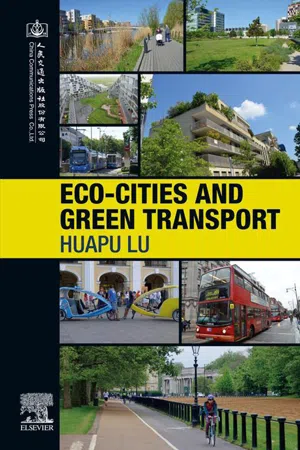
Eco-Cities and Green Transport
About this book
Eco-cities and Green Transport presents a systematic, uniform, and structured way to examine different cities at different scales in order to suggest unique solutions appropriate to each scale. The book examines city infrastructure and the built environment, transport system supply and demand, and transport behavior to offer innovative policy solutions for various transport modes. With end of chapter experiences and lessons summarized, the book provides an in-depth analysis of the advantages and disadvantages for transforming cities and their transport systems to meet residents current and future needs.
The increasingly rapid growth of global urbanization requires cities to be built in an ecologically sustainable, energy efficient, and livable way. A critical component in achieving these goals is an urban transportation system that uses natural resources as reasonably as possible. The outcome of a ten-year data collection research effort by the author and his team, the book sheds new insights into these challenges using a thorough investigation of traffic systems in 20 cities from 13 countries throughout Asia, Europe, and the United States.
- Summarizes the essential experiences of green transport projects from cities around the world
- Analyzes projects using a consistent structure, allowing comparison of best practices and policy approaches
- Overviews the latest sustainable urban transportation concepts, tools, and best practices
Information
Chapter 1
Copenhagen, Denmark
Abstract
This chapter summarizes the experience of green transportation and eco-city construction and expounds the general situation of Copenhagen city, the history and policy of motorization development, urban structure and land use, the characteristics of transportation mode sharing, road network and public transportation, the construction of pedestrian transportation system in old urban areas, and the exploration and innovation of modern architectural design in the city. The chapter also focuses on the construction of the bicycle transportation system in Copenhagen.
Keywords
Bicycle system; Copenhagen; pedestrian system; eco-city; land use; motorization; green transportation
1.1 Overview of the city
Copenhagen is the capital, largest city, and largest sea port of the Kingdom of Denmark, and is also the largest city in Nordic countries. It is the home of the famous fairy-tale writer Andersen, a historical and cultural city, and the political, economic, and cultural center of Denmark. Hovedstaden is located in eastern Denmark, including Copenhagen city, Copenhagen county, Frederiksberg city, Frederiksberg county, Roskilde county, and Barnhdm region, etc. “Copenhagen city center” refers to the central city of Copenhagen (i.e., the old town), that is, the “Indre By” part of Fig. 1.1. “Copenhagen city” refers to the area of Copenhagen city center and its surrounding suburbs, all of which are shown in Fig. 1.1. “Copenhagen county” and “Copenhagen city” both belong to the region of Copenhagen, but do not overlap in administrative division. Copenhagen county is an aggregation of other small towns. Copenhagen city is the most active and representative city in the region of Copenhagen. Without special explanation, “Copenhagen” refers to “Copenhagen city” in the common sense in this book [1].
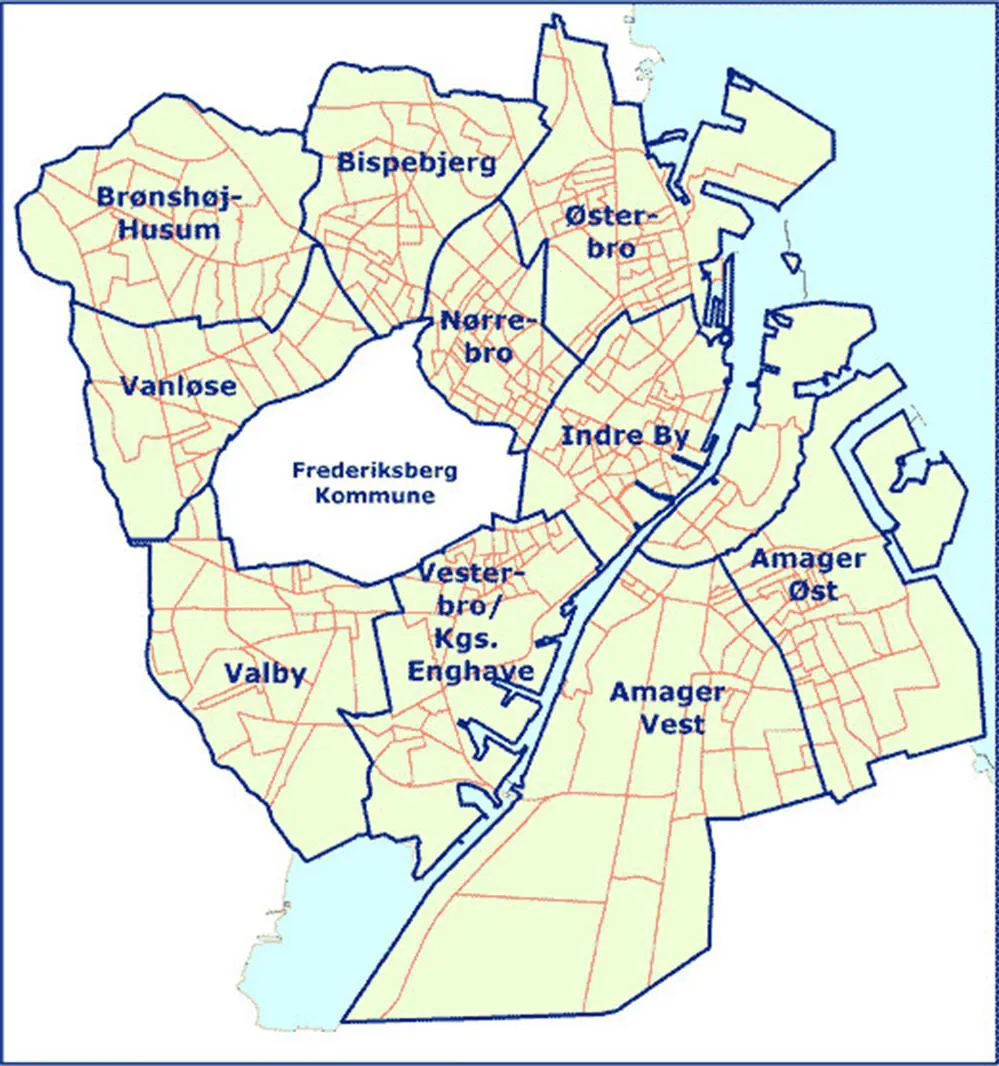
The areas, populations, and densities of Copenhagen’s regions are shown in Table 1.1. GDP statistics for different years in the region of Copenhagen are shown in Table 1.2.
Table 1.1
| Region of Copenhagen | Copenhagen city | Copenhagen city center | |
|---|---|---|---|
| Area (km2) | 2553.1 | 455.61 | 77.2 |
| Population | 1,736,889 | 1,230,728 | 562,379 |
| Density (people/km2) | 680 | 2700 | 7280 |

Source: StatBank, Denmark. Data from http://www.statistikbanken.dk/BEF1A07.
Table 1.2
| Year | 2005 | 2006 | 2007 | 2008 | 2009 | 2010 | 2011 |
|---|---|---|---|---|---|---|---|
| Per capita GDP (ten thousand dollars) | 6.32 | 6.47 | 6.69 | 6.86 | 6.58 | 7.14 | 7.11 |

1.2 Urban mobility development and motorization policy
Statistical data in 2010 show that the number of motor vehicles in Copenhagen was 2.1 million, with a private car ownership rate of 22.3%. According to the latest data from the Copenhagen Police Bureau in 2012, there were about 312,600 motor vehicles entering and leaving Copenhagen daily, accounting for only 14.9% of the total vehicle ownership in the city, which shows that the usage frequency is very low [2].
From 2000 to 2010, the number of motor vehicles in Copenhagen increased by 17% and the traffic volume in the region of Copenhagen increased by 8%, while the road traffic volume in the five basins area in the city center decreased by nearly 10%. This is inseparable from Copenhagen’s advocacy of “Green Transportation—by Bicycles” and its restrictive policy on motor vehicles [3].
In terms of motor vehicle policy, Copenhagen mainly adopts a restrictive approach. Despite the small motor vehicle traffic volume, the government continues to impel people to abandon private cars and switch to green modes of transportation such as public transport, bicycles, and walking. The restrictions on motor vehicles in Copenhagen are mainly reflected in two aspects: car purchase and parking.
As early as World War II, the Copenhagen government imposed a ban on car imports and maintained it for quite a long time after the war. Since the late 1970s, the Copenhagen government has lifted the tax on private car purchase, with car taxes roughly three times the car price [1].
For parking, the city governm...
Table of contents
- Cover image
- Title page
- Table of Contents
- Copyright
- Preface
- Chapter 1. Copenhagen, Denmark
- Chapter 2. Stockholm, Sweden
- Chapter 3. Singapore, Singapore
- Chapter 4. Curitiba, Brazil
- Chapter 5. Tokyo, Japan
- Chapter 6. Paris, France
- Chapter 7. Seoul, Korea
- Chapter 8. New York, United States
- Chapter 9. London, United Kingdom
- Chapter 10. Amsterdam, The Netherlands
- Chapter 11. Munich, Germany
- Chapter 12. Madrid, Spain
- Chapter 13. San Francisco, United States
- Chapter 14. St. Petersburg, Russia
- Chapter 15. Rio de Janeiro, Brazil
- Chapter 16. Carmel, United States
- Chapter 17. Letchworth, United Kingdom
- Chapter 18. Malmo, Sweden
- Chapter 19. San Carlos, Brazil
- Chapter 20. Los Angeles, United States
- Index
Trusted by 375,005 students
Access to over 1.5 million titles for a fair monthly price.
Study more efficiently using our study tools.
Frequently asked questions
Yes, you can cancel anytime from the Subscription tab in your account settings on the Perlego website. Your subscription will stay active until the end of your current billing period. Learn how to cancel your subscription
No, books cannot be downloaded as external files, such as PDFs, for use outside of Perlego. However, you can download books within the Perlego app for offline reading on mobile or tablet. Learn how to download books offline
Perlego offers two plans: Essential and Complete
- Essential is ideal for learners and professionals who enjoy exploring a wide range of subjects. Access the Essential Library with 800,000+ trusted titles and best-sellers across business, personal growth, and the humanities. Includes unlimited reading time and Standard Read Aloud voice.
- Complete: Perfect for advanced learners and researchers needing full, unrestricted access. Unlock 1.5M+ books across hundreds of subjects, including academic and specialized titles. The Complete Plan also includes advanced features like Premium Read Aloud and Research Assistant.
We are an online textbook subscription service, where you can get access to an entire online library for less than the price of a single book per month. With over 1.5 million books across 990+ topics, we’ve got you covered! Learn about our mission
Look out for the read-aloud symbol on your next book to see if you can listen to it. The read-aloud tool reads text aloud for you, highlighting the text as it is being read. You can pause it, speed it up and slow it down. Learn more about Read Aloud
Yes! You can use the Perlego app on both iOS and Android devices to read anytime, anywhere — even offline. Perfect for commutes or when you’re on the go.
Please note we cannot support devices running on iOS 13 and Android 7 or earlier. Learn more about using the app
Please note we cannot support devices running on iOS 13 and Android 7 or earlier. Learn more about using the app
Yes, you can access Eco-Cities and Green Transport by Huapu Lu in PDF and/or ePUB format, as well as other popular books in Technology & Engineering & Environmental Management. We have over 1.5 million books available in our catalogue for you to explore.