eBook - ePub
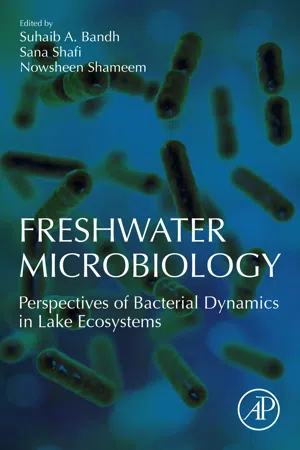
Freshwater Microbiology
Perspectives of Bacterial Dynamics in Lake Ecosystems
- 450 pages
- English
- ePUB (mobile friendly)
- Available on iOS & Android
eBook - ePub
About this book
Freshwater Microbiology: Perspectives of Bacterial Dynamics in Lake Ecosystems provides a comprehensive and systematic analysis of microbial ecology in lakes. It offers basic information on how well the bacterial community composition varies along the spatio-temporal and trophic gradients along with the evaluation of the bioindicator species of bacteria so as to act as a key to predict the trophic status of lake ecosystems. The book helps to identify the factors of potential importance in structuring the bacterial communities in lakes as it delves into the dynamics and diversity of bacterial community composition in relation to various water quality parameters. It helps to identify the possibility of bioremediation plans and devising future policy decisions, with better conservation and management practices.
- Provides a comprehensive and systematic analysis of microbial ecology
- Helps to identify the factors of potential importance in structuring the bacterial community composition
- Gives insight into the bacterial diversity of freshwater lake ecosystems along with their industrial potential
- Caters to the needs and aspirations of students and professional researchers
Information
Chapter 1
Bacterial community composition in lakes
Ajar Nath Yadav 1 , Neelam Yadav 2 , Divjot Kour 1 , Akhilesh Kumar 3 , Kritika Yadav 3 , Amit Kumar 3 , Ali A. Rastegari 4 , Shashwati Ghosh Sachan 5 , Bhanumati Singh 6 , Vinay Singh Chauhan 6 , and Anil Kumar Saxena 7 1 Department of Biotechnology, Akal College of Agriculture, Eternal University, Baru Sahib, India 2 Gopi Nath P.G. College, Veer Bahadur Singh Purvanchal University, Ghazipur, India 3 Department of Botany, Dayalbagh Educational Institute, Agra, India 4 Department of Molecular and Cell Biochemistry, Falavarjan Branch, Islamic Azad University, Isfahan, Iran 5 Department of Bio-Engineering, Birla Institute of Technology, Mesra, Ranchi, India 6 Department of Biotechnology, Bundelkhand University, Jhansi, India 7 ICAR-National Bureau of Agriculturally Important Microorganisms, Mau, India
Abstract
Bacteria are ubiquitous organisms, inhabiting almost every part of earth including the extreme habitats, and in aquatic ecosystems they represent dense assemblages with varied morphological, physiological and ecological preferences. In these freshwater ecosystems bacterial community composition is determined by using various culture-dependent as well as culture-independent techniques (DNA isolation, PCR amplifications, amplified ribosomal DNA restriction analysis, sequencing, and phylogenetic profiling). The chapter deals with the bacterial community composition of lakes, their diversity, distribution, functional annotations, and their relationship with other organisms in aquatic ecosystem. Later in the chapter the bacterial community's responses to disturbance (natural as well as anthropogenic) are discussed. The chapter further reviews the bacterial community composition of various lakes, novel species obtained from these lakes, and the dominant phyla (Actinobacteria, Cyanobacteria, Acidobacteria, Caldeserica, Calditrichaeota, Verrucomicrobia, Chlorobi, Planctomycetes, Nitrospirae, Chloroflexi, Bacteriodetes, Firmicutes, and Proteobacteria) found in these freshwater ecosystems.
Keywords
Bacterial community composition; Biodiversity; Lake habitats; Novel bacterial species; Population dynamic
Introduction
During the course of evolution of life on earth, microbes evolved long before the origin of plants and animals, thus making them the oldest life forms on earth. They are more than 3.5–3.8 billion years old, single-celled organisms, so small in size that millions of microbes fit in the eye of a needle. Microbes are omnipresent on earth, inhabiting almost every part of the earth including soil, water, air, and even other organisms (Canganella & Wiegel, 2011; Yadav, Kumar et al., 2017; Yadav, Verma, Kumar, Sachan, & Saxena, 2017). They also inhabit the extreme habitats including hot springs (Brock, 2012; Brook, 1980; Kumar, Yadav, Tiwari, Prasanna, & Saxena, 2014; Sahay et al., 2017; Suman, Verma, Yadav, & Saxena, 2015; Verma, Yadav, Suman, & Saxena, 2012; Yadav, Verma et al., 2015), deep sea hydrothermal vents (McCollom & Shock, 1997); saline environments (Antón, Rosselló-Mora, Rodríguez-Valera, & Amann, 2000; Saxena et al., 2016; Yadav, Sharma et al., 2015); cold environments—Permafrost soils, glaciers, ice sheets, and snow cover (Boyd et al., 2011; Singh et al., 2016; Yadav, 2015, p. 234; Yadav, Sachan, Verma, & Saxena, 2015; Yadav, Sachan, Verma, Tyagi et al., 2015); acid mine drainages (Baker & Banfield, 2003); and kilometers beneath earth’s surface (White, Phelps, & Onstot, 1998). The extremophilic microbes have also been reported as associated with plants growing in extreme environmental conditions (Kour et al., 2017; Rana, Kour, Yadav, Kumar, & Dhaliwal, 2016; Srivastava et al., 2013; Yadav, Verma, Sachan, Kaushik, & Saxena, 2013). Bacteria appear more abundantly than other creatures, like plants and animals, in these diverse habitats on the face of earth, with their numbers ranging from 4 × 1030 to 6 × 1030 on earth (Horner-Devine, Carney, & Bohannan, 2004). They are also abundantly found in oceanic and terrestrial environments, for example, in marine waters bacterial numbers range from 0.2 to 2.0 × 10⁹ cells/L (Turley & Mackie, 1994). These extreme environments usually present hostile conditions to humans and the majority of life forms on earth, but the extremophilic bacteria found therein have evolved to tolerate or even thrive well within these e...
Table of contents
- Cover image
- Title page
- Table of Contents
- Copyright
- List of contributors
- Preface
- Acknowledgments
- Chapter 1. Bacterial community composition in lakes
- Chapter 2. Bacterial diversity of the rock-water interface in freshwater ecosystem
- Chapter 3. Impact of environmental changes and human activities on bacterial diversity of lakes
- Chapter 4. Spatio-temporal patterns of bacterial diversity along environmental gradients and bacterial attachment to organic aggregates
- Chapter 5. Metagenomic insights into the diversity and functions of microbial assemblages in lakes
- Chapter 6. Depth distribution of microbial diversity in lakes
- Chapter 7. Exploring bacterial diversity: from cell to sequence
- Chapter 8. Bacterial biofilms: the remarkable heterogeneous biological communities and nitrogen fixing microorganisms in lakes
- Chapter 9. Microbial diversity in freshwater ecosystems and its industrial potential
- Chapter 10. Bacteria: the natural indicator of environmental pollution
- Index
Trusted by 375,005 students
Access to over 1.5 million titles for a fair monthly price.
Study more efficiently using our study tools.
Frequently asked questions
Yes, you can cancel anytime from the Subscription tab in your account settings on the Perlego website. Your subscription will stay active until the end of your current billing period. Learn how to cancel your subscription
No, books cannot be downloaded as external files, such as PDFs, for use outside of Perlego. However, you can download books within the Perlego app for offline reading on mobile or tablet. Learn how to download books offline
Perlego offers two plans: Essential and Complete
- Essential is ideal for learners and professionals who enjoy exploring a wide range of subjects. Access the Essential Library with 800,000+ trusted titles and best-sellers across business, personal growth, and the humanities. Includes unlimited reading time and Standard Read Aloud voice.
- Complete: Perfect for advanced learners and researchers needing full, unrestricted access. Unlock 1.5M+ books across hundreds of subjects, including academic and specialized titles. The Complete Plan also includes advanced features like Premium Read Aloud and Research Assistant.
We are an online textbook subscription service, where you can get access to an entire online library for less than the price of a single book per month. With over 1.5 million books across 990+ topics, we’ve got you covered! Learn about our mission
Look out for the read-aloud symbol on your next book to see if you can listen to it. The read-aloud tool reads text aloud for you, highlighting the text as it is being read. You can pause it, speed it up and slow it down. Learn more about Read Aloud
Yes! You can use the Perlego app on both iOS and Android devices to read anytime, anywhere — even offline. Perfect for commutes or when you’re on the go.
Please note we cannot support devices running on iOS 13 and Android 7 or earlier. Learn more about using the app
Please note we cannot support devices running on iOS 13 and Android 7 or earlier. Learn more about using the app
Yes, you can access Freshwater Microbiology by Suhaib A. Bandh in PDF and/or ePUB format, as well as other popular books in Biological Sciences & Biology. We have over 1.5 million books available in our catalogue for you to explore.