- 336 pages
- English
- ePUB (mobile friendly)
- Available on iOS & Android
eBook - ePub
Fracture Mechanics
About this book
Fracture Mechanics covers classical and modern methods and introduce new/unique techniques, making this text an important resource for anyone involved in the study or application of fracture mechanics. Using insights from leading experts in fracture mechanics, it provides new approaches and new applications to advance the understanding of crack initiation and propagation.
With a concise and easily understood mathematical treatment of crack tip fields, this book provides the basis for applying fracture mechanics in solving practical problems. It features a unique coverage of bi-material interfacial cracks, with applications to commercially important areas of composite materials, layered structures, and microelectronic packaging. A full chapter is devoted to the cohesive zone model approach, which has been extensively used in recent years to simulate crack propagation. A unified discussion of fracture criteria involving nonlinear/plastic deformations is also provided.
The book is an invaluable resource for mechanical, aerospace, civil, and biomedical engineers in the field of mechanics as well as for graduate students and researchers studying mechanics.
- Concise and easily understood mathematical treatment of crack tip fields (chapter 3) provides the basis for applying fracture mechanics in solving practical problems
- Unique coverage of bi-material interfacial cracks (chapter 8), with applications to commercially important areas of composite materials, layered structures, and microelectronic packaging
- A full chapter (chapter 9) on the cohesive zone model approach, which has been extensively used in recent years to simulate crack propagation
- A unified discussion of fracture criteria involving nonlinear/plastic deformations
Trusted by 375,005 students
Access to over 1 million titles for a fair monthly price.
Study more efficiently using our study tools.
Information
Chapter 1. Introduction
This chapter first introduces the concept of classical failure theory for defect-free solids and discusses the inability of the classical theory in predicting failure of materials when defects are present. The chapter then introduces the fracture mechanics concept starting with the crack tip stress characteristics. Both the stress intensity factor and energy release rate fracture criteria are introduced. Finally, the chapter briefly describes the historical development of fracture mechanics from Griffith's pioneering work on brittle fracture of glass in the 1920s, to Irwin's stress intensity factor concept and fracture criterion in the 1950s, and to elastic-plastic fracture mechanics research in the 1960s and early 1970s. The chapter concludes with a brief introduction of recent developments in fracture mechanics research since the 1990s.
Keywords: classical failure theory; Griffith theory; linear elastic fracture mechanics; elastic-plastic fracture mechanics; history of fracture mechanics.
1.1. Failure of Solids
Failure of solids and structures can take various forms. A structure may fail without breaking the material, such as in elastic buckling. However, failure of the material in a structure surely will lead to failure of the structure. Two general forms of failure in solids are excessive permanent (plastic) deformation and breakage. Plasticity can be viewed as an extension of elasticity for decribing the mechanical behavior of solids beyond yielding. The theory of plasticity has been studied for more than a century and has long been employed for structural designs. On the other hand, the latter form of failure is usually regarded as the strength of a solid, implying the total loss of load-bearing capability of the solid. For brittle solids, this form of failure often causes the body under load to break into two or more separated parts.
Unlike plasticity, the prediction of the strength of solid materials was all based on phenomenological approaches before the inception of fracture mechanics. Many phenomenological failure criteria in terms of stress or strain have been proposed and calibrated against experimental results. In the commonly used failure criteria, such as the maximum principal stress or strain criterion, a failure envelope in the stress or strain space is constructed based on limited experimental strength data. Failure is assumed to occur when the maximum normal stress at a point in the material exceeds the strength envelope, that is,

In general, the classical phenomenological failure theories predict failure of engineering materials and structures with reasonable accuracy in applications where the stress field is relatively uniform. These theories are often unreliable in the presence of high-stress gradients resulting from cutouts. Moreover, there were many premature structural failures at stresses that were well below the critical values specified in the classical failure theories.
The most frequently cited example is the failure of Liberty cargo ships built during World War II. Among roughly 2700 all-welded hull ships, more than 100 were seriously fractured and about 10 were fractured in half [1-1]. It was demonstrated [1-2] that cracks were first initiated at the stress concentration locations and then propagated in the hull, resulting in the catastrophic failure. Other significant examples include fuselage failure in Comet passenger jet airplanes from 1953 to 1955 [1-3] and failure of heavy rotors in steam turbines from 1955 to 1956 [1-4].
The aforementioned historical events led researchers to recognize that defects are the original cause of failure and in strength predictions, materials cannot be always assumed free of defects. Cracks and other forms of defects may be introduced during materials manufacturing and processing, as well as during service. For instance, rapid quenching of cast irons results in microcracks in the material. Cyclic stresses induce cracks in the connections of the structural components. The stresses at the crack tip are much higher than the material strength, which is measured under a state of uniform stress in laboratory condition. The high stresses near the crack tip drive the crack to extend, leading to the eventual catastrophic failure of the material. Failure caused by crack propagation is usually called fracture failure. The classical failure criteria assume that materials are free of defects, and hence are not capable of predicting fracture failure, or failure of materials containing crack-like flaws.
1.2. Fracture Mechanics Concepts
Fracture mechanics is a subject of engineering science that deals with failure of solids caused by crack initiation and propagation. There are two basic approaches to establish fracture criteria, or crack propagation criteria: crack tip stress field (local) and energy balance (global) approaches. In the crack tip field approach, the crack tip stress and displacement states are first analyzed and parameters governing the near-tip stress and displacement fields are identified. Linear elastic analysis of a cracked body shows that stresses around the crack tip vary according to r1/2, where r is the distance from the tip. It is clear that stresses become unbounded as r approaches the crack tip. Such a singular stress field makes the classical strength of materials failure criteria inapplicable.
A fundamental concept of fracture mechanics is to accept the theoretical stress singularity at the crack tip but not use the stress directly to determine failure/crack extension. This is based on the fact that the tip stress is limited by the yield stress or the cohesive stress between atoms and singular stresses are the results of linear elasticity. It is also recognized that the singular stress field is a convenient representation of the actual finite stress field if the discrepancy between the two lies in a small region near the crack tip. This notion is referred to as small-scale yielding.
The stresses near the tip of a crack in linearly elastic solids have the following universal form independent of applied loads and the geometry of the cracked body (Chapter 3):
(1.1)
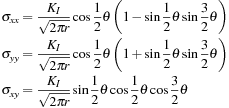
Based on this obervation, Irwin [1-5] proposed a fracture criterion which states that crack growth occurs when the stress intensity factor reaches a critical value, that is,
(1.2)


The criterion in Eq. (1.2) is bas...
Table of contents
- Cover image
- Table of Contents
- Front Matter
- Copyright
- Dedication
- Preface
- About the Authors
- Chapter 1. Introduction
- Chapter 2. Griffith Theory of Fracture
- Chapter 3. The Elastic Stress Field around a Crack Tip
- Chapter 4. Energy Release Rate
- Chapter 5. Mixed Mode Fracture
- Chapter 6. Crack Tip Plasticity
- Chapter 7. Elastic-Plastic Fracture Criteria
- Chapter 8. Interfacial Cracks between Two Dissimilar Solids
- Chapter 9. Cohesive Zone Model
- Chapter 10. Special Topics
- Appendix. Stress Intensity Factors
- Index
Frequently asked questions
Yes, you can cancel anytime from the Subscription tab in your account settings on the Perlego website. Your subscription will stay active until the end of your current billing period. Learn how to cancel your subscription
No, books cannot be downloaded as external files, such as PDFs, for use outside of Perlego. However, you can download books within the Perlego app for offline reading on mobile or tablet. Learn how to download books offline
Perlego offers two plans: Essential and Complete
- Essential is ideal for learners and professionals who enjoy exploring a wide range of subjects. Access the Essential Library with 800,000+ trusted titles and best-sellers across business, personal growth, and the humanities. Includes unlimited reading time and Standard Read Aloud voice.
- Complete: Perfect for advanced learners and researchers needing full, unrestricted access. Unlock 1.4M+ books across hundreds of subjects, including academic and specialized titles. The Complete Plan also includes advanced features like Premium Read Aloud and Research Assistant.
We are an online textbook subscription service, where you can get access to an entire online library for less than the price of a single book per month. With over 1 million books across 990+ topics, we’ve got you covered! Learn about our mission
Look out for the read-aloud symbol on your next book to see if you can listen to it. The read-aloud tool reads text aloud for you, highlighting the text as it is being read. You can pause it, speed it up and slow it down. Learn more about Read Aloud
Yes! You can use the Perlego app on both iOS and Android devices to read anytime, anywhere — even offline. Perfect for commutes or when you’re on the go.
Please note we cannot support devices running on iOS 13 and Android 7 or earlier. Learn more about using the app
Please note we cannot support devices running on iOS 13 and Android 7 or earlier. Learn more about using the app
Yes, you can access Fracture Mechanics by Chin-Teh Sun,Zhihe Jin in PDF and/or ePUB format, as well as other popular books in Technology & Engineering & Materials Science. We have over one million books available in our catalogue for you to explore.