eBook - ePub
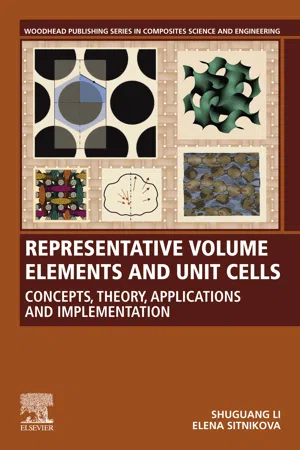
Representative Volume Elements and Unit Cells
Concepts, Theory, Applications and Implementation
- 482 pages
- English
- ePUB (mobile friendly)
- Available on iOS & Android
eBook - ePub
Representative Volume Elements and Unit Cells
Concepts, Theory, Applications and Implementation
About this book
Numerical methods to estimate material properties usually involve analysis of a representative volume element (RVE) or unit cell (UC). The representative volume element (RVE) or unit cell (UC) is the smallest volume over which a measurement can be made that will yield a value representative of the whole. RVEs and UCs are widely used in the characterisation of materials with multiscale architectures such as composites. However, finite element (FE) software packages such as Abaqus and Comsol MultiPhysics do not offer the capability for RVE and UC modelling directly on their own. To apply them to analyse RVEs and UCs, the generation of the FE models for them, the imposition of boundary conditions, and the extraction of directly relevant results are essentially the responsibility of the user. These have tended to be incorrectly implemented by users! For the first time, this book will provide a comprehensive account on correct modelling of RVEs and UCs, which will eliminate any uncertainties and ambiguities.The book offers a complete and thorough review on the subject of RVEs and UCs, establishing a framework on a rigorous mathematical and mechanical basis to ensure that basic concepts, such as symmetry and free body diagrams, are applied correctly and consistently. It also demonstrates to readers that rigorous applications of mathematics and mechanics are meant to make things clear, consistent, thorough and, most of all, simple and easy to follow, rather than the opposite as many perceive. As a result, the book shows that the appropriate use of RVEs and UCs can deliver an effective and reliable means of material characterisation. It not only provides a much needed comprehensive account on material characterisation but, more importantly, explains how such characterisation can be conducted in a consistent and systematic manner. It also includes a ready-to-use open source code for UCs that can be downloaded from a companion site for potential users to utilise, adapt and expand as they wish.
- The companion site for the book can be found at https://www.elsevier.com/books-and-journals/book-companion/9780081026380
- The theories presented in this book will give users more confidence when applying RVE and UC models to analyse materials of complex architectures with accuracy and efficiency
- Systematic explanations of RVE and UC theories have been included, as well as their applications in composites
- It illustrates in detail how to set up UC models and provides an open source code to implement via Abaqus
Information
Table of contents
- Cover image
- Title page
- Table of Contents
- Copyright
- Dedication
- Preface
- Part One. Basics
- Part Two. Consistent formulation of unit cells and representative volume elements
- Part Three. Further developments
- Index
Trusted by 375,005 students
Access to over 1.5 million titles for a fair monthly price.
Study more efficiently using our study tools.
Frequently asked questions
Yes, you can cancel anytime from the Subscription tab in your account settings on the Perlego website. Your subscription will stay active until the end of your current billing period. Learn how to cancel your subscription
No, books cannot be downloaded as external files, such as PDFs, for use outside of Perlego. However, you can download books within the Perlego app for offline reading on mobile or tablet. Learn how to download books offline
Perlego offers two plans: Essential and Complete
- Essential is ideal for learners and professionals who enjoy exploring a wide range of subjects. Access the Essential Library with 800,000+ trusted titles and best-sellers across business, personal growth, and the humanities. Includes unlimited reading time and Standard Read Aloud voice.
- Complete: Perfect for advanced learners and researchers needing full, unrestricted access. Unlock 1.5M+ books across hundreds of subjects, including academic and specialized titles. The Complete Plan also includes advanced features like Premium Read Aloud and Research Assistant.
We are an online textbook subscription service, where you can get access to an entire online library for less than the price of a single book per month. With over 1.5 million books across 990+ topics, we’ve got you covered! Learn about our mission
Look out for the read-aloud symbol on your next book to see if you can listen to it. The read-aloud tool reads text aloud for you, highlighting the text as it is being read. You can pause it, speed it up and slow it down. Learn more about Read Aloud
Yes! You can use the Perlego app on both iOS and Android devices to read anytime, anywhere — even offline. Perfect for commutes or when you’re on the go.
Please note we cannot support devices running on iOS 13 and Android 7 or earlier. Learn more about using the app
Please note we cannot support devices running on iOS 13 and Android 7 or earlier. Learn more about using the app
Yes, you can access Representative Volume Elements and Unit Cells by Shuguang Li,Elena Sitnikova in PDF and/or ePUB format, as well as other popular books in Technology & Engineering & Materials Science. We have over 1.5 million books available in our catalogue for you to explore.