eBook - ePub
Phenotypic Switching
Implications in Biology and Medicine
- 762 pages
- English
- ePUB (mobile friendly)
- Available on iOS & Android
eBook - ePub
Phenotypic Switching
Implications in Biology and Medicine
About this book
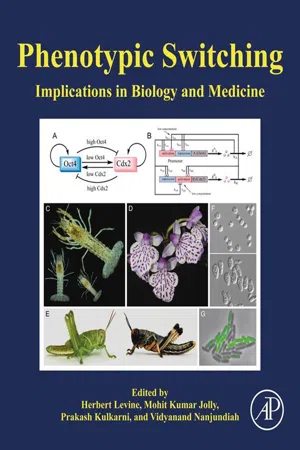
Phenotypic Switching: Implications in Biology and Medicine provides a comprehensive examination of phenotypic switching across biological systems, including underlying mechanisms, evolutionary significance, and its role in biomedical science. Contributions from international leaders discuss conceptual and theoretical aspects of phenotypic plasticity, its influence over biological development, differentiation, biodiversity, and potential applications in cancer therapy, regenerative medicine and stem cell therapy, among other treatments. Chapters discuss fundamental mechanisms of phenotypic switching, including transition states, cell fate decisions, epigenetic factors, stochasticity, protein-based inheritance, specific areas of human development and disease relevance, phenotypic plasticity in melanoma, prostate cancer, breast cancer, non-genetic heterogeneity in cancer, hepatitis C, and more.
This book is essential for active researchers, basic and translational scientists, clinicians, postgraduates and students in genetics, human genomics, pathology, bioinformatics, developmental biology, evolutionary biology and adaptive opportunities in yeast.
- Thoroughly addresses the conceptual, experimental and translational aspects that underlie phenotypic plasticity
- Emphasizes quantitative approaches, nonlinear dynamics, mechanistic insights and key methodologies to advance phenotypic plasticity studies
- Features a diverse range of chapter contributions from international leaders in the field
Information
Topic
MedicineSubtopic
Genetics in MedicineTable of contents
- Cover image
- Title page
- Table of Contents
- Copyright
- List of contributors
- Preface: Early thoughts on phenotypic plasticity in development and evolution
- Summaries of contributions
- Acknowledgments
- 1. The fundamentals of phenotypic plasticity
- 2. Rethinking the role of chance in the explanation of cell differentiation
- 3. Random walk across the epigenetic landscape
- 4. Manoeuvring protein functions and functional levels by structural excursions
- 5. Prion-mediated phenotypic diversity in fungi
- 6. Bistability in virus–host interaction networks underlies the success of hepatitis C treatments
- 7. Quantifying Waddington landscapes, paths, and kinetics of cell fate decision making of differentiation/development
- 8. The physics of cell fate
- 9. Disentangling the environmentally induced and stochastic developmental components of phenotypic variation
- 10. The evolution of cell differentiation in animals: biomolecular condensates as amplification hubs of inherent cell functions
- 11. Phenotypic switching and its evolutionary consequences
- 12. Cell-state organization by exploratory sloppy dynamics
- 13. Emergence of metabolic heterogeneity in cell populations: lessons from budding yeast
- 14. Stochastic phenotypic switching in endothelial cell heterogeneity
- 15. Regulation of phenotypic plasticity from the perspective of evolutionary developmental biology
- 16. Phenotypic plasticity and the origins of novelty
- 17. Niche construction and the transition to herbivory: Phenotype switching and the organization of new nutritional modes
- 18. Nature, nurture, and noise in bird song ontogeny as determinants of phenotypic and functional variation among dialects
- 19. Domestication as a process generating phenotypic diversity
- 20. The glycobiology of ovarian cancer progression: phenotypic switches and microenvironmental influences
- 21. Epithelial-mesenchymal transition in cancer
- 22. Phenotypic switching and prostate diseases: a model proposing a causal link between benign prostatic hyperplasia and prostate cancer
- 23. Phenotypic plasticity and lineage switching in prostate cancer
- 24. Implications of non-genetic heterogeneity in cancer drug resistance and malignant progression
- 25. Phenotypic plasticity: the emergence of cancer stem cells and collective cell migration
- 26. Adaptive phenotypic switching in breast cancer in response to matrix deprivation
- 27. Phenotypic instability induced by tissue disruption at the origin of cancer
- 28. Evolutionary strategies to overcome cancer cell resistance to treatment
- Index
Trusted by 375,005 students
Access to over 1.5 million titles for a fair monthly price.
Study more efficiently using our study tools.
Frequently asked questions
Yes, you can cancel anytime from the Subscription tab in your account settings on the Perlego website. Your subscription will stay active until the end of your current billing period. Learn how to cancel your subscription
No, books cannot be downloaded as external files, such as PDFs, for use outside of Perlego. However, you can download books within the Perlego app for offline reading on mobile or tablet. Learn how to download books offline
Perlego offers two plans: Essential and Complete
- Essential is ideal for learners and professionals who enjoy exploring a wide range of subjects. Access the Essential Library with 800,000+ trusted titles and best-sellers across business, personal growth, and the humanities. Includes unlimited reading time and Standard Read Aloud voice.
- Complete: Perfect for advanced learners and researchers needing full, unrestricted access. Unlock 1.5M+ books across hundreds of subjects, including academic and specialized titles. The Complete Plan also includes advanced features like Premium Read Aloud and Research Assistant.
We are an online textbook subscription service, where you can get access to an entire online library for less than the price of a single book per month. With over 1.5 million books across 990+ topics, we’ve got you covered! Learn about our mission
Look out for the read-aloud symbol on your next book to see if you can listen to it. The read-aloud tool reads text aloud for you, highlighting the text as it is being read. You can pause it, speed it up and slow it down. Learn more about Read Aloud
Yes! You can use the Perlego app on both iOS and Android devices to read anytime, anywhere — even offline. Perfect for commutes or when you’re on the go.
Please note we cannot support devices running on iOS 13 and Android 7 or earlier. Learn more about using the app
Please note we cannot support devices running on iOS 13 and Android 7 or earlier. Learn more about using the app
Yes, you can access Phenotypic Switching by Herbert Levine,Mohit Kumar Jolly,Prakash Kulkarni,Vidyanand Nanjundiah in PDF and/or ePUB format, as well as other popular books in Medicine & Genetics in Medicine. We have over 1.5 million books available in our catalogue for you to explore.