- 616 pages
- English
- ePUB (mobile friendly)
- Available on iOS & Android
eBook - ePub
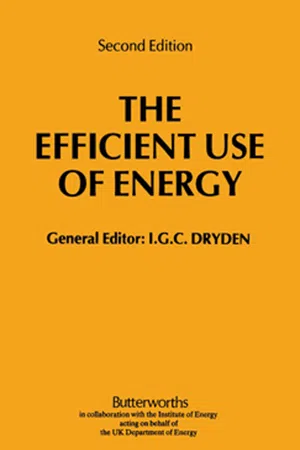
The Efficient Use of Energy
About this book
The Efficient Use of Energy, Second Edition is a compendium of papers discussing the efficiency with which energy is used in industry. The collection covers relevant topics in energy handling and describes the more important features of plant and equipment. The book is organized into six parts. Part I presents the various methods of heat production. The second part discusses the use of heat in industry and includes topics in furnace design, industrial heating, boiler plants, and water treatment. Part III deals with the production of mechanical and electrical energy. It tackles the principles of internal combustion engines, generators, and the use of nuclear energy. Total energy systems and heat salvage are covered in Part IV. Part V elucidates on the use of refractory and insulating materials and the importance of instrumentation and control in the regulation of energy consumption. The final section focuses on the environmental aspect of energy production such as the control of pollutants emanating from plants during production. The book will be of use to engineers and plant production managers.
Information
Table of contents
- Cover image
- Title page
- Table of Contents
- Copyright
- Foreword to the First Edition
- Preface
- Revisions made in Second Edition
- Note
- Editorial Panel, 1971/72
- Editorial Advisory Committee
- Contributors
- Chapter 1: Plan and perspective
- Chapter 2: Economic and cost factors in the choice of fuel and equipment
- PRODUCTION OF HEAT
- USE OF HEAT
- PRODUCTION OF MECHANICAL AND ELECTRICAL ENERGY
- TOTAL ENERGY SYSTEMS AND HEAT SALVAGE
- MATERIALS AND CONTROL
- ENVIRONMENTAL ASPECTS
- APPENDIXES
- Units: Explanatory Notes
Trusted by 375,005 students
Access to over 1.5 million titles for a fair monthly price.
Study more efficiently using our study tools.
Frequently asked questions
Yes, you can cancel anytime from the Subscription tab in your account settings on the Perlego website. Your subscription will stay active until the end of your current billing period. Learn how to cancel your subscription
No, books cannot be downloaded as external files, such as PDFs, for use outside of Perlego. However, you can download books within the Perlego app for offline reading on mobile or tablet. Learn how to download books offline
We are an online textbook subscription service, where you can get access to an entire online library for less than the price of a single book per month. With over 1.5 million books across 990+ topics, we’ve got you covered! Learn about our mission
Look out for the read-aloud symbol on your next book to see if you can listen to it. The read-aloud tool reads text aloud for you, highlighting the text as it is being read. You can pause it, speed it up and slow it down. Learn more about Read Aloud
Yes! You can use the Perlego app on both iOS and Android devices to read anytime, anywhere — even offline. Perfect for commutes or when you’re on the go.
Please note we cannot support devices running on iOS 13 and Android 7 or earlier. Learn more about using the app
Please note we cannot support devices running on iOS 13 and Android 7 or earlier. Learn more about using the app
Yes, you can access The Efficient Use of Energy by I.G.C. Dryden in PDF and/or ePUB format, as well as other popular books in Tecnología e ingeniería & Ingeniería mecánica. We have over 1.5 million books available in our catalogue for you to explore.