eBook - ePub
Handbook of Energy
Diagrams, Charts, and Tables
- 1,034 pages
- English
- ePUB (mobile friendly)
- Available on iOS & Android
eBook - ePub
About this book
Handbook of Energy, Volume I: Diagrams, Charts, and Tables provides comprehensive, organized coverage on all phases of energy and its role in society, including its social, economic, political, historical, and environmental aspects. While there is a wealth of information about energy available, it is spread across many books, journals, and websites and it tends to target either a particular form of energy or a specific audience. Handbook of Energy provides a central repository of information that meets diverse user communities. It focuses on visual, graphic, and tabular information in a schematic format. Individuals and researchers at all educational levels will find the Handbook of Energy to be a valuable addition to their personal libraries.
- Easy-to-read technical diagrams and tables display a vast array of data and concepts
Information
Topic
Physical SciencesSubtopic
EnergyPart I
Sources
Section 1 Bioenergetics
Section 2 Biomass
Section 3 Hydropower
Section 4 Wind
Section 5 Coal
Section 6 Oil and Gas
Section 7 Electricity
Section 8 Nuclear
Section 9 Renewables
Section 10 Solar
Section 11 Photovoltaic
Section 12 Geothermal
Section 13 Hydrogen
Section 14 Fuel Cells
Section 15 Ocean Energy
Section 1
Bioenergetics
Figures
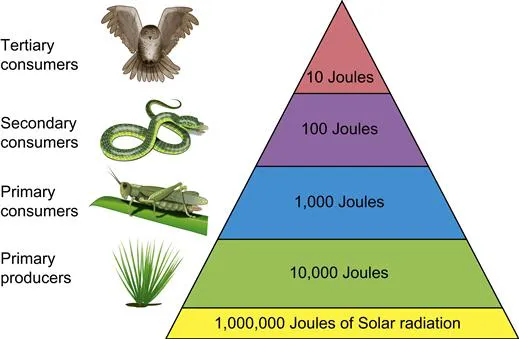
Figure 1.1 Ecological or energy pyramid, with amount of energy at each trophic level.
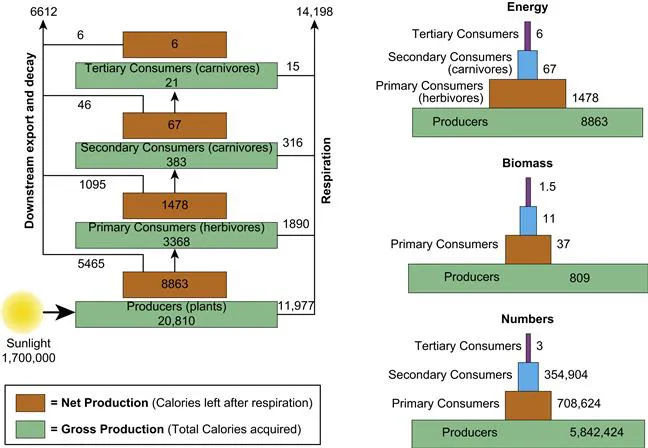
Figure 1.2 The flow of energy through a river ecosystem in Silver Springs, Florida. Energy units are kilocalories per square meter per year (kcal/m2/yr). Biomass units represent the dry weight of organic matter (per square meter). The pyramid of numbers is derived from a census of the populations of autotrophs, herbivores, and two levels of carnivores on an acre (0.4 hectare) of a typical grassland. The figures represent number of individuals counted at each trophic level. Source: Energy data from Odum, Howard T. 1957. Trophic Structure and Productivity of Silver Springs, Florida. Ecological Monographs 27:55–112; adapted from Kimball, John W., Kimball’s Biology Pages, <http://users.rcn.com/jkimball.ma.ultranet/BiologyPages/W/Welcome.html>.
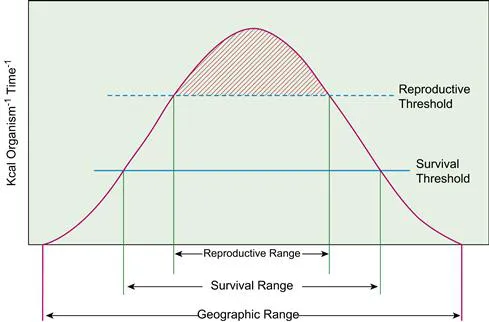
Figure 1.3 Organisms have ranges of tolerance for environmental factors (sunlight, temperature, pH, ec.). Optimum conditions are those that are most favorable for an organism to survive, grow and reproduce. This optimum is somewhere within the range of tolerance for that organism. Source: Adapted from Hall, C.A.S., J.A. Stanford and R. Hauer. 1992. The distribution and abundance of organisms as a consequence of energy balances along multiple environmental gradients. Oikos 65: 377–390.
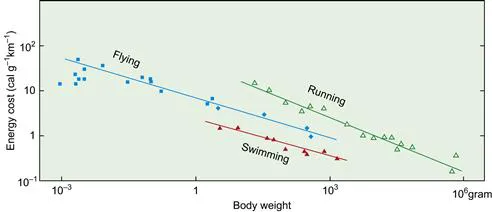
Figure 1.4 Energy cost of locomotion for swimming, flying, and running animals, as a function of body size. Source: Data from Schmidt-Nielsen, K. 1972. Locomotion: energy cost of swimming, flying and running. Science 177, 222–228.
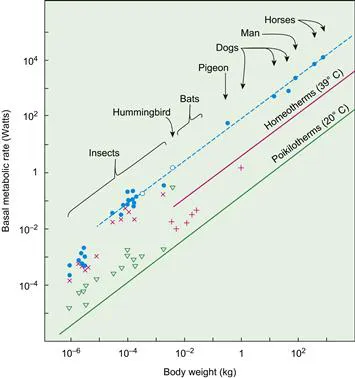
Figure 1.5 The relation between basal metabolic rate and body weight. Source: Data from Monteith, J.L. and M.H. Unsworth. 1990. Principles of Environmental Physics (Second Edition), (London, Edward Arnold).
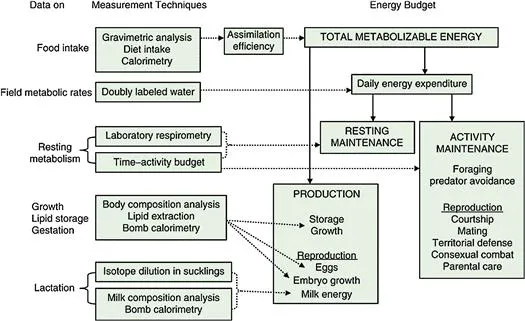
Figure 1.6 Generalized energy budget used to examine reproductive energetics. Source: Kunz, Thomas H. and Kimberly S. Orrell. 2004. Reproduction, Energy Costs of, In: Cutler J. Cleveland, Editor-in-Chief, Encyclopedia of Energy, (New York, Elsevier), Pages 423-442.
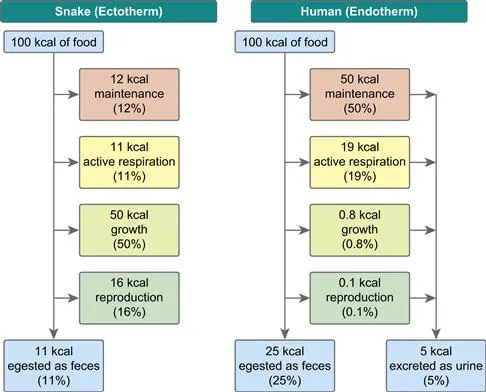
Figure 1.7 Comparative energetics of a snake (ectotherm) and human (endotherm). Source: Data from Kaufmann, Robert K. and Cleveland, Cutler J. 2007. Environmental Science (McGraw-Hill, Dubuque, IA).
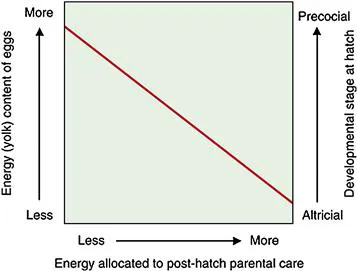
Figure 1.8 General relationship among energy content of eggs, energy allocated to post-hatch parental care, and development stage of offspring at hatch. Source: Kunz, Thomas H. and Kimberly S. Orrell. 2004. Reproduction, ...
Table of contents
- Cover image
- Title page
- Table of Contents
- Copyright
- Preface
- Acknowledgements
- Part I: Sources
- Part II: Foundations
- Part III: Applications
- Part IV: Impacts
- Part V: Correlations
Trusted by 375,005 students
Access to over 1.5 million titles for a fair monthly price.
Study more efficiently using our study tools.
Frequently asked questions
Yes, you can cancel anytime from the Subscription tab in your account settings on the Perlego website. Your subscription will stay active until the end of your current billing period. Learn how to cancel your subscription
No, books cannot be downloaded as external files, such as PDFs, for use outside of Perlego. However, you can download books within the Perlego app for offline reading on mobile or tablet. Learn how to download books offline
Perlego offers two plans: Essential and Complete
- Essential is ideal for learners and professionals who enjoy exploring a wide range of subjects. Access the Essential Library with 800,000+ trusted titles and best-sellers across business, personal growth, and the humanities. Includes unlimited reading time and Standard Read Aloud voice.
- Complete: Perfect for advanced learners and researchers needing full, unrestricted access. Unlock 1.5M+ books across hundreds of subjects, including academic and specialized titles. The Complete Plan also includes advanced features like Premium Read Aloud and Research Assistant.
We are an online textbook subscription service, where you can get access to an entire online library for less than the price of a single book per month. With over 1.5 million books across 990+ topics, we’ve got you covered! Learn about our mission
Look out for the read-aloud symbol on your next book to see if you can listen to it. The read-aloud tool reads text aloud for you, highlighting the text as it is being read. You can pause it, speed it up and slow it down. Learn more about Read Aloud
Yes! You can use the Perlego app on both iOS and Android devices to read anytime, anywhere — even offline. Perfect for commutes or when you’re on the go.
Please note we cannot support devices running on iOS 13 and Android 7 or earlier. Learn more about using the app
Please note we cannot support devices running on iOS 13 and Android 7 or earlier. Learn more about using the app
Yes, you can access Handbook of Energy by Cutler J. Cleveland,Christopher G. Morris in PDF and/or ePUB format, as well as other popular books in Physical Sciences & Energy. We have over 1.5 million books available in our catalogue for you to explore.