- 966 pages
- English
- ePUB (mobile friendly)
- Available on iOS & Android
eBook - ePub
Encyclopedia of Caves
About this book
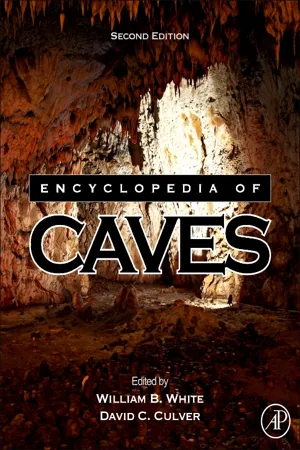
Encyclopedia of Caves is a self-contained, beautifully illustrated work dedicated to caves and their unique environments. It includes more than 100 comprehensive articles from leading scholars and explorers in 15 different countries. Each entry is detailed and scientifically sound, yet accessible for students and non-scientists. This large-format reference is enchanced with hundreds of full-color photographs, maps, and drawings from the authors' own work, which provide unique images of the underground environment.
- Global in reach--authors are an international team of experts covering caves from around the world
- Includes 24 new articles commissioned especially for this 2nd edition
- Articles contain extensive bibliographies cross-referencing related essays
- Hundreds of color photographs, maps, charts and illustrations of cave features and biota
- A-Z sequence and a comprehensive index allow for easy location of topics
- Glossary presents definitions of all key vocabulary items
Information
Topic
Physical SciencesSubtopic
Geology & Earth SciencesTable of contents
- Cover image
- Table of Contents
- Front-matter
- Copyright
- Contents By Subject Area
- List of Contributors
- Guide to the Encyclopedia
- Preface
- Adaptation to Low Food
- Adaptive Shifts
- Anchihaline (ANCHIALINE) Caves and Fauna
- Ancient Cavers in Eastern North America
- Asellus Aquaticus
- Astyanax Mexicanus
- Bats
- Beetles
- Behavioral Adaptations
- Breakdown
- Burnsville Cove, Virginia
- Camps
- Castleguard Cave, Canada
- Cave Dwellers in the Middle East
- Cave Ecosystems
- Cave, Definition of
- Cavefish of China
- Chemoautotrophy
- Clastic Sediments in Caves
- Closed Depressions in Karst Areas
- Coastal Caves
- Contamination of Cave Waters by Heavy Metals
- Contamination of Cave Waters by Nonaqueous Phase Liquids
- Cosmogenic Isotope Dating of Cave Sediments
- Crustacea
- Dinaric Karst
- Diversity Patterns in Australia
- Diversity Patterns in Europe
- Diversity Patterns in the Dinaric Karst
- Diversity Patterns in the Tropics
- Diversity Patterns in the United States
- Documentation and Databases
- Ecological Classification of Subterranean Organisms
- Entranceless Caves, Discovery of
- Entrances
- Epikarst
- Epikarst Communities
- Evolution of Lineages
- Exploration of Caves—General
- Exploration of Caves—Underwater Exploration Techniques
- Exploration of Caves—Vertical Caving Techniques
- Folklore, Myth, and Legend, Caves in
- Food Sources
- Friars Hole System, West Virginia
- Gammarus minus: A Model System for the Study of Adaptation to the Cave Environment
- Geophysics of Locating Karst and Caves
- Glacier Caves
- Guano Communities
- Gypsum Caves
- Gypsum Flowers and Related Speleothems
- Helictites and Related Speleothems
- Hydrogeology of Karst Aquifers
- Hydrothermal Caves
- Ice in Caves
- Invasion, Active versus Passive
- Jewel Cave, South Dakota
- Karren, Cave
- Karren, Surface
- Karst
- Kazumura Cave, Hawaii
- Krubera (Voronja) Cave
- Lampenflora
- Lechuguilla Cave, New Mexico, U.S.A.
- Life History Evolution
- Mammoth Cave System, Kentucky
- Mapping Subterranean Biodiversity
- Marine Regressions
- Maya Caves
- Microbes
- Minerals
- Modeling of Karst Aquifers
- Mollusks
- Morphological Adaptations
- Multilevel Caves and Landscape Evolution
- Mulu Caves, Malaysia
- Myriapods
- Natural Selection
- Neutral Mutations
- Niphargus: A Model System for Evolution and Ecology
- Nitrate Contamination in Karst Groundwater
- Nullarbor Caves, Australia
- Paleoclimate Records from Speleothems
- Paleomagnetic Records in Cave Sediments
- Paleontology of Caves
- Passage Growth and Development
- Passages
- Population Structure
- Postojna–Planina Cave System, Slovenia
- Protecting Caves and Cave Life
- Quartzite Caves of South America
- Recreational Caving
- Rescues
- Responses to Low Oxygen
- Root Communities in Lava Tubes
- Salamanders
- Saltpetre Mining
- Scallops
- Shallow Subterranean Habitats
- Show Caves
- Siebenhengste Cave System, Switzerland
- Sinking Streams and Losing Streams
- Sistema Huautla, Mexico
- Soil Piping and Sinkhole Failures
- Solution Caves in Regions of High Relief
- Solution Caves in Regions of Moderate Relief
- Species Interactions
- Speleogenesis, Hypogenic
- Speleogenesis, Telogenetic
- Speleothem Deposition
- Speleothems
- Spiders and Related Groups
- Springs
- Stalactites and Stalagmites
- Sulfuric Acid Caves
- Tiankeng
- Ukraine Giant Gypsum Caves
- Underwater Caves of the Yucatán Peninsula
- Uranium Series Dating of Speleothems
- Vertebrate Visitors—Birds and Mammals
- Vicariance and Dispersalist Biogeography
- Vjetrenica Cave, Bosnia and Herzegovina
- Volcanic Rock Caves
- Wakulla Spring Underwater Cave System, Florida
- Water Chemistry in Caves
- Water Tracing in Karst Aquifers
- Wetlands in Cave and Karst Regions
- White-Nose Syndrome
- Worms
- Index
Trusted by 375,005 students
Access to over 1.5 million titles for a fair monthly price.
Study more efficiently using our study tools.
Frequently asked questions
Yes, you can cancel anytime from the Subscription tab in your account settings on the Perlego website. Your subscription will stay active until the end of your current billing period. Learn how to cancel your subscription
No, books cannot be downloaded as external files, such as PDFs, for use outside of Perlego. However, you can download books within the Perlego app for offline reading on mobile or tablet. Learn how to download books offline
Perlego offers two plans: Essential and Complete
- Essential is ideal for learners and professionals who enjoy exploring a wide range of subjects. Access the Essential Library with 800,000+ trusted titles and best-sellers across business, personal growth, and the humanities. Includes unlimited reading time and Standard Read Aloud voice.
- Complete: Perfect for advanced learners and researchers needing full, unrestricted access. Unlock 1.5M+ books across hundreds of subjects, including academic and specialized titles. The Complete Plan also includes advanced features like Premium Read Aloud and Research Assistant.
We are an online textbook subscription service, where you can get access to an entire online library for less than the price of a single book per month. With over 1.5 million books across 990+ topics, we’ve got you covered! Learn about our mission
Look out for the read-aloud symbol on your next book to see if you can listen to it. The read-aloud tool reads text aloud for you, highlighting the text as it is being read. You can pause it, speed it up and slow it down. Learn more about Read Aloud
Yes! You can use the Perlego app on both iOS and Android devices to read anytime, anywhere — even offline. Perfect for commutes or when you’re on the go.
Please note we cannot support devices running on iOS 13 and Android 7 or earlier. Learn more about using the app
Please note we cannot support devices running on iOS 13 and Android 7 or earlier. Learn more about using the app
Yes, you can access Encyclopedia of Caves by William B. White,David C. Culver in PDF and/or ePUB format, as well as other popular books in Physical Sciences & Geology & Earth Sciences. We have over 1.5 million books available in our catalogue for you to explore.