eBook - ePub
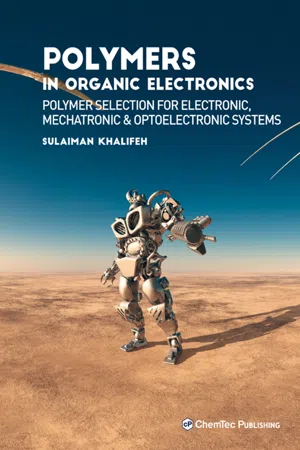
Polymers in Organic Electronics
Polymer Selection for Electronic, Mechatronic, and Optoelectronic Systems
- 616 pages
- English
- ePUB (mobile friendly)
- Available on iOS & Android
eBook - ePub
Polymers in Organic Electronics
Polymer Selection for Electronic, Mechatronic, and Optoelectronic Systems
About this book
Polymers in Organic Electronics: Polymer Selection for Electronic, Mechatronic, and Optoelectronic Systems provides readers with vital data, guidelines, and techniques for optimally designing organic electronic systems using novel polymers. The book classifies polymer families, types, complexes, composites, nanocomposites, compounds, and small molecules while also providing an introduction to the fundamental principles of polymers and electronics. Features information on concepts and optimized types of electronics and a classification system of electronic polymers, including piezoelectric and pyroelectric, optoelectronic, mechatronic, organic electronic complexes, and more. The book is designed to help readers select the optimized material for structuring their organic electronic system.Chapters discuss the most common properties of electronic polymers, methods of optimization, and polymeric-structured printed circuit boards. The polymeric structures of optoelectronics and photonics are covered and the book concludes with a chapter emphasizing the importance of polymeric structures for packaging of electronic devices.
- Provides key identifying details on a range of polymers, micro-polymers, nano-polymers, resins, hydrocarbons, and oligomers
- Covers the most common electrical, electronic, and optical properties of electronic polymers
- Describes the underlying theories on the mechanics of polymer conductivity
- Discusses polymeric structured printed circuit boards, including their rapid prototyping and optimizing their polymeric structures
- Shows optimization methods for both polymeric structures of organic active electronic components and organic passive electronic components
Information
1
INTRODUCTION TO POLYMERS FOR ELECTRONIC ENGINEERS
1.1 OVERVIEW
Conventional materials such as metals and ceramics have been replaced by polymers (homopolymers, copolymers, composites, complexes, blends of small molecules, and alloys), in electronic, microelectronic, and nanoelectronic systems because of their complex molecular characteristics and attractive electrical, electronic, mechanical, physical, chemical, and optical properties.1 Polymers help to achieve low cost, short lead time, reduced weight, and they can be molded into very complex shapes, having properties that can easily satisfy the requirements. The above features are crucial in microelectronics and nanoelectronics based on three-dimensional printed circuit boards 3D-PCBs; molded integrated devices MID; flexible (bendable and stretchable) polymeric substrates; integrated electronic systems (such as integrated circuits ICs); and electronic components working at high temperatures. The further examples are the developed generations of microelectromechanical systems MEMS and nanoelectromechanical systems NEMS which started with utilization of silicone Q polymers in integrated circuits.2
Note: Silicone polymer (abbreviated as Q) should not be confused with the silicon chemical element (abbreviated as Si). Generally, polymers are compounds of organic nature consisted of different combinations of carbon, oxygen, hydrogen, nitrogen, in addition to other elements. Polymers are available in the form of solid, liquid, filament, or powder states. According to their chemical nature, polymers can be grouped into families, subfamilies, and members. Polymers can be formed (molded) through the application of both heat and pressure.
Electric conductivity (σ) of some polymers represents the key feature of structuring electronic, microelectronic, nanoelectronic, and optoelectronic systems. Organic electronics (also called organic electronic components or polymeric electronic components) term was the starting point of forming electronic polymers. The electric conductivity of both inorganic and organic compounds can be measured in Siemens/cm (or S/cm). σ < 10−7 for insulators, 10−7 < σ <102 for semiconductors, σ > 102 for metals, and σ » 1020 for superconductors).46
Electronic polymers (also called organic electronics such as electrically active polymers EAPs having inherent electrical conductivity) cover a considerable field of material science that focuses on the development of electrically conducting polymers, small molecules, and complexes designed for development of novel electronic, microelectronic, and nanoelectronic systems (including displays, organic light-emitting diodes OLEDs, organic electroluminescent devices, organic thin-film transistors OTFTs, nanorobots, organic solar cells/photovoltaics, sensors, and actuators).47 Examples of electronic polymers include polyacetylene PAC having electric conductivity σ = 104-105 S/cm; polyaniline PANI (σ = 102-103 S/cm); poly(p-phenylene vinylene) PPV (σ = 103-104 S/cm); and polythiophene PT (σ = 103-104 S/cm).3 Generally, the electrical conductivity of such polymers results from a process called “doping” (oxidation or reduction).46
The main classes of electronic polymers include electroactive polymers EAPs (also called intelligent polymers), shape-memory polymers/alloys, ferroelectric polymers, and piezoelectric polymers/materials. They are characterized by the capability of change in dimension or shape upon external stimuli such as electric field or light.3,6 For example, the ferroelectric polymer, called poly(vinylidene fluoride) PVDF, is a member of electronic polymers applied widely in actuators and sensors of robots (included microrobots and nanorobots).
Micro and nanomachining technologies such as microinjection molding are the micro- and nano-tools used for structuring polymeric micro and nanoelectronic systems.4 For example, some of the new microelectronics being molded recently include hearing aids, sensors, biomedical components, and fiber-optic components. Some companies can make micro- or nano-parts weighing 0.0002 grams with tolerances of 0.004 mm and tighter. So, what are the electronic polymers?
1.2 SYNTHETIC ELECTRONIC POLYMERS
Polymers (commercially called plastics or plastic materials) are compounds of organic nature (often produced from crude oil) with high molecular weight, which can be shaped by the application of heat and pressure, such as the applied heat and pressure of an injection molding process. Chemically, they are built up of monomers as repeating units of shorter carbon-containing compounds hav...
Table of contents
- Cover image
- Title page
- Table of Contents
- Copyright
- Dedication
- Acknowledgments
- Chapter 1: INTRODUCTION TO POLYMERS FOR ELECTRONIC ENGINEERS
- Chapter 2: ELECTRONICS FOR POLYMER ENGINEERS
- Chapter 3: OPTIMIZED ELECTRONIC POLYMERS, SMALL MOLECULES, COMPLEXES, AND ELASTOMERS FOR ORGANIC ELECTRONIC SYSTEMS
- Chapter 4: OPTIMIZATION OF ELECTRICAL, ELECTRONIC AND OPTICAL PROPERTIES OF ORGANIC ELECTRONIC STRUCTURES
- Chapter 5: OPTIMIZATION OF POLYMERIC STRUCTURES OF ORGANIC PRINTED CIRCUIT BOARDS
- Chapter 6: OPTIMIZED POLYMERIC STRUCTURES OF ORGANIC ACTIVE ELECTRONIC COMPONENTS
- Chapter 7: POLYMERIC STRUCTURES OPTIMIZED FOR ORGANIC PASSIVE ELECTRONIC COMPONENTS
- Chapter 8: OPTIMIZING POLYMERIC STRUCTURES IN ORGANIC OPTOELECTRONICS
- Chapter 9: OPTIMIZING POLYMERIC STRUCTURES OF ORGANIC ELECTRONIC PACKAGES
- INDEX
Trusted by 375,005 students
Access to over 1.5 million titles for a fair monthly price.
Study more efficiently using our study tools.
Frequently asked questions
Yes, you can cancel anytime from the Subscription tab in your account settings on the Perlego website. Your subscription will stay active until the end of your current billing period. Learn how to cancel your subscription
No, books cannot be downloaded as external files, such as PDFs, for use outside of Perlego. However, you can download books within the Perlego app for offline reading on mobile or tablet. Learn how to download books offline
Perlego offers two plans: Essential and Complete
- Essential is ideal for learners and professionals who enjoy exploring a wide range of subjects. Access the Essential Library with 800,000+ trusted titles and best-sellers across business, personal growth, and the humanities. Includes unlimited reading time and Standard Read Aloud voice.
- Complete: Perfect for advanced learners and researchers needing full, unrestricted access. Unlock 1.5M+ books across hundreds of subjects, including academic and specialized titles. The Complete Plan also includes advanced features like Premium Read Aloud and Research Assistant.
We are an online textbook subscription service, where you can get access to an entire online library for less than the price of a single book per month. With over 1.5 million books across 990+ topics, we’ve got you covered! Learn about our mission
Look out for the read-aloud symbol on your next book to see if you can listen to it. The read-aloud tool reads text aloud for you, highlighting the text as it is being read. You can pause it, speed it up and slow it down. Learn more about Read Aloud
Yes! You can use the Perlego app on both iOS and Android devices to read anytime, anywhere — even offline. Perfect for commutes or when you’re on the go.
Please note we cannot support devices running on iOS 13 and Android 7 or earlier. Learn more about using the app
Please note we cannot support devices running on iOS 13 and Android 7 or earlier. Learn more about using the app
Yes, you can access Polymers in Organic Electronics by Sulaiman Khalifeh in PDF and/or ePUB format, as well as other popular books in Technology & Engineering & Materials Science. We have over 1.5 million books available in our catalogue for you to explore.