- 674 pages
- English
- ePUB (mobile friendly)
- Available on iOS & Android
eBook - ePub
About this book
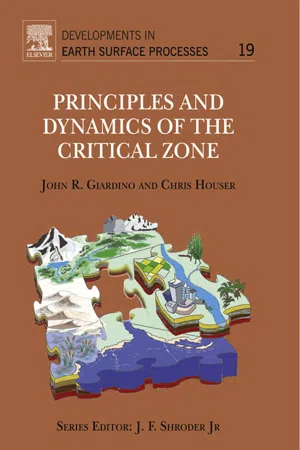
Principles and Dynamics of the Critical Zone is an invaluable resource for undergraduate and graduate courses and an essential tool for researchers developing cutting-edge proposals. It provides a process-based description of the Critical Zone, a place that The National Research Council (2001) defines as the "heterogeneous, near surface environment in which complex interactions involving rock, soil, water, air, and living organisms regulate the natural habitat and determine the availability of life-sustaining resources." This text provides a summary of Critical Zone research and outcomes from the NSF funded Critical Zone Observatories, providing a process-based description of the Critical Zone in a wide range of environments with a specific focus on the important linkages that exist amongst the processes in each zone. This book will be useful to all scientists and students conducting research on the Critical Zone within and outside the Critical Zone Observatory Network, as well as scientists and students in the geosciences – atmosphere, geomorphology, geology and pedology.
- The first text to address the principles and concepts of the Critical Zone
- A comprehensive approach to the processes responsible for the development and structure of the Critical Zone in a number of environments
- An essential tool for undergraduate and graduate students, and researchers developing cutting-edge proposals
Information
Chapter 1
Introduction to the Critical Zone
John R. Giardino*
Chris Houser**
* High Alpine and Arctic Research Program, Department of Geology and Geophysics and the Water Management and Hydrological Science Graduate Program, Texas A&M University, College Station, Texas, USA
** Department of Geography, Department of Geology and Geophysics, Office of the Dean of Geosciences, Texas A&M University, College Station, Texas, USA
* High Alpine and Arctic Research Program, Department of Geology and Geophysics and the Water Management and Hydrological Science Graduate Program, Texas A&M University, College Station, Texas, USA
** Department of Geography, Department of Geology and Geophysics, Office of the Dean of Geosciences, Texas A&M University, College Station, Texas, USA
Abstract
The National Research Council (NRC, 2001, p. 2) defined the Critical Zone as “the heterogeneous, near surface environment in which complex interactions involving rock, soil, water, air and living organisms regulate the natural habitat and determine availability of life sustaining resources.” From this original definition, many, now loosely worded, definitions have been crafted to define the limits of this zone as ranging from the top of the canopy layer down to the bottom of the aquifer, so that the Critical Zone includes all the upper zone of Earth sensu lato. The term Critical Zone, referring to this near-surface and surface zone, was first introduced by Gail Ashley in 1988 to recognize that soil connects the vegetation canopy to the soil; the soil connects to the weathered materials and the weathered materials connect to bedrock, and bedrock provides the connection to the aquifer. In recognition of the importance of this cause-and-effect relationship between previously unconnected spheres, the US National Science Foundation (NSF) established 10 Critical Zone Observatories (CZOs) supported by a national office. This was followed by the establishment of Soil Transformations in European Catchments (SoilTrEC) by the consortium of European Union members. Today there are 64 CZOs spread across the planet but within a narrow range of biophysical environments. The raison d’être of the Critical Zone network is driven by basic principles of science: all the research at each location is focused on asking fundamental integrated biophysical questions and collecting and building long-term data banks from a well-studied environment. In this respect, one of the most important applied aspects of the global CZO network will be the development of reliable data that will lead to enlightened policy and management of the geoscience base of Earth. The name “Critical Zone” has become a fashionable term, but very little, truly integrated work occurs at the CZOs, which we argue will only be possible if it recognized that the real thread that connects all the components of the Critical Zone is water. That said, we think the Critical Zone concept is still a step in the right direction to serve as a unifying principle for the geosciences and an opportunity for truly integrative research of the biophysical environment and the role of humans within that environment.
Keywords
Critical Zone
water
Critical Zone Observatories
regolith
soil
It ain’t what they call you, it's what you answer to.
W.C. Fields
1.1. Introduction
Pick up a newspaper or magazine. Turn on the television or radio and watch or listen to the news or typical talk show. All of these will have articles or programs that focus on global change and human-caused actions that focus on drought, floods, earthquakes, oil spills, hurricanes, tsunamis, forest fires, coastal erosion, landslides, avalanches, and pollution of air and water resources. The list can go on and on. Partly as a result of the impact of these events on humans and the environment, the Nation Research Council's (NRC) Committee on Basic Research Opportunities in the Earth Sciences, and the National Science Foundation (NSF) created the Critical Zone Observatory (CZO) program (NRC, 2001). Whereas the NRC conceptualized the term, the funding of the program fell on the shoulders of NSF.
In the Principles and Dynamics in the Critical Zone, we have assembled a group of authors to provide a broad-ranging approach to Critical Zone research that extends beyond the current CZOs. Each chapter has been written with the perspective of integrating the viewpoints from specific fields into an interdisciplinary view of the Critical Zone. Each chapter provides a view of a specific discipline or from a specific environment and the contributions it brings to Critical Zone research. As a first step in reading this volume, we begin by providing a succinct overview of the Critical Zone.
1.2. Brief history and background of the Critical Zone observation network and Critical Zone Observatories
In 2001, a panel of the US National Research Council (NRC, 2001) r...
Table of contents
- Cover
- Title page
- Table of Contents
- Copyright
- Dedication
- List of Contributors
- Foreword
- Chapter 1: Introduction to the Critical Zone
- Chapter 2: The Role of Critical Zone Observatories in Critical Zone Science
- Chapter 3: Climate of the Critical Zone
- Chapter 4: Regolith and Weathering (Rock Decay) in the Critical Zone
- Chapter 5: Soil Morphology in the Critical Zone: The Role of Climate, Geology, and Vegetation in Soil Formation in the Critical Zone
- Chapter 6: Soil Geochemistry in the Critical Zone: Influence on Atmosphere, Surface- and Groundwater Composition
- Chapter 7: A Terrestrial Landscape Ecology Approach to the Critical Zone
- Chapter 8: Ecohydrology and the Critical Zone: Processes and Patterns Across Scales
- Chapter 9: Rivers in the Critical Zone
- Chapter 10: Characteristic and Role of Groundwater in the Critical Zone
- Chapter 11: A Review of Mass Movement Processes and Risk in the Critical Zone of Earth
- Chapter 12: The Impact of Glacial Geomorphology on Critical Zone Processes
- Chapter 13: Periglacial Processes and Landforms in the Critical Zone
- Chapter 14: The Critical Zone in Desert Environments
- Chapter 15: The Critical Zone in Tropical Environments
- Chapter 16: The Critical Zone of Coastal Barrier Systems
- Chapter 17: Geospatial Science and Technology for Understanding the Complexities of the Critical Zone
- Chapter 18: The Built Environment in the Critical Zone: From Pre- to Postindustrial Cities
- Chapter 19: Natural and Anthropogenic Factors Affecting Groundwater in the Critical Zone of the Texas Triangle Megaregion
- Chapter 20: A Summary and Future Direction of the Principles and Dynamics of the Critical Zone
- Subject Index
Trusted by 375,005 students
Access to over 1.5 million titles for a fair monthly price.
Study more efficiently using our study tools.
Frequently asked questions
Yes, you can cancel anytime from the Subscription tab in your account settings on the Perlego website. Your subscription will stay active until the end of your current billing period. Learn how to cancel your subscription
No, books cannot be downloaded as external files, such as PDFs, for use outside of Perlego. However, you can download books within the Perlego app for offline reading on mobile or tablet. Learn how to download books offline
Perlego offers two plans: Essential and Complete
- Essential is ideal for learners and professionals who enjoy exploring a wide range of subjects. Access the Essential Library with 800,000+ trusted titles and best-sellers across business, personal growth, and the humanities. Includes unlimited reading time and Standard Read Aloud voice.
- Complete: Perfect for advanced learners and researchers needing full, unrestricted access. Unlock 1.5M+ books across hundreds of subjects, including academic and specialized titles. The Complete Plan also includes advanced features like Premium Read Aloud and Research Assistant.
We are an online textbook subscription service, where you can get access to an entire online library for less than the price of a single book per month. With over 1.5 million books across 990+ topics, we’ve got you covered! Learn about our mission
Look out for the read-aloud symbol on your next book to see if you can listen to it. The read-aloud tool reads text aloud for you, highlighting the text as it is being read. You can pause it, speed it up and slow it down. Learn more about Read Aloud
Yes! You can use the Perlego app on both iOS and Android devices to read anytime, anywhere — even offline. Perfect for commutes or when you’re on the go.
Please note we cannot support devices running on iOS 13 and Android 7 or earlier. Learn more about using the app
Please note we cannot support devices running on iOS 13 and Android 7 or earlier. Learn more about using the app
Yes, you can access Principles and Dynamics of the Critical Zone by in PDF and/or ePUB format, as well as other popular books in Biological Sciences & Ecology. We have over 1.5 million books available in our catalogue for you to explore.