- 336 pages
- English
- ePUB (mobile friendly)
- Available on iOS & Android
eBook - ePub
About this book
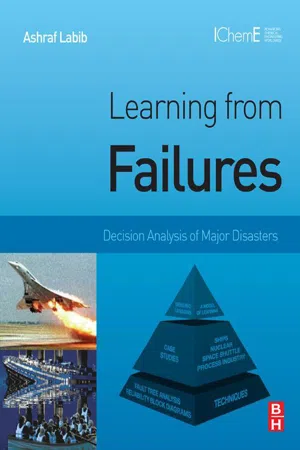
Learning from Failures provides techniques to explore the root causes of specific disasters and how we can learn from them. It focuses on a number of well-known case studies, including: the sinking of the Titanic; the BP Texas City incident; the Chernobyl disaster; the NASA Space Shuttle Columbia accident; the Bhopal disaster; and the Concorde accident. This title is an ideal teaching aid, informed by the author's extensive teaching and practical experience and including a list of learning outcomes at the beginning of each chapter, detailed derivation, and many solved examples for modeling and decision analysis.
This book discusses the value in applying different models as mental maps to analyze disasters. The analysis of these case studies helps to demonstrate how subjectivity that relies on opinions of experts can be turned into modeling approaches that can ensure repeatability and consistency of results. The book explains how the lessons learned by studying these individual cases can be applied to a wide range of industries.
This work is an ideal resource for undergraduate and postgraduate students, and will also be useful for industry professionals who wish to avoid repeating mistakes that resulted in devastating consequences.
- Explores the root cause of disasters and various preventative measures
- Links theory with practice in regard to risk, safety, and reliability analyses
- Uses analytical techniques originating from reliability analysis of equipment failures, multiple criteria decision making, and artificial intelligence domains
Information
Part 1
Background of Analytical Methods Used in Investigation of Disasters
Outline
Chapter 1
Introduction to the Concept of Learning from Failures
This book is about two questions—how do we learn from failures? and why do we need to learn from failures? Seemingly simple they are really quite profound and we need to dig deeper for suitable answers. Here we will introduce the concept of learning from failures by analyzing reported disasters, exploring techniques that can help us to understand the root causes of such incidents, how they unfolded over time, and how we can learn generic lessons from them.
Keywords
Learning from failures; taxonomy of theories; reliability; safety; hindsight; generic lessons
1.1 Introduction
There is evidence that lessons gained from major disasters have not really been learned by the very same organizations involved in those disasters: the multiple disasters, for example, that occurred in organizations such as NASA (the Challenger and Columbia accidents) and BP (Texas City refinery and Deepwater Horizon accidents). So why do organizations and institutions fail to learn? When accidents happen, what are the factors that can drive the unlearning process? And, how can organizations learn and change their policies, routines, and procedures through feedback? In this book, the concepts of learning and unlearning from failures are investigated and a new theory is developed in order to address these questions and to provide a mechanism for feedback. It has been reported that organizations learn more effectively from failures than from successes (Madsen and Desai, 2010) that failures contain valuable information, but that organizations vary in their ability to learn from them (Desai, 2010). It is also argued that organizations vicariously learn from the failures and near-failures of others (Kim and Miner, 2007; Madsen, 2009). However, it can also be argued that lessons gained from major failures have often not really been learned by the very same organizations involved in them. This been exemplified by recent incidents within major organizations such as BP, NASA, and Toyota.
The first case concerns BP. In March 2005, a series of explosions and fires occurred at its Texas City refinery killing 15 people and injured 170 (Vaidogas and Juocevičius, 2008). An analysis of BP’s recent history (Khan and Amyotte, 2007) showed that the March 2005 disaster was not an isolated incident and concluded that BP led the US refining industry in its incidence of fatalities over the previous decade—and in April an explosion destroyed its Deepwater Horizon drilling rig, killing 11 workers and initiating a major oil spill.
The second case concerns NASA which experienced the Challenger launch disaster in 1986 followed by the Columbia disaster in 2003. Both failures have been analyzed (Vaughan, 1996, 2005) and attention drawn to a consistent and institutionalized practice of underestimating failures as early warning signals and having too much belief in the track record of past successful launches. It was also noted that NASA concluded that both accidents were attributed to “failures of foresight” (Smith, 2003).
The third case concerns Toyota. In January 2010, a quality problem affected Toyota which led to a global recall, of more than 8.5 million vehicles, to deal with various problems, including sticking gas pedals, braking software errors, and defective floor mats. And again, on July 5, 2010, Toyota began recalling more than 90,000 luxury Lexus and Crown vehicles in Japan as part of a global recall regarding defective engines (Kageyama, 2010).
The author has coauthored a paper entitled “Not Just Rearranging the Deckchairs on the Titanic: Learning from Failures through Risk and Reliability Analysis” published in The Journal of Safety Science (Labib and Read, 2013), which is the first part of the title implying that learning should not lead to doing something pointless or insignificant that will soon be overtaken by events, or that contributes nothing to the solution of the current problem.
I have also written and coauthored related papers which have followed the same theme as in this present book in proposing an analytical tool or a hybrid of such tools in an integrated approach and then demonstrating the value of such an approach through a case study of a disaster or of multiple disasters. This included one (Davidson and Labib, 2003) in which we analyzed the 2000 Concorde accident using a multiple criterion prioritization approach called the analytical hierarchy process (AHP). There, we also proposed a systematic methodology for the implementation of design improvements based on experience of past failures and this has been conducted and applied in the case of the Concorde after the 2000 accident.
I have also been involved in presenting reliability engineering techniques such as failure mode effect analysis (FMEA), fault tree analysis (FTA), and reliability block diagrams (RBD) which have been used to analyze the Bhopal disaster (Labib and Champaneri, 2012) and show how such techniques can help in building a mental model of the causal effects of the disaster. The Bhopal study was also used to develop a new logic gate in the fault tree proposed for analyzing s...
Table of contents
- Cover image
- Title page
- Table of Contents
- Copyright
- Acknowledgments
- Part 1: Background of Analytical Methods Used in Investigation of Disasters
- Part 2: A–Z of Disastrous Case Studies
- Part 3: Generic Lessons, Other Models of Learning from Failures and Research Directions
- Not Just Rearranging the Deckchairs on the Titanic: Learning from Failures Through Risk and Reliability Analysis
- References
- Glossary of Terms
- Index
Trusted by 375,005 students
Access to over 1.5 million titles for a fair monthly price.
Study more efficiently using our study tools.
Frequently asked questions
Yes, you can cancel anytime from the Subscription tab in your account settings on the Perlego website. Your subscription will stay active until the end of your current billing period. Learn how to cancel your subscription
No, books cannot be downloaded as external files, such as PDFs, for use outside of Perlego. However, you can download books within the Perlego app for offline reading on mobile or tablet. Learn how to download books offline
Perlego offers two plans: Essential and Complete
- Essential is ideal for learners and professionals who enjoy exploring a wide range of subjects. Access the Essential Library with 800,000+ trusted titles and best-sellers across business, personal growth, and the humanities. Includes unlimited reading time and Standard Read Aloud voice.
- Complete: Perfect for advanced learners and researchers needing full, unrestricted access. Unlock 1.5M+ books across hundreds of subjects, including academic and specialized titles. The Complete Plan also includes advanced features like Premium Read Aloud and Research Assistant.
We are an online textbook subscription service, where you can get access to an entire online library for less than the price of a single book per month. With over 1.5 million books across 990+ topics, we’ve got you covered! Learn about our mission
Look out for the read-aloud symbol on your next book to see if you can listen to it. The read-aloud tool reads text aloud for you, highlighting the text as it is being read. You can pause it, speed it up and slow it down. Learn more about Read Aloud
Yes! You can use the Perlego app on both iOS and Android devices to read anytime, anywhere — even offline. Perfect for commutes or when you’re on the go.
Please note we cannot support devices running on iOS 13 and Android 7 or earlier. Learn more about using the app
Please note we cannot support devices running on iOS 13 and Android 7 or earlier. Learn more about using the app
Yes, you can access Learning from Failures by Ashraf Labib in PDF and/or ePUB format, as well as other popular books in Technology & Engineering & Chemical & Biochemical Engineering. We have over 1.5 million books available in our catalogue for you to explore.