- 604 pages
- English
- ePUB (mobile friendly)
- Available on iOS & Android
eBook - ePub
About this book
Waste: A Handbook for Management gives the broadest, most complete coverage of waste in our society. The book examines a wide range of waste streams, including:
- Household waste (compostable material, paper, glass, textiles, household chemicals, plastic, water, and e-waste)
- Industrial waste (metals, building materials, tires, medical, batteries, hazardous mining, and nuclear)
- Societal waste (ocean, military, and space)
- The future of landfills and incinerators
Covering all the issues related to waste in one volume helps lead to comparisons, synergistic solutions, and a more informed society. In addition, the book offers the best ways of managing waste problems through recycling, incineration, landfill and other processes.
- Co-author Daniel Vallero interviewed on NBC's Today show for a segment on recycling
- Scientific and non-biased overviews will assist scientists, technicians, engineers, and government leaders
- Covers all main types of waste, including household, industrial, and societal
- Strong focus on management and recycling provides solutions
Information
Subtopic
Gestione ambientaleChapter 1. Trends in Waste Management
Valerie L. Shulman
European Tyre Recycling Association (ETRA), Avenue de Tervueren 16, 1040 Brussels, Belgium
Outline
1. Introduction3
2. The Catalyst for Change4
3. Sustainable Development: The Context for Recycling5
3.1. The Post-War Period5
3.2. The Period of Globalisation7
4. Implementation and Progress8
5. Interpretations10
1. Introduction
Waste management and recycling are neither new concepts nor new activities. In fact, materials had been recycled long before the term was coined in the twentieth century. People have always seen value in items cast-off by others. Witness the aphorism that ‘one’s trash is another man’s treasure’.
Historically, waste management has been inextricably linked with the evolution of human communities, population growth and the emergence and development of commerce. During the past century, consumption and production patterns have changed radically – due in part to the greater freedom of movement of money, goods and people.
Population growth has taken precedence in terms of economic development and the creation of waste. World population trebled from approximately 2 billion in 1925–2000, when it topped 6 billion (see Box 1.1). The vast growth spurt has been attributed to the benefits of economic development, including improved healthcare, higher fertility rates, lower infant mortality and long-life expectancy, primarily in developing countries. Care must be taken when using such global data. For example, less developed nations have experienced growth without many of these benefits, that is, they continue to experience high infant mortality because of poor nutrition and infectious diseases, whereas wealthier countries have advanced healthcare but have witnessed an overall lower fertility rate – which endures today.
BOX 1.1
POPULATION GROWTH
| Year | Estimated Population |
|---|---|
| 3000 BCE | 14,000,000 |
| 2000 BCE | 27,000,000 |
| 1000 BCE | 50,000,000 |
| 500 BCE | 100,000,000 |
| 200 BCE | 150,000,000 |
| 1 AD | 200,000,000 |
| 1000 AD | 310,000,000 |
| 1804 | 1,000,000,000 |
| 1925 | 2,000,000,000 |
| 1939 | 2,200,000,000 |
| 1945 | 2,300,000,000 |
| 1950 | 2,500,000,000 |
| 1960 | 3,000,000,000 |
| 1975 | 4,000,000,000 |
| 1988 | 5,000,000,000 |
| 2000 | 6,000,000,000 |
The population explosion has exerted greater pressures on production and consumption and indirectly the accumulation of waste. Over time, it has become apparent that the single most important driving forces modifying the environment are population size and growth – and how man exploits available natural resources.
2. The Catalyst for Change
At the end of World War II, the world was in shambles from virtually every perspective: physically, economically, socially and environmentally. The war had been the most pervasive military conflict in human history – over land, on the seas and in the air. Sixty-one countries and many territories on six continents, as well as all the world’s oceans, suffered devastating damage and long-term social, economic and environmental effects. Only the Western hemisphere, parts of the Near East and sub-Saharan Africa were unscathed.
Wars are most notorious for their tolls on human populations, but they also severely affect ecosystems. Rivers and lakes, jungles and forests and farmlands and deltas were obliterated – with dangerous wastes left behind. Hundreds of cities were demolished and many others rendered virtually uninhabitable. Infrastructure was decimated – bridges, roads and railroads were laid to waste – and rendered nonfunctional.
Almost 60 million civilians and military personnel were killed and tens of millions more were seriously injured and/or permanently maimed. War-induced famines took the lives of more than 2 million more in Africa and Asia [1]. Millions remained homeless throughout the war-torn world. Thousands more were captives of foreign nations – even at home.
According to the International Registry of Sunken Ships [2], more than 12,500 sunken vessels including battleships, aircraft carriers, destroyers, landing craft and more than 5000 merchant ships were scattered on ocean floors. Governments estimate that more than 335,000 aircraft were lost, primarily over Europe, Asia and Africa [3]. Thousands of tonnes of unexploded ordnance including mines, bombs and various forms of ammunition litter seabeds, fields, jungles, caves and even home gardens.
More than 60 years after the end of the war, experts estimate that it could take another 150 years to clear the detritus and neutralise the hazardous content – which continue to pose dire threats to the environment, humans and creatures in the seas, on land and in the air. In addition to military debris, every type of waste imaginable – from natural to synthetic materials – including construction rubble, plastic debris, synthetic rubber, electronic equipment and parts, transistors, microwave materials, and synthetic fuels, among hundreds of others, became the residue of the war – and had to be treated and disposed.
Many of the products created for the ‘war effort’ have become the most common products of today – with the same problems and issues surrounding their treatment and disposal. Pesticide formulations, such as the organophosphates, owe their basic chemical structures to chemical war agents. Petrochemical products also have grown substantially in response to war efforts. In addition, abandoned ammunition dumps, practice ranges, and other military facilities continue to be vexing hazardous waste sites.
The definition of wartime waste is complex. For example, among the most harmful and tragic wastes are abandoned land mines, which continue to cause death and inflict harm long after their initial use.
3. Sustainable Development: The Context for Recycling
As early as 1942, signatories to the Atlantic Charter had initiated discussions about an organisation that could replace the failed League of Nations. Before the final guns were silenced, world leaders had begun to prepare for the future – one without war, in which disputes could potentially be resolved through discussion and cooperation. The structure and substance of the United Nations was agreed among 50 nations – with 51 available to sign it into international law.
Signed on 26 June 1945, the UN Charter came into force on 24 October 1945, as an international organisation with the goal of providing a platform for dialogue and cooperation among nations in order ‘to save succeeding generations from the scourge of war’. Inherent within the Charter is the recognition that equal rights and self-determination are imperative for each sovereign nation – large or small, wealthy or poor, and must be supported. During the next half-century, these concepts would pervade all aspects of UN undertakings – from decolonisation and economic development to environmental and waste issues.
At its inception, five interactive themes were identified: international law, international security, economic development, social progress, and human rights. The infrastructure provided for six principal organs: the Trusteeship Council, a the Security Council, the General Assembly, the Economic and Social Council, the International Court of Justice and the Secretariat (see Fig. 1.1). Each organisation had its own mission and objectives, which have evolved over time to reflect current issues and needs.
aThe Trusteeship Council was a bridge between the League of Nations (LoN) and the United Nations – with a limited brief. The Trust territories were former mandates under the LoN or taken from nations defeated at the end of World War II. Once its mandated responsibility for 11 colonial countries had expired in 1994, Council operations were suspended.
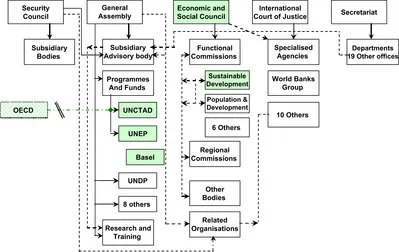 |
| FIGURE 1.1 United Nations (UN) structure concerning the environment [4] is an adaptation of the UN organisation chart to illustrate the relationships between and among the five current organs. |
Actions related to the environment, and by extension to waste management, can best be described in terms of three broad periods: the post-war period (1945–1970); globalisation, scientific and environmental awareness (1970–1990) and implementation and progress (1990 to the present).
3.1. The Post-War Period
The post-war period can be described as one of far-reaching political, social and economic changes.
• Governments were responsible for ...
Table of contents
- Cover Image
- Table of Contents
- Frontmatter
- Copyright
- Preface
- Prologue
- Contributors
- Introduction
- Chapter 1. Trends in Waste Management
- Chapter 2. Green Engineering and Sustainable Design Aspects of Waste Management
- Chapter 3. Regulation of Wastes
- Chapter 4. Waste Collection
- Introduction
- Chapter 5. Mine Waste
- Chapter 6. Metal Waste
- Chapter 7. Radioactive Waste Management
- Chapter 8. Municipal Waste Management
- Chapter 9. Wastewater
- Chapter 10. Recovered Paper
- Chapter 11. Glass Waste
- Chapter 12. Textile Waste
- Chapter 13. Chemicals in Waste: Household Hazardous Waste
- Chapter 14. Reusing Nonhazardous Industrial Waste Across Business Clusters
- Chapter 15. Construction Waste
- Chapter 16. Thermal Waste Treatment
- Chapter 17. Thermochemical Treatment of Plastic Solid Waste
- Chapter 18. Air Pollution
- Chapter 19. Ocean Pollution
- Chapter 20. Electronic Waste
- Chapter 21. Tyre Recycling
- Chapter 22. Battery Waste
- Chapter 23. Medical Waste
- Chapter 24. Agricultural Waste and Pollution
- Chapter 25. Military Solid and Hazardous Wastes—Assessment of Issues at Military Facilities and Base Camps
- Chapter 26. Space Waste
- Chapter 27. Hazardous Wastes
- Chapter 28. Thermal Pollution
- Chapter 29. Land Pollution
- Introduction
- Chapter 30. Landfills – Yesterday, Today and Tomorrow
- Chapter 31. Pollution Management and Responsible Care
- Chapter 32. Risk Assessment, Management, and Accountability
- Epilogue
- Index
- Color Plates
Trusted by 375,005 students
Access to over 1.5 million titles for a fair monthly price.
Study more efficiently using our study tools.
Frequently asked questions
Yes, you can cancel anytime from the Subscription tab in your account settings on the Perlego website. Your subscription will stay active until the end of your current billing period. Learn how to cancel your subscription
No, books cannot be downloaded as external files, such as PDFs, for use outside of Perlego. However, you can download books within the Perlego app for offline reading on mobile or tablet. Learn how to download books offline
Perlego offers two plans: Essential and Complete
- Essential is ideal for learners and professionals who enjoy exploring a wide range of subjects. Access the Essential Library with 800,000+ trusted titles and best-sellers across business, personal growth, and the humanities. Includes unlimited reading time and Standard Read Aloud voice.
- Complete: Perfect for advanced learners and researchers needing full, unrestricted access. Unlock 1.5M+ books across hundreds of subjects, including academic and specialized titles. The Complete Plan also includes advanced features like Premium Read Aloud and Research Assistant.
We are an online textbook subscription service, where you can get access to an entire online library for less than the price of a single book per month. With over 1.5 million books across 990+ topics, we’ve got you covered! Learn about our mission
Look out for the read-aloud symbol on your next book to see if you can listen to it. The read-aloud tool reads text aloud for you, highlighting the text as it is being read. You can pause it, speed it up and slow it down. Learn more about Read Aloud
Yes! You can use the Perlego app on both iOS and Android devices to read anytime, anywhere — even offline. Perfect for commutes or when you’re on the go.
Please note we cannot support devices running on iOS 13 and Android 7 or earlier. Learn more about using the app
Please note we cannot support devices running on iOS 13 and Android 7 or earlier. Learn more about using the app
Yes, you can access Waste by Trevor Letcher,Daniel A. Vallero,Trevor M. Letcher in PDF and/or ePUB format, as well as other popular books in Tecnologia e ingegneria & Gestione ambientale. We have over 1.5 million books available in our catalogue for you to explore.