eBook - ePub
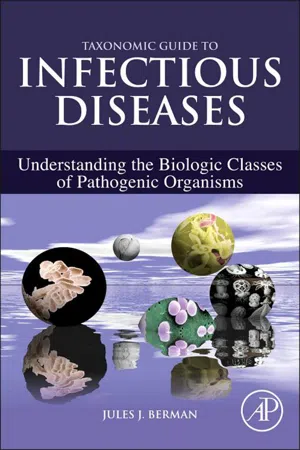
Taxonomic Guide to Infectious Diseases
Understanding the Biologic Classes of Pathogenic Organisms
- 374 pages
- English
- ePUB (mobile friendly)
- Available on iOS & Android
eBook - ePub
Taxonomic Guide to Infectious Diseases
Understanding the Biologic Classes of Pathogenic Organisms
About this book
In the past few decades, there have been great advances in the phylogenetic classification of infectious diseases of man. Taxonomic Guide to Infectious Diseases organizes this information into a standard biological classification and provides a short, clinically-oriented description of every genus (class) of infectious organism. It covers an overview of modern taxonomy, including a description of the kingdoms of life and the evolutionary principles underlying the class hierarchy, and each following chapter will describe one phylum and the genera that contain infectious species. Taxonomic Guide to Infectious Diseases is written in an engaging, narrative style, providing the reader with an easy to digest yet clinically-oriented story of the pathogenic features of each genus. Designed for researchers, clinicians and students of infectious diseases, medical microbiology and pathology.
- Offers genus-by-genus classification of infectious diseases along with short, clinically-oriented descriptions of each genus
- Presents comprehensive lists of infectious species for each genera and identifies diseases caused by each species
- Compiled and written by a well-known pathologist with extensive experience in diagnosing human infectious diseases
Information
Subtopic
Infectious DiseasesIndex
Biological SciencesPart I
Principles of Taxonomy
Chapter 1 The Magnitude and Diversity of Infectious Diseases
Chapter 2 What is a Classification?
Chapter 3 The Tree of Life
Chapter 1
The Magnitude and Diversity of Infectious Diseases
“All interest in disease and death is only another expression of interest in life.”
Thomas Mann
The Importance of Infectious Diseases in Terms of Human Mortality
According to the U.S. Census Bureau, on July 20, 2011, the USA population was 311 806 379, and the world population was 6 950 195 831 [2]. The U.S. Central Intelligence agency estimates that the USA crude death rate is 8.36 per 1000 and the world crude death rate is 8.12 per 1000 [3]. This translates to 2.6 million people dying in 2011 in the USA, and 56.4 million people dying worldwide. These numbers, calculated from authoritative sources, correlate surprisingly well with the widely used rule of thumb that 1% of the human population dies each year.
How many of the world’s 56.4 million deaths can be attributed to infectious diseases? According to World Health Organization, in 1996, when the global death toll was 52 million, “Infectious diseases remain the world’s leading cause of death, accounting for at least 17 million (about 33%) of the 52 million people who die each year” [4]. Of course, only a small fraction of infections result in death, and it is impossible to determine the total incidence of infectious diseases that occur each year, for all organisms combined. Still, it is useful to consider some of the damage inflicted by just a few of the organisms that infect humans.
Malaria infects 500 million people. About 2 million people die each year from malaria [4].
About 2 billion people have been infected with Mycobacterium tuberculosis. Tuberculosis kills about 3 million people each year [4].
Each year, about 4 million children die from lung infections, and about 3 million children die from infectious diarrheal diseases [4]. Rotaviruses are one of many causes of diarrheal disease (Group III Viruses, Chapter 41). In 2004, rotaviruses were responsible for about half a million deaths, mostly in developing countries [5].
Worldwide, about 350 million people are chronic carriers of hepatitis B, and about 100 million people are chronic carriers of hepatitis C. In aggregate, about one quarter (25 million) of the hepatitis C chronic carriers will eventually die from ensuing liver diseases [4].
Infectious organisms can kill individuals through mechanisms other than through the direct pathologic effects of growth, invasion, and inflammation. Infectious organisms have been implicated in vascular disease. The organisms implicated in coronary artery disease and stroke include Chlamydia pneumoniae and Cytomegalovirus [6].
Infections caused by a wide variety of infectious organisms can result in cancer. About 7.2 million deaths occur each year from cancer, worldwide. About one-fifth of these cancer deaths are caused by infectious organisms [7]. In Europe, 60–70% of liver cancer cases are caused by hepatitis C virus; 10–15% of liver cancer is caused by hepatitis B infection [8]. Organisms contributing to cancer deaths include bacteria (Helicobacter pylori), animal parasites (schistosomes and liver flukes), and viruses (Herpesviruses, Papillomaviruses, Hepadnaviruses, Flaviviruses, Retroviruses, Polyomaviruses). Though fungal and plant organisms do not seem to cause cancer through human infection, they produce a multitude of biologically active secondary metabolites (i.e., synthesized molecules that are not directly involved in the growth of the organism), some of which are potent carcinogens. For example, aflatoxin produced by Aspergillus flavus, is possibly the most powerful carcinogen ever studied [9].
In summary, infectious diseases are the number one killer of humans worldwide, and they contribute to vascular disease and cancer, the two leading causes of death in the most developed countries. These observations clearly indicate that every healthcare professional, not just infectious disease specialists, must understand the biology of infectious organisms. A listing of the number of occurrences of some common infectious diseases is provided in Appendix II.
Only a Small Percentage of Terrestrial Organisms are Pathogenic in Humans
Given all the suffering caused by infectious organisms, you might begin to wonder whether the majority of terrestrial life-forms are devoted to the annihilation of the human species. Not to worry. Only a tiny fraction of the life forms on earth are infectious to humans. The exact fraction is hard to estimate because nobody knows the total number of terrestrial species. Most taxonomists agree that the number is in the millions, but estimates range from a few million up to several hundred million.
It is worth noting that species counts, even among the most closely scrutinized classes of organisms, are prone to underestimation. In the past, the rational basis for splitting a group of organisms into differently named species required, at the very least, heritable functional or morphologic differences among the members of the group. Gene sequencing has changed the rules for assigning new species. For example, various organisms with subtle differences from Bacteroides fragilis have been elevated to the level of species based on DNA homology studies. These include Bacteroides distasonis, Bacteroides ovatus, Bacteroides thetaiotaomicron, and Bacteroides vulgatus[10].
For the sake of discussion, let us accept that there are 50 million species of organisms on earth (a gross underestimate by some accounts). There have been about 1400 pathogenic organisms reported in the medical literature. This means that if you should stumble randomly upon a member of one of the species of life on earth, the probability that it is an infectious pathogen is about 0.000028.
Of the approximately 1400 infectious organisms that have been recorded somewhere in the medical literature, the vast majority of these are “case report” items; instances of diseases that have, to the best of anyone’s knowledge, occurred once or a handful of times. They are important to epidemiologists because today’s object of medical curiosity may emerge as tomorrow’s global epidemic. Very few of these ultra-rare causes of human disease ever gain entry to a clinical microbiology textbook. Textbooks, even the most comprehensive, cover about three hundred organisms (excluding viruses) that are considered clinically important. In this book, we will cover about 350 living organisms and about 150 viruses within the main text. The Appendix lists about 1400 organisms (common, rare, and ultra-rare). This may seem like way too much to learn, but do not despair. Infectious agents fall into a scant 40 biological classes (32 classes of living organisms plus seven classes of viruses plus one class of prions). When you’ve learned the basic biology of the major taxonomic divisions that contain all the infectious organisms, you will understand the fundamental biological features that characterize every clinical organism. Almost everything else you need to learn can be acquired from web resources.
Chapter 2
What is a Classification?
“Deus creavit, Linnaeus disposuit,” Latin for “God Creates, Linnaeus organizes.”
Carolus Linnaeus
Classifications Drive Down the Complexity of Knowledge Domains
The human brain is constantly processing visual and other sensory information collected from the environment. When we walk down the street, we see images of concrete and asphalt and grass and other persons and birds and so on. Every step we take conveys a new world of sensory input. How can we process it all? The mathematician and philosopher Karl Pearson (1857–1936) has likened the human mind to a “sorting machine” [11]. We take a stream of sensory information and sort it into objects, and then we collect the individual objects into general classes. The green stuff on the ground is classified as “grass”, and the grass is subclassified under some larger groups such as “plants”. Flat stretches of asphalt and concrete may be classified under “road” and the road might be subclassified under “man-made constructions”. If we did not have a culturally determined classification of objects in the world, we would have no languages, no ability to communicate ideas, no way to remember what we see, and no way to draw general inferences about anything at all. Simply put, without classification, we would not be human.
Every culture has some particular way to impose a uniform way of perceiving the environment. In English-speaking cultures, the term “hat” denotes a universally recognized object. Hats may be composed of many different types of materials, and they may vary greatly in size, weight, and shape. Nonetheless, we can almost always identify a hat when we see one, and we can distinguish a hat from all other types of objects. An object is not classified as a hat simply because it shares a few structural similarities with other hats. A hat is classified as a hat because it has a relationship to every other hat, as an item of clothing that fits over the head. Likewise, all biological classifications are built by relationships, not by similarities [12].
General Principles of Classification
Oddly enough, despite the importance of classification in our lives, few humans have a rational understanding of the process of classification; it’s all done for us on a subconscious level. Consequently, when we need to build and explain a formal classification, it can be difficult to know where to begin. As an example, how might we go about creating a classification of toys? Would we arrange the toys by color (red toys, blue toys, etc.), or by size (big toys, medium-sized toys), or composition (metal toys, plastic toys, cotton toys). How could we be certain that when other people create a classification for toys, their classification will be equivalent to ours?
For modern biologists, the key to the classification of living organisms is evolutionary descent (i.e., phylogeny). The hierarchy of classes corresponds to the succession of organisms that evolved from the earliest living organism to the current set of extant species. Historically, pre-Darwinian biologists who knew nothing about evolution, somehow produced a classification that looked much like the classification we use today. Before the discovery of the Burgess shale (discovered in 1909 by Charles Walcott), taxonomists could not conduct systematic reviews of organisms in rock strata; hence, they could not determine the epoch in which classes of organisms first came into existence, nor could they determine which fossil species preceded other species. Until late in the twentieth century, taxonomists could not sequence nucleic acids; hence, they could not follow the divergence of shared genes in different organisms. Yet they managed to produce a fairly accurate taxonomy. A nineteenth-century taxonomist would have no trouble adjusting to the classification used in this book.
How did the early taxonomists arrive so close to our modern taxonomy, without the benefit of the principles of evolution, geobiology, modern paleontological discoveries, or molecular biology? For example, how was it possible for Aristotle to know, about two thousand years ago, that a dolphin is a mammal, not a fish? Aristotle studied the anatomy and the developmental biology of many different types of animals. One large group of animals was distinguished by a gestational period in which a developing embryo is nourished by a placenta, and the offspring are delivered into the world as formed, but small versions of the adult animals (i.e., not as eggs or larvae), and the newborn animals feed from milk excreted from nipples, overlying specialized glandular organs (mammae). Aristotle knew that these were features that specifically characterized one group of animals and distinguished this group from all the other groups of animals. He also knew that dolphins had all these features; fish did not. He correctly reasoned that dolphins were a type of mammal, not a type of fish. Aristotle was ridiculed by his contemporaries for whom it was obvious that dolphins were a type of fish. Unlike Aristotle, they based their cl...
Table of contents
- Cover image
- Title page
- Table of Contents
- Dedication
- Copyright
- Preface
- Nota Bene
- About the Author
- About the Cover Art
- Part I. Principles of Taxonomy
- Part II. Bacteria
- Part III. Eukaryotes
- Part IV. Animals
- Part V. Fungi
- Part VI. Nonliving Infectious Agents: Viruses and Prions
- APPENDIX I. Additional Notes on Taxonomy
- APPENDIX II. Number of Occurrences of Some Common Infectious Diseases
- APPENDIX III. Organisms Causing Infectious Disease in Humans
- Glossary
- Index
Trusted by 375,005 students
Access to over 1.5 million titles for a fair monthly price.
Study more efficiently using our study tools.
Frequently asked questions
Yes, you can cancel anytime from the Subscription tab in your account settings on the Perlego website. Your subscription will stay active until the end of your current billing period. Learn how to cancel your subscription
No, books cannot be downloaded as external files, such as PDFs, for use outside of Perlego. However, you can download books within the Perlego app for offline reading on mobile or tablet. Learn how to download books offline
Perlego offers two plans: Essential and Complete
- Essential is ideal for learners and professionals who enjoy exploring a wide range of subjects. Access the Essential Library with 800,000+ trusted titles and best-sellers across business, personal growth, and the humanities. Includes unlimited reading time and Standard Read Aloud voice.
- Complete: Perfect for advanced learners and researchers needing full, unrestricted access. Unlock 1.5M+ books across hundreds of subjects, including academic and specialized titles. The Complete Plan also includes advanced features like Premium Read Aloud and Research Assistant.
We are an online textbook subscription service, where you can get access to an entire online library for less than the price of a single book per month. With over 1.5 million books across 990+ topics, we’ve got you covered! Learn about our mission
Look out for the read-aloud symbol on your next book to see if you can listen to it. The read-aloud tool reads text aloud for you, highlighting the text as it is being read. You can pause it, speed it up and slow it down. Learn more about Read Aloud
Yes! You can use the Perlego app on both iOS and Android devices to read anytime, anywhere — even offline. Perfect for commutes or when you’re on the go.
Please note we cannot support devices running on iOS 13 and Android 7 or earlier. Learn more about using the app
Please note we cannot support devices running on iOS 13 and Android 7 or earlier. Learn more about using the app
Yes, you can access Taxonomic Guide to Infectious Diseases by Jules J. Berman in PDF and/or ePUB format, as well as other popular books in Biological Sciences & Infectious Diseases. We have over 1.5 million books available in our catalogue for you to explore.