- 320 pages
- English
- ePUB (mobile friendly)
- Available on iOS & Android
eBook - ePub
About this book
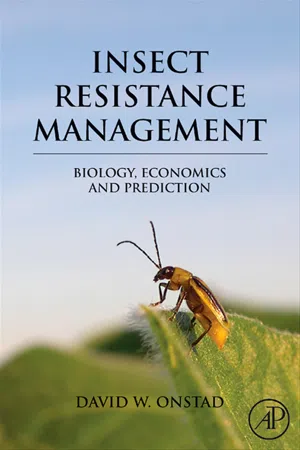
Insects, mites, and ticks have a long history of evolving resistance to pesticides, host-plant resistance, crop rotation, pathogens, and parasitoids. Insect resistance management (IRM) is the scientific approach to preventing or delaying pest evolution and its negative impacts on agriculture, public health, and veterinary issues. This book provides entomologists, pest management practitioners, developers of new technologies, and regulators with information about the many kinds of pest resistance including behavioral and phenological resistance. Abstract concepts and various case studies provide the reader with the biological and economic knowledge required to manage resistance. No other source has the breadth of coverage of this book: genomics to economics, transgenic insecticidal crops, insecticides, and other pest management tactics such as crop rotation. Dr. David W. Onstad and a team of experts illustrate how IRM becomes efficient, effective and socially acceptable when local, social and economic aspects of the system are considered. Historical lessons are highlighted with new perspectives emphasized, so that future research and management may be informed by past experience, but not constrained by it.
- First book in 15 years to provide the history and explore aspects of a variety of stakeholders
- Contributors include experts on ecological aspects of IRM, molecular and population genetics, economics, and IRM social issues
- Biochemistry and molecular genetics of insecticides presented with an mphasis on past 15 years of research including Cry proteins in transgenic crops
- Encourages scientists and stakeholders to implement and coordinate strategies based on local social conditions
Information
Chapter 1
Major Issues in Insect Resistance Management
David W. Onstad,
Publisher Summary
This chapter discusses some of the most challenging aspects of pest management, namely the dynamics of society’s competition and struggles with arthropods over evolutionary time. In this case, evolutionary time is not the millions of years required for macro-evolution and speciation, but the tens of years that are required for pest populations to evolve the ability to withstand or overcome control. Entomologists, acarologists, and practitioners of integrated pest management (IPM) know that arthropods can evolve resistance to chemicals, host-plant defenses, and cultural practices such as crop rotation. Insect resistance is a general term representing heritable traits selected by management. These traits typically permit an arthropod to overcome pest management due to changes in behavior, maturation, or biochemical processes. Insect resistance is similar to the term host-plant resistance, which means that the plant has defenses against and is resistant to an arthropod. Throughout the book, the term insect resistance will be used, even though other arthropods, such as mites and ticks, are also frequent targets of pest management. The greater the effectiveness and success of arthropod pest management, the greater the likelihood of the pest evolving resistance to that management tactic. As the goals or tactics involve significant pest population reduction, one likely will need to manage the evolution of resistance to the management tactics that are wished to be effective. Insect resistance management (IRM) is the scientific approach to managing pests over the long run so that resistance does not interfere with our ability to accomplish our goals.
Philosophy and History
Nature is exciting because it is dynamic, and the management of nature can be equally exciting and certainly challenging. This book presents a story about some of the most challenging aspects of pest management: the dynamics of society’s competition and struggles with arthropods over evolutionary time. In this case, evolutionary time is not the millions of years required for macro-evolution and speciation, but the tens of years that are required for pest populations to evolve the ability to withstand or overcome control.
Entomologists, acarologists, and practitioners of integrated pest management (IPM) know that arthropods can evolve resistance to chemicals, host-plant defenses, and cultural practices such as crop rotation. Insect resistance is a general term representing heritable traits selected by management. These traits typically permit an arthropod to overcome pest management due to changes in behavior, maturation, or biochemical processes. Insect resistance is similar to the term host-plant resistance, which means that the plant has defenses against and is resistant to an arthropod. Throughout the book, the term insect resistance will be used, even though other arthropods, such as mites and ticks, are also frequent targets of pest management.
The greater the effectiveness and success of arthropod pest management, the greater the likelihood of the pest evolving resistance to that management tactic. This is particularly true when the goal of pest management is to reduce the pest population and maintain it at a very low level. The probability of resistance evolution will be lower when goals emphasize the prevention of damage and disease, such as the promotion of crop tolerance, which sometimes can be accomplished without harming most of the pest population. Nevertheless, if our goals or tactics involve significant pest population reduction, we likely will need to manage the evolution of resistance to the management tactics that we wish to be so effective. Insect resistance management (IRM) is the scientific approach to managing pests over the long run so that resistance does not interfere with our ability to accomplish our goals.
A common attitude in the practice of pest management is to expect that effective pesticides and other tactics will always be available in the future as each current treatment fails due to resistance. This is not a sophisticated strategy, and it often is a wasteful and inefficient one. Of course, this requires the farmer and public health official to do nothing other than hope for the best. As each failure is observed, stakeholders search for a cure.
In the past, IRM has often emphasized this reactive approach to sequential failures of insecticides. Each insecticide is used for several years until it no longer adequately controls the pest population. Population monitoring may help identify problems before regional failure occurs. Under the best circumstances of reactive IRM, a new class of toxin with a different mode of action (physiological mechanism that kills the pest, Pittendrigh et al., Chapter 3; Head and Savinelli, Chapter 5) is introduced to manage the pest again with pesticides. This reliance on sequential use of tactics for control is the hallmark of reactive, some call it curative, IRM. This approach requires an optimistic view of science and industry’s capabilities to produce new tactics and chemicals for future use in pest management.
The alternative approach is preventative IRM. In preventative IRM, resistance management plans are implemented when an IPM tactic is first introduced. In industry, this is called product stewardship. These plans alter the design and control of the management system so that the tactic (insecticide, crop rotation, host-plant resistance) can make a significant contribution to IPM for a period that otherwise would not have been possible. This approach is based on a pessimistic view of nature and industry: when we are careless, pests evolve faster than science and industry can develop new solutions. On the other hand, if we are careful and delay the evolution of resistance, we give our best scientists and technologists time to focus on a much wider range of management tools for the entire system. This approach does place a greater burden on practitioners and end users (ranchers, farmers, public health officials, citizens). However, since practitioners do not “own” pest susceptibility to management tactics, they should never believe and act as though elimination of susceptibility is simply an externality of their business activities (Mitchell and Onstad, Chapter 2).
The purpose of this book is to promote scientific, predictive, and preventative IRM. The book is written for those scientists, regulators, and consultants who wish to participate in the difficult but valuable efforts to (1) incorporate IRM into IPM, (2) develop economical IRM plans, and (3) design IRM plans for local environmental and social conditions.
History and Current Status of Resistance to Pesticides
Georghiou and Lagunes-Tejeda (1991) documented the history of field observations of resistance to pesticides. They stated that the first report of resistance was published by Melander (1914), who described the resistance of orchard pests to sulfur-lime, a compound typical of the inorganic chemicals used for pest management one hundred years ago. By 1989, Georghiou and Lagunes-Tejeda (1991) had counted over 500 arthropod species with strains evolving resistance in the field to toxins used against them. Within this total, 23 beneficial species were included. The resistant pests are categorized as crop pests (59%) and medical or veterinary pests (41%). By 1989, chemicals selecting for resistance included not only the modern classes of organic chemicals (cyclodiene, DDT, organophosphate, carbamate, pyrethroid) but also inorganic and elemental chemicals (e.g., arsenicals, sulfur) commonly used before 1940.
The best source for up-to-date information about resistance by arthropods to pesticides around the world is the Arthropods Resistant to Pesticides Database, ARPD (http://www.pesticideresistance.org/), sponsored by Michigan State University, the Insecticide Resistance Action Committee (IRAC), and the United States Department of Agriculture. The database contains reports of resistance cases from 1914 to the present, including all of those reported by Georghiou and Lagunes-Tejeda (1991). Each case is defined by the time and location at which the resistance is first discovered. Mota-Sanchez et al. (2002) provide a detailed description of the database and an analysis of its contents. Forty-four percent of the cases involve organophosphate pesticides, while organochlorine pesticides are involved in 32% of the cases of resistance. As of 2006, the database contained over 7,400 cases involving 550 species (see also Table 5.1 of Head and Savinelli). The public can search the database for information, and authorized experts can submit new cases.
Major Themes
IRM is often considered the management of the evolution of resistance in an arthropod species. However, this is a very narrow and restricted view of the interacting ecological and socio-economic systems that not only are affected by resistance but determine whether resistance will evolve. Just as IPM does not simply focus on killing pests, IRM should not be limited to restraining the dynamics of genes. In this section, I introduce several major themes that are expressed throughout the book.
Integrated Pest Management
IPM was conceptualized during the 1950s when insecticide resistance, non-target effects, and economic waste were clearly apparent (Stern et al., 1959). Practitioners understood the consequences for the larger environment and the longer term, but implementation of IPM emphasized short-term economic efficiency and integration of cultural, biological, and chemical control measures. For example, by including natural enemies as biological control agents in the management of pests, IPM practitioners knew that more specific and less harmful chemicals would need to be used over the long run (Hoy, 1990; Hull et...
Table of contents
- Cover image
- Title page
- Table of Contents
- Preface
- List of Contributors
- Chapter 1: Major Issues in Insect Resistance Management
- Chapter 2: Valuing Pest Susceptibility to Control
- Chapter 3: Resistance in the Post-Genomics Age
- Chapter 4: Concepts and Complexities of Population Genetics
- Chapter 5: Adapting Insect Resistance Management Programs to Local Needs
- Chapter 6: Negative Cross-Resistance: Past, Present, and Future Potential
- Chapter 7: Resistance by Ectoparasites
- Chapter 8: Resistance to Crop Rotation
- Chapter 9: Arthropod Resistance to Crops
- Chapter 10: The Role of Environment in Insect Resistance Management
- Chapter 11: Insect Resistance Management: Adoption and Compliance
- Chapter 12: Modeling for Prediction and Management
- Chapter 13: Monitoring Resistance
- Chapter 14: The Future of Insect Resistance Management
- Index
Trusted by 375,005 students
Access to over 1.5 million titles for a fair monthly price.
Study more efficiently using our study tools.
Frequently asked questions
Yes, you can cancel anytime from the Subscription tab in your account settings on the Perlego website. Your subscription will stay active until the end of your current billing period. Learn how to cancel your subscription
No, books cannot be downloaded as external files, such as PDFs, for use outside of Perlego. However, you can download books within the Perlego app for offline reading on mobile or tablet. Learn how to download books offline
Perlego offers two plans: Essential and Complete
- Essential is ideal for learners and professionals who enjoy exploring a wide range of subjects. Access the Essential Library with 800,000+ trusted titles and best-sellers across business, personal growth, and the humanities. Includes unlimited reading time and Standard Read Aloud voice.
- Complete: Perfect for advanced learners and researchers needing full, unrestricted access. Unlock 1.5M+ books across hundreds of subjects, including academic and specialized titles. The Complete Plan also includes advanced features like Premium Read Aloud and Research Assistant.
We are an online textbook subscription service, where you can get access to an entire online library for less than the price of a single book per month. With over 1.5 million books across 990+ topics, we’ve got you covered! Learn about our mission
Look out for the read-aloud symbol on your next book to see if you can listen to it. The read-aloud tool reads text aloud for you, highlighting the text as it is being read. You can pause it, speed it up and slow it down. Learn more about Read Aloud
Yes! You can use the Perlego app on both iOS and Android devices to read anytime, anywhere — even offline. Perfect for commutes or when you’re on the go.
Please note we cannot support devices running on iOS 13 and Android 7 or earlier. Learn more about using the app
Please note we cannot support devices running on iOS 13 and Android 7 or earlier. Learn more about using the app
Yes, you can access Insect Resistance Management by David W. Onstad in PDF and/or ePUB format, as well as other popular books in Technology & Engineering & Botany. We have over 1.5 million books available in our catalogue for you to explore.