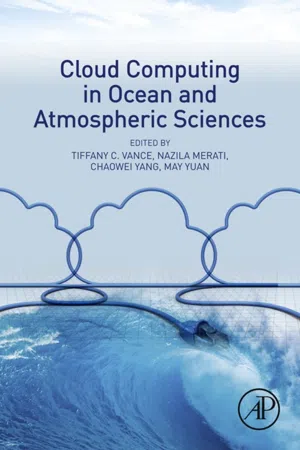
eBook - ePub
Cloud Computing in Ocean and Atmospheric Sciences
- 454 pages
- English
- ePUB (mobile friendly)
- Available on iOS & Android
eBook - ePub
Cloud Computing in Ocean and Atmospheric Sciences
About this book
Cloud Computing in Ocean and Atmospheric Sciences provides the latest information on this relatively new platform for scientific computing, which has great possibilities and challenges, including pricing and deployments costs and applications that are often presented as primarily business oriented. In addition, scientific users may be very familiar with these types of models and applications, but relatively unfamiliar with the intricacies of the hardware platforms they use.
The book provides a range of practical examples of cloud applications that are written to be accessible to practitioners, researchers, and students in affiliated fields. By providing general information on the use of the cloud for oceanographic and atmospheric computing, as well as examples of specific applications, this book encourages and educates potential users of the cloud. The chapters provide an introduction to the practical aspects of deploying in the cloud, also providing examples of workflows and techniques that can be reused in new projects.
- Provides real examples that help new users quickly understand the cloud and provide guidance for new projects
- Presents proof of the usability of the techniques and a clear path to adoption of the techniques by other researchers
- Includes real research and development examples
- that are ideal for cloud computing adopters in ocean and atmospheric domains
Information
Table of contents
- Cover image
- Title page
- Table of Contents
- Copyright
- Dedication
- List of Contributors
- Author Biographies
- Foreword
- Acknowledgments
- Introduction
- Chapter 1. A Primer on Cloud Computing
- Chapter 2. Analysis Patterns for Cloud-Centric Atmospheric and Ocean Research
- Chapter 3. Forces and Patterns in the Scientific Cloud: Recent History and Beyond
- Chapter 4. Data-Driven Atmospheric Sciences Using Cloud-Based Cyberinfrastructure: Plans, Opportunities, and Challenges for a Real-Time Weather Data Facility
- Chapter 5. Supporting Marine Sciences With Cloud Services: Technical Feasibility and Challenges
- Chapter 6. How We Used Cloud Services to Develop a 4D Browser Visualization of Environmental Data at the Met Office Informatics Lab
- Chapter 7. Cloud Computing in Education
- Chapter 8. Cloud Computing for the Distribution of Numerical Weather Prediction Outputs
- Chapter 9. A2CI: A Cloud-Based, Service-Oriented Geospatial Cyberinfrastructure to Support Atmospheric Research
- Chapter 10. Polar CI Portal: A Cloud-Based Polar Resource Discovery Engine
- Chapter 11. Climate Analytics as a Service
- Chapter 12. Using Cloud-Based Analytics to Save Lives
- Chapter 13. Hadoop in the Cloud to Analyze Climate Datasets
- Chapter 14. LiveOcean
- Chapter 15. Usage of Social Media and Cloud Computing During Natural Hazards
- Chapter 16. Dubai Operational Forecasting System in Amazon Cloud
- Chapter 17. Utilizing Cloud Computing to Support Scalable Atmospheric Modeling: A Case Study of Cloud-Enabled ModelE
- Chapter 18. ERMA® to the Cloud
- Chapter 19. A Distributed, RESTful Data Service in the Cloud in a Federal Environment—A Cautionary Tale
- Chapter 20. Conclusion and the Road Ahead
- Index
Trusted by 375,005 students
Access to over 1.5 million titles for a fair monthly price.
Study more efficiently using our study tools.
Frequently asked questions
Yes, you can cancel anytime from the Subscription tab in your account settings on the Perlego website. Your subscription will stay active until the end of your current billing period. Learn how to cancel your subscription
No, books cannot be downloaded as external files, such as PDFs, for use outside of Perlego. However, you can download books within the Perlego app for offline reading on mobile or tablet. Learn how to download books offline
Perlego offers two plans: Essential and Complete
- Essential is ideal for learners and professionals who enjoy exploring a wide range of subjects. Access the Essential Library with 800,000+ trusted titles and best-sellers across business, personal growth, and the humanities. Includes unlimited reading time and Standard Read Aloud voice.
- Complete: Perfect for advanced learners and researchers needing full, unrestricted access. Unlock 1.5M+ books across hundreds of subjects, including academic and specialized titles. The Complete Plan also includes advanced features like Premium Read Aloud and Research Assistant.
We are an online textbook subscription service, where you can get access to an entire online library for less than the price of a single book per month. With over 1.5 million books across 990+ topics, we’ve got you covered! Learn about our mission
Look out for the read-aloud symbol on your next book to see if you can listen to it. The read-aloud tool reads text aloud for you, highlighting the text as it is being read. You can pause it, speed it up and slow it down. Learn more about Read Aloud
Yes! You can use the Perlego app on both iOS and Android devices to read anytime, anywhere — even offline. Perfect for commutes or when you’re on the go.
Please note we cannot support devices running on iOS 13 and Android 7 or earlier. Learn more about using the app
Please note we cannot support devices running on iOS 13 and Android 7 or earlier. Learn more about using the app
Yes, you can access Cloud Computing in Ocean and Atmospheric Sciences by Tiffany C Vance,Nazila Merati,Chaowei Yang,May Yuan in PDF and/or ePUB format, as well as other popular books in Computer Science & Computer Science General. We have over 1.5 million books available in our catalogue for you to explore.