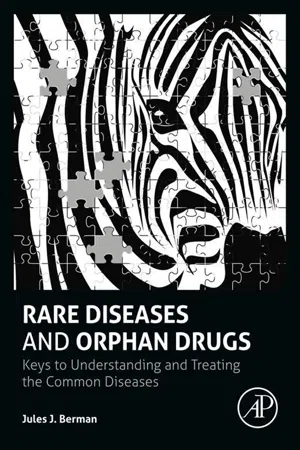
eBook - ePub
Rare Diseases and Orphan Drugs
Keys to Understanding and Treating the Common Diseases
- 400 pages
- English
- ePUB (mobile friendly)
- Available on iOS & Android
eBook - ePub
Rare Diseases and Orphan Drugs
Keys to Understanding and Treating the Common Diseases
About this book
Rare Diseases and Orphan Drugs shows that much of what we now know about common diseases has been achieved by studying rare diseases. It proposes that future advances in the prevention, diagnosis, and treatment of common diseases will come as a consequence of our accelerating progress in the field of rare diseases.
Understanding the complex steps in the development of common diseases, such as cancer, cardiovascular disease, and metabolic diseases, has proven a difficult problem. Rare diseases, however, are often caused by aberrations of a single gene. In rare diseases, we may study how specific genetic defects can trigger a series of events that lead to the expression of a particular disease. Often, the disease process manifested in a certain rare disease is strikingly similar to the disease process observed in a common disease.
This work ties the lessons learned about rare diseases to our understanding of common ones. Chapters covering the number of common diseases are minimized, while rare diseases are introduced as single diseases or as members of diseases classes. After reading this book, readers will appreciate how further research into the rare diseases may lead to new methods for preventing, diagnosing, and treating all diseases, rare or common.
- Makes rare diseases relevant to clinicians and researchers by tying lessons learned about the rare diseases to our understanding of the common diseases
- Stresses basic pathologic mechanisms that account for human disease (e.g., disorders of cell development, replication, maintenance, function and structure), that can be understood without prior training in pathology
- Discusses advanced concepts in molecular biology and genetics in a simple, functional context appropriate for medical trainees and new researchers
- Offers insights into how further research into rare diseases may lead to new methods for preventing, diagnosing, and treating all diseases
Information
Topic
MedicinaSubtopic
FarmacologiaChapter 1
What are the Rare Diseases, and Why do we Care?
Abstract
In the U.S., rare diseases are disorders that affect fewer than 200,000 individuals. There are about 7000 known rare diseases affecting, in aggregate, 25–30 million Americans. Many of the rare diseases are caused by single gene mutations, often occurring as inherited diseases with a simple Mendelian pattern of inheritance. In the past few decades, most of the scientific breakthroughs in disease research have come from research in the rare diseases. No such comparable progress has occurred in the area of the common diseases.
Keywords
Rare Diseases Act of 2002; Number of rare diseases; Incidence of rare diseases; Definition of rare diseases; Orphan diseases
1.1 The definition of rare disease
“The beginnings and endings of all human undertakings are untidy.”
—John Galsworthy
In the U.S., Public Law 107-280, the Rare Diseases Act of 2002 states: “Rare diseases and disorders are those which affect small patient populations, typically populations smaller than 200,000 individuals in the United States” [1]. Since the population of the U.S. is about 314 million (in 2013), this comes to about one case for every 1570 persons. This is not too far from the definition recommended by the European Commission on Public Health; fewer than one in 2000 people. It is important to have numeric criteria for the rare diseases, because special laws exist in the U.S. and in Europe to stimulate research and drug development for diseases that meet the criteria for being “rare” (see Section 14.2). Unfortunately, it is very difficult to know, with any certainty, the specific prevalence or incidence of any of the rare diseases (see Glossary items, Prevalence, Incidence). A certain percentage of the cases will go unreported, or undiagnosed, or misdiagnosed. Though it is impossible to obtain accurate and up-to-date prevalence data on every rare disease, in the U.S. the National Institutes of Health has estimated that rare diseases affect, in aggregate, 25–30 million Americans [2].
There seems to be a growing consensus that there are about 7000 rare diseases [3]. Depending on how you choose to count diseases, this may be a gross underestimate. There are several thousand inherited conditions with a Mendelian inheritance pattern [4]. To these, we must add the different types of cancer. Every cancer, other than the top five or ten most common cancers, occurs with an incidence much less than 200,000 and would qualify as a rare disease. There are more than 3000 named types of cancer, and many of these cancers have well-defined subtypes, with their own morphologic, clinical, or genetic characteristics. Including defined subtypes, there are well over 6000 rare types of cancer [5–8]. Regarding the rare infectious diseases, well over 1400 different infectious organisms have been reported in the literature [9]. A single infectious organism may manifest as several different named conditions, each with its own distinctive clinical features. For example, leishmaniasis, an infectious disease that is common in Africa but rare in Europe, may present in one of four different forms (cutaneous, visceral, diffuse cutaneous, and mucocutaneous). When we add in the many rare nutritional, toxic, and degenerative diseases that occur in humans, the consensus estimate of the number of rare diseases seems woefully inadequate. Nonetheless, the low-ball “7000” number tells us that there are many rare diseases; way too many for any individual to fully comprehend.
The rare diseases are sometimes referred to as orphan diseases. The term is apt for several reasons. First, the term “orphan” applies to children, and it happens that neonates, infants, and children are at highest risk for the most devastating rare diseases. Second, the concept of an “orphan disease” implies a lack of stewardship. For far too long, the rare diseases were neglected by clinicians, medical researchers, the pharmaceutical industry, and society in general (see Glossary item, Neglected disease). The rare diseases manifested as strange and often disfiguring maladies that occurred without any obvious cause. Primitive and not-so-primitive cultures have attributed a supernatural origin for the rare diseases of childhood. It was common for children with disfiguring diseases to be confined in homes or institutions and hidden from society. Over the past 40 years, these conditions have changed drastically, and for the better. A confluence of political, social, and scientific enlightenments has led to stunning advances in the field of rare diseases, and these advances have spilled over into the common diseases. If the rare diseases are orphans, then orphans have been adopted by caring and competent guardians.
Today, there are effective treatments for many of the rare diseases. Hence, it is crucial to make correct diagnoses, at early stages of disease, before irreversible organ damage develops.
1.1.1 Rule—Rare diseases are easily misdiagnosed, and are often mistaken for a common disease or for some other rare disease.
Brief Rationale—It is impossible for any physician to attain clinical experience with more than a small fraction of the total number of rare diseases. When it comes to rare diseases, every doctor is a dilettante.
In 1993, Reggie Lewis was the 27-year-old captain of the Boston Celtics basketball team. Mr. Lewis enjoyed good health until the moment when he collapsed during a basketball game. Mr. Lewis’ collapse attracted the attention of cardiologists across the nation. A medical team assembled by the New England Baptist Hospital opined that Mr. Lewis had cardiomyopathy, a life-threatening condition that would require Mr. Lewis to retire from basketball immediately. A second team of experts, assembled at the Brigham and Women’s Hospital, disagreed. They rendered a diagnosis of vaso-vagal fainting, a benign condition. A third team of experts, from St. John’s Hospital in Santa Monica, California, was non-committal. The Santa Monica team suggested that Mr. Lewis play basketball, but with a heart monitor attached to his body. With three discordant diagnoses, Mr. Lewis decided to take his chances, continuing his athletic career. Soon thereafter, Lewis died, quite suddenly, from cardiomyopathy, while playing basketball [10].
A few dozen common diseases account for the majority of ailments encountered in the typical medical practice. When a physician encounters a rare disease for the first time, he or she may be no more capable than a medical student to reach a correct diagnosis. The presenting symptoms of many rare diseases are disarmingly pedestrian (e.g., failure to thrive, weakness, fatigability, etc.) and the first reaction of any physician might be to make a tentative diagnosis of a common disease. Only after treatment fails, and symptoms do not resolve, are alternate diagnoses considered. It is not unusual for an accurate diagnosis to follow numerous visits to several physicians [11]. In the interim, the disease worsens, the medical bills grow, and the emotional distress builds.
1.2 Remarkable progress in the rare diseases
“Most [rare diseases] result from a dysfunction of a single pathway due to a defective gene. Understanding the impact of a single defect may therefore yield insights into the more complex pathways involved in common diseases which are generally multifactorial.”
—Segolene Ayme and Virginie Hivert, from Orphanet [12].
Excluding genes causing rare cancers, more than 2000 genes have been linked to 2000 rare diseases [12]. In most cases, these links are presumed to be causal (i.e., mutations in the gene lead to the development of the disease). Virtually every gene known to cause a rare disease was discovered within the past half century. The diseases whose underlying causes were known, prior to about 1960, numbered in the hundreds, and the majority of these well-understood diseases were caused by infectious organisms (see Glossary item, Infectious disease).
Progress in the genetic diseases greatly accelerated in the 1960s, and the earliest advances came to the group of diseases known as inborn errors of metabolism. Treatments consisted of avoidance of substances that could not be metabolized in affected individuals or supplementations for missing metabolites (e.g., avoidance of phenylalanine in newborns with phenylketonuria, supplements of thyroid hormone in congenital hypothyroidism, avoidance of galactose in newborns with galactosemia, supplementation with biotin in newborns with biotinidase deficiency, specially formulated low protein diets for newborns with maple syrup urine disease, and so on).
Some of the groundbreaking advances in rare disease research include the 1956 discovery of the specific molecular alteration in hemoglobin that causes sickle cell disease [13,14]; and the identification of the cystic fibrosis gene in 1989 [15]. In 2007, Leber congenital amaurosis, a form of inherited blindness, was the first disease to be treated, with some clinical improvement, using genetic engineering. The mutated RPE65 gene was replaced with a functioning gene [16]. Partial vision was obtained in individuals who were previously blind. It remains to be seen whether genetic engineering will ever restore adequate and long-term vision to individuals with Leber congenital amaurosis [17]. It is noteworthy that the test case was made on an extremely rare form of blindness, not a common form such as macular degeneration. The reason why rare diseases are superior to common diseases, when developing innovative treatment methods, is a topic that will be discussed in Chapter 14.
Currently, drug development for the rare diseases is far exceeding anything seen in the common diseases. Since 1983, more than 350 drugs have been approved to treat rare diseases [18]. By 2011, the U.S. Food and Drug Administration had designated over 2300 medicines as orphan drugs (see Glossary item, Orphan drug). That same year, 460 drugs were in development to treat or prevent the rare diseases [18]. Meanwhile, in Europe, 20% of the innovative products with marketing authorization were developed for rare diseases [12].
As we shall discuss in later chapters, many factors have contributed to the remarkable advances in the rare diseases. The upshot of these advances is that we know much more about the rare diseases, in terms of pathogenesis and treatment, than we know about the common diseases (see Glossary item, Pathogenesis). At this point, there is every expectation that the greatest breakthroughs in understanding the general mechanisms of disease processes will come from research on the rare diseases [19].
Let us briefly examine a few general statements that will be developed in ensuing chapters.
1.2.1 Rule—Rare diseases are not the exceptions to the general rules of disease biology; they are the exceptions upon which the general rules are based.
Brief Rationale—All biological systems must follow the same rules. If a rare disease is the basis for a general assertion about the biology of disease, then the rule must apply to the common diseases.
Every rare disease tells us something about the normal functions of organisms. When we study a rare hemoglobinopathy, we learn something about the consequences that befall when normal hemoglobin is replaced with an abnormal hemoglobin. This information leads us to a deeper understanding of the normal role of hemoglobin. Likewise, rare urea cycle disorders, coagulation disorders, metabolic disorders, and endocrine disorders have taught us how these functional pathways operate under normal conditions (see Glossary item, Pathway) [19].
1.2.2 Rule—Every common disease is a collection of different diseases that happen to have the same clinical phenotype (see Glossary item, Phenotype).
Brief Rationale—Numerous causes and pathways may lead to the same biological outcome.
Consider the heart attack; its risk of occurrence is elevated by many factors. Obesity, poor diet, smoking, stress, lack of exercise, hypertension, diabetes, disorders of blood lipid metabolism, infections, male ge...
Table of contents
- Cover image
- Title page
- Table of Contents
- Copyright
- Dedication
- Acknowledgments
- Foreword
- Preface
- Chapter 1. What are the Rare Diseases, and Why do we Care?
- Chapter 2. What are the Common Diseases?
- Chapter 3. Six Observations to Ponder while Reading this Book
- Chapter 4. Aging
- Chapter 5. Diseases of the Heart and Vessels
- Chapter 6. Infectious Diseases and Immune Deficiencies
- Chapter 7. Diseases of Immunity
- Chapter 8. Cancer
- Chapter 9. Causation and the Limits of Modern Genetics
- Chapter 10. Pathogenesis: Causation’s Shadow
- Chapter 11. Rare Diseases and Common Diseases: Understanding their Fundamental Differences
- Chapter 12. Rare Diseases and Common Diseases: Understanding their Relationships
- Chapter 13. Shared Benefits
- Chapter 14. Conclusion
- Appendix I. List of Genes Causing More than One Disease
- Appendix II. Rules, Some of Which are Always True, and All of Which are Sometimes True
- Glossary
- Index
Trusted by 375,005 students
Access to over 1.5 million titles for a fair monthly price.
Study more efficiently using our study tools.
Frequently asked questions
Yes, you can cancel anytime from the Subscription tab in your account settings on the Perlego website. Your subscription will stay active until the end of your current billing period. Learn how to cancel your subscription
No, books cannot be downloaded as external files, such as PDFs, for use outside of Perlego. However, you can download books within the Perlego app for offline reading on mobile or tablet. Learn how to download books offline
Perlego offers two plans: Essential and Complete
- Essential is ideal for learners and professionals who enjoy exploring a wide range of subjects. Access the Essential Library with 800,000+ trusted titles and best-sellers across business, personal growth, and the humanities. Includes unlimited reading time and Standard Read Aloud voice.
- Complete: Perfect for advanced learners and researchers needing full, unrestricted access. Unlock 1.5M+ books across hundreds of subjects, including academic and specialized titles. The Complete Plan also includes advanced features like Premium Read Aloud and Research Assistant.
We are an online textbook subscription service, where you can get access to an entire online library for less than the price of a single book per month. With over 1.5 million books across 990+ topics, we’ve got you covered! Learn about our mission
Look out for the read-aloud symbol on your next book to see if you can listen to it. The read-aloud tool reads text aloud for you, highlighting the text as it is being read. You can pause it, speed it up and slow it down. Learn more about Read Aloud
Yes! You can use the Perlego app on both iOS and Android devices to read anytime, anywhere — even offline. Perfect for commutes or when you’re on the go.
Please note we cannot support devices running on iOS 13 and Android 7 or earlier. Learn more about using the app
Please note we cannot support devices running on iOS 13 and Android 7 or earlier. Learn more about using the app
Yes, you can access Rare Diseases and Orphan Drugs by Jules J. Berman in PDF and/or ePUB format, as well as other popular books in Medicina & Farmacologia. We have over 1.5 million books available in our catalogue for you to explore.